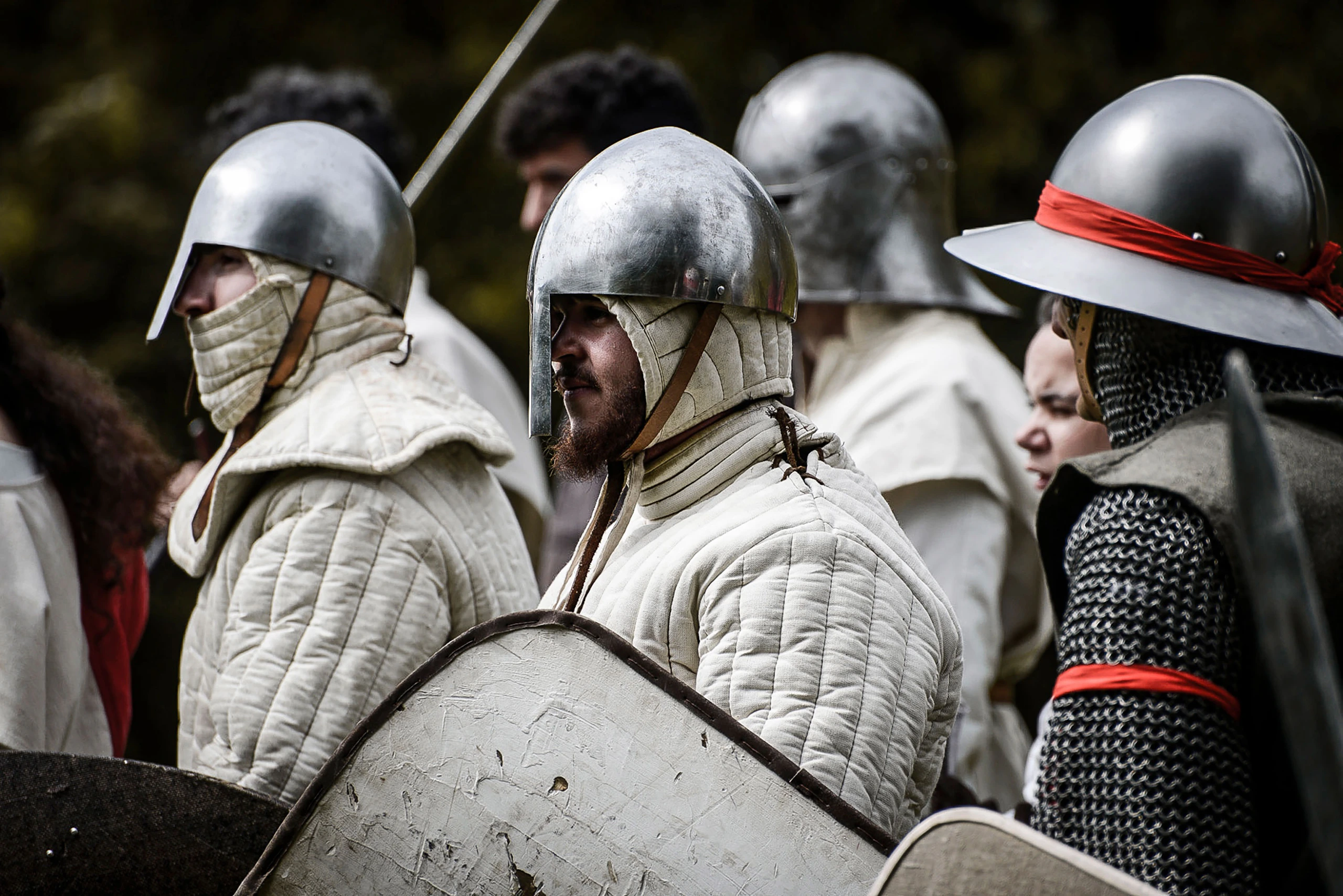
One of the charming details of Fior di Battaglia is that Fiore dei Liberi names his students in the text. Not just as a list of pupils, but as a roll of honour. He tells you who trained under him, which famous duel each one was preparing for, and how their fights turned out. For a medieval master writing in the early 1400s, this is a remarkable act of pride and also of careful documentation. It lets us reach across six centuries and see Fiore's art in actual practice.
Most of his named students were condottieri, the mercenary captains who sold their military expertise to the Italian city-states throughout the fourteenth and fifteenth centuries. Fighting was their profession. Judicial duels were sometimes part of that profession. And when they needed to prepare for a duel, they came to Fiore.
This post is a short tour of the most notable names, and what their documented fights show us about armizare working in the real world.
Piero Paolo del Verde
Piero Paolo del Verde, also known in German as Peter von Grünen, was a mercenary captain in late-fourteenth-century Italy. Fiore lists him among his earliest students and mentions training him in Perugia around 1381.
Verde fought a duel with Peter Kornwald that year, and while the detailed fight record does not survive clearly, the fact that Fiore prepared him shapes our understanding of how trainers and fighters worked together in the medieval period. The duel was a contracted event; both fighters brought trainers; the trainers conditioned their students in the specific weapons and scenarios of the expected fight. Fiore was in the business of this kind of work long before he wrote his manuscript.
Galeazzo Cattaneo dei Grumelli (Galeazzo Gonzaga)
The most famous of Fiore's documented students was Galeazzo Gonzaga of Mantua. In 1395, Galeazzo was challenged by the French marshal Jean II le Maingre, called Boucicaut, one of the most celebrated knights of the age. Boucicaut had made disparaging remarks about the valour of Italian fighters at the French royal court, and Galeazzo answered by challenging him to a judicial duel.
Fiore trained Galeazzo for the duel in Padua, under the patronage of Francesco Novello da Carrara, Lord of Padua, and Francesco Gonzaga, Lord of Mantua. The duel was scheduled for 15 August 1395.
The fight was supposed to begin with spears on horseback (see our horseback combat post for what this would have looked like). Boucicaut became impatient and, in a breach of duelling form, dismounted and attacked Galeazzo before Galeazzo could mount his own horse. Galeazzo struck Boucicaut a solid blow on the helmet, but was subsequently disarmed. At this point, Boucicaut called for his poleaxe but the lords intervened to end the duel.
A draw, essentially, in favour of the better-behaved fighter. But the duel made Galeazzo's reputation and confirmed Fiore as a master-trainer at the highest level of Italian duelling culture.
Niccolò Unricilino (Nikolo von Urslingen)
Another of Fiore's students was Niccolò Unricilino, a German mercenary known in his own tongue as Nikolo von Urslingen. The specific details of his duels are less well-documented than Galeazzo's, but Fiore includes him in the roll of students, which tells us Fiore was training men from both Italic and Germanic lands. The Italian-German exchange of martial knowledge that shaped European fencing throughout the fifteenth century was happening in Fiore's training yards.
Lancillotto Beccaria di Pavia
Lancillotto Beccaria was another of Fiore's named students, a Pavian nobleman and mercenary. Fiore trained him in the art, though the specific duels Beccaria fought are not clearly documented in surviving records. His inclusion in Fiore's list confirms the master's reach across the mercenary class of north-central Italy.
Giovannino da Baggio di Milano
One of Fiore's most extensively documented students was Giovannino da Baggio of Milan, who fought a notable duel in Pavia on 24 June 1399. The duel was hosted by Gian Galeazzo Visconti, Duke of Milan, and Baggio's opponent was a German squire named Sirano.
The format of the duel shows the full range of medieval armoured combat. Three bouts of mounted lance, then three bouts each of dismounted pollaxe, estoc, and dagger. This is exactly the weapon sequence Fiore's manuscript teaches: mounted lance, pollaxe, armoured sword, and dagger. The duel was designed to test the full breadth of the fighter's art, and Fiore's training prepared Baggio for every phase.
In the mounted phase, they rode two additional passes beyond the scheduled three. On the fifth pass, Baggio impaled Sirano's horse through the chest, slaying the horse but losing his lance in the process. They then fought the remaining nine dismounted bouts as scheduled, and because all the weapons were blunted, both combatants reportedly emerged from these exchanges unharmed.
A draw, again, essentially. But a draw that showcased the comprehensive training Fiore had given Baggio. The same fighter handled lance, pollaxe, estoc, and dagger competently across thirteen scheduled bouts. That is armizare operating as Fiore designed it: a complete martial art covering every weapon a knight might need.
Azzone di Castelbarco
Fiore's final named student was Azzone di Castelbarco, whom he trained late in his career, probably around 1399. Castelbarco fought a duel with Giovanni degli Ordelaffi, who is known to have died in 1399, confirming Fiore's continuing activity at that date. Beyond this, the details are scarce.
What the Students Tell Us About the Master
Read the list of Fiore's documented students and three patterns emerge.
Fiore trained fighters for real duels. These are not theoretical pupils. They are documented mercenary captains in documented judicial combats. The art Fiore wrote down was the art he had prepared these men to use, under the highest possible stakes. When Fiore says a technique works, he is speaking from the experience of having trained men whose lives depended on it working.
The full weapon suite was in constant use. Galeazzo trained for mounted lance. Baggio trained for a thirteen-bout sequence covering lance, pollaxe, estoc, and dagger. Fiore's insistence on the complete system, grappling through horseback, was not theoretical. It was what his students needed.
The master's reputation was pan-Italian. Fiore worked in Perugia, Padua, Pavia, and probably elsewhere. His students came from Italian and German backgrounds. The mercenary culture of late-medieval Italy crossed regional and linguistic lines, and Fiore's training yard stood at the centre of that crossing.
Fiore's Own Honours
Fiore also wrote, in his manuscript, that in the course of his own long life he had been forced to fight five duels himself, against certain "false" masters who envied his art and challenged him. He won all five, unarmoured except for gambesons and chamois gloves, with sharp swords, without injury.
This is the master at the centre of the roll of students. A man who had not just trained famous duellists but had fought his own duels, and had five victories to prove that his art worked when his own skin was at stake. That is the voice we read in Fior di Battaglia. Not a theorist. A veteran.
The Living Line
Fiore died sometime after 1409 (the exact date is unknown). His named students' names survived in his book, but the line of direct pupil-to-pupil transmission did not continue in a recognisable way. Later Italian masters like Filippo di Vadi drew on Fiore, but the Italian fencing tradition over the next century evolved into the Bolognese school and other descendants without preserving Fiore's exact lineage.
And then, six hundred years later, modern HEMA practitioners picked up the Getty manuscript and began reconstructing armizare from the page. Fiore's students are historically finished. But his art has living students again. At HEMA Penzance we train the same guards, the same cuts, the same plays, that Galeazzo and Baggio trained for the highest-stakes duels of their era.
The teacher died in 1410. The teaching did not.
Come and Learn
We practise Fiore's complete system every Tuesday evening at Penzance Leisure Centre, 7pm to 9pm. Your first lesson is free, all equipment is provided, and no experience is necessary. Come along and see for yourself.
Historical details in this article draw on the biographical information in Wiktenauer's entry on Fiore de'i Liberi and standard scholarship.