"I am the noble weapon called the dagger, that in the narrow play roams all over. Whoever knows my malice and my art will have a good understanding with any weapon."
So speaks the dagger itself, in Fiore's manuscript. Listen to the pride in its voice. I am the noble weapon. Not the humble one, not the desperate one. The noble one. A medieval Italian master would not apologise for teaching you knife fighting, because he understood something the modern world has partly forgotten: in a fight where you expect to come out alive, the dagger is often the thing that finishes the argument.
After grappling, the daga is the second section of Fior di Battaglia. Fiore placed it there deliberately. Grappling is the root; the dagger is the first weapon that grows from the root. Every dagger technique in the book rests on the physics of abrazare, and every later weapon rests on the lessons of the dagger. If you want to understand how Fiore thinks, there is no skipping this section.
The Weapon Fiore Trained
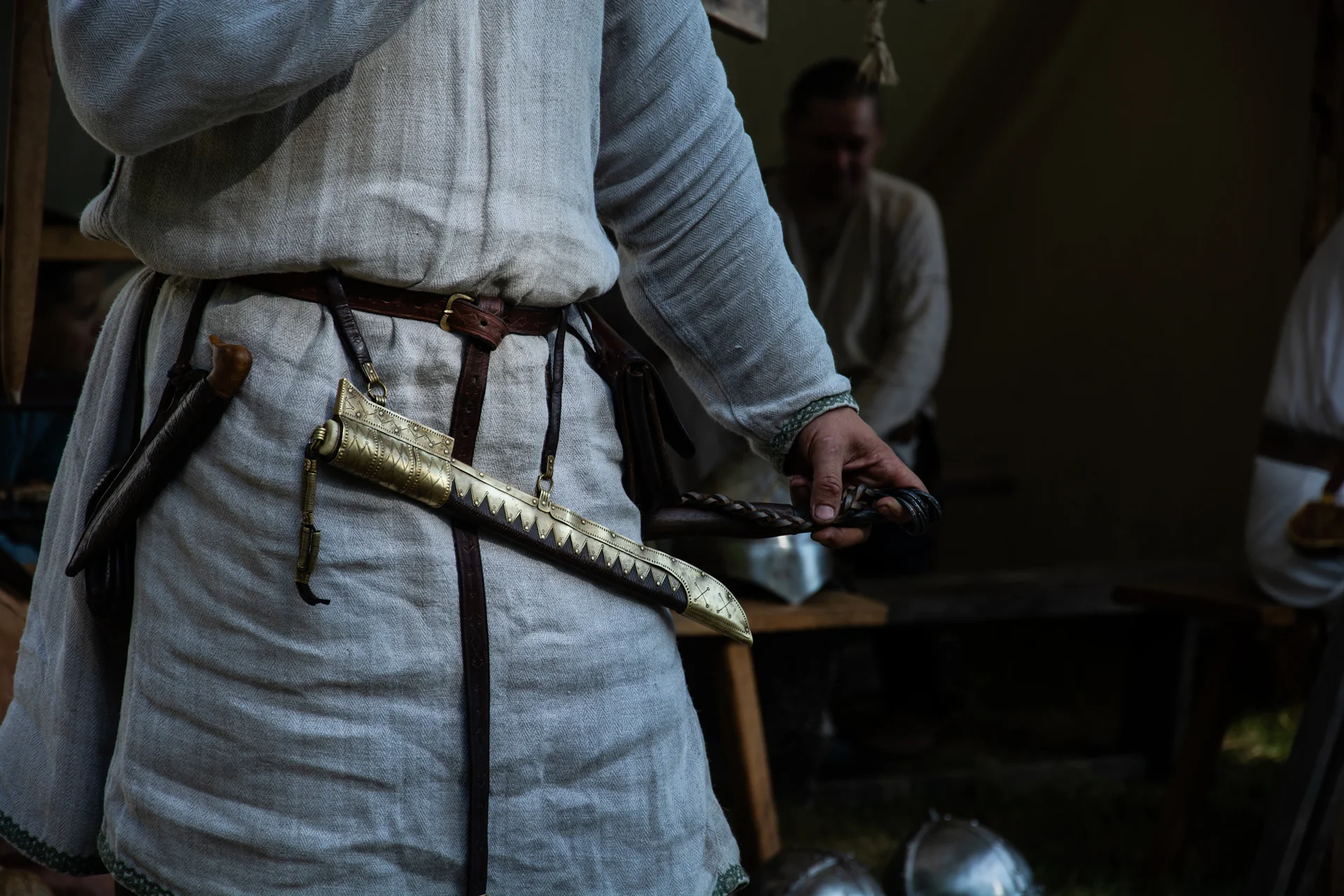
The dagger of Fiore's world was the rondel. A long, narrow spike with a stiff diamond or triangular cross-section, a round disc guard at the hand (the "rondel"), and a round pommel at the end to brace the palm. The blade was not meant to slash. It was meant to punch through.
This matters because rondel daggers were made for piercing armour. A cut might glance off a mail shirt or a padded gambeson, but a rondel's point, driven home with the weight of the body behind it, could find the gap between the pieces of a breastplate, or the vision slit of a helmet, or the underside of the armpit where no plate reaches. The rondel was the weapon that ended armoured duels. When a fully armoured knight was on the ground and the pollaxe had done its work, the rondel was what finished the exchange.
It was also the weapon of everyday life. Gentleman or commoner, almost every man in medieval Italy carried one. In an alleyway, in a tavern, in a street quarrel, the rondel was the sudden weapon that made a disagreement into a dying. Fiore wrote the dagger section not as a duelling sport, but as a response to a real and constant danger. Doubt yourself when against anyone with the dangerous knife.
The First Rule: Doubt Yourself
Fiore opens the dagger section with a warning that every modern HEMA practitioner should reread before they think about knife defence.
"Doubt yourself when against anyone with the dangerous knife. The arms, the hands and the elbows must immediately go against it."
Three sentences, and the first one is the most important. Doubt yourself. Fiore, a proud master, a knight who has broken more arms than he will bother to count, is telling you to be afraid. That is not weakness. That is correct calibration. The knife is cheap, fast, and close. It can come from anyone. Even a shallow penetrating wound can cut an artery or a major organ. The modern fantasy of the confident martial artist disarming an attacker with two moves is exactly what Fiore is warning against. Real knife fighting is dangerous, and treating it as anything else gets you killed.
So doubt yourself. And then, having felt the fear properly, respond with precision. The arms, the hands, the elbows. Immediately. These are the three tools that do the work of a dagger defence, and they must move the moment the threat begins, without thought, without delay.
The Five Things
Once you have felt the danger and moved to meet it, Fiore gives you his most important instruction. It is the same instruction that sits underneath all of his grappling, and it is the frame that organises everything you will do for the rest of the dagger section.
"To do this, always do these five things. Take the dagger, strike, break the arms, bind them, and put him on the ground. These five plays will not abandon one another."
- Take the dagger.
- Strike.
- Break the arms.
- Bind them.
- Put him on the ground.
Five actions, in whichever order the fight offers them. Fiore says it directly: these five plays will not abandon one another. One rolls on to another. If you cannot take the dagger, you strike first and take it second. If you cannot break the arm, you bind the wrist and throw. The five things are a complete repertoire, and a dagger fight is won when enough of them have happened.
Listen to the master's voice on each of them. On taking the dagger:
"Because I carry the dagger in my right hand, I show my art. It is well deserved, because for anyone that will draw a dagger against me, I will take it from your hand."
On breaking the arms:
"The broken arms I carry tell my art. I say without a lie that I have broken and dislocated many arms in my life."
On the locks:
"I am the master of unlocking and also locking the arms of those who go against me. I will put you in great trouble and can depend on the way my binds and breaks work."
On the throws:
"You ask me how I put this man under my feet. Thousands have gone there, trying to match my art of grappling."
This is Fiore at his most confident. The dagger section is not a how-to manual. It is a man writing down what he actually does to people who try to stab him.
The Nine Masters
Fiore structures his dagger teaching around nine remedy masters. Each master is a figure in the manuscript, standing for a specific answer to a specific kind of attack. If your opponent strikes downward with the dagger (fendente), one master shows you the response. If they thrust upward (sottano), another master shows you a different response. If they strike horizontally, another. If they reverse the grip, another. Each master then has a number of scholars, who demonstrate the follow-on plays: the locks, the throws, the disarms, the strikes that complete the remedy.
The nine masters, in order of the manuscript:
- First Master. Responds to a descending blow on the inside of his body.
- Second, Third, and Fourth Masters. Respond to descending and rising attacks, teaching variations on the cover and disarm.
- Fifth Master. A close-quarter master, famous for the wrist-pin against his chest that creates a third-class lever at the elbow.
- Sixth and Seventh Masters. Respond to the thrust and the reverse grip, showing the breaks and binds.
- Eighth and Ninth Masters. The final masters, who cover the remaining edge cases and demonstrate the finishing throws.
You will not learn all nine in your first month. You will not learn them in your first year. Beginners at HEMA Penzance typically spend a long time with the First and the Fifth Masters, because those two alone contain most of the system's grammar. The First Master teaches you the cover and the initial disarm; the Fifth Master teaches you the wrist-to-chest pin that finishes so many exchanges. Together, they are most of what a beginner needs to start grasping Fiore's dagger logic.
The Physics at Work
Every dagger play in Fiore's system is an application of the leverage principles that run through his grappling. Look at the Fifth Master's wrist-pin. The pin itself is a fulcrum: the opponent's wrist, immobilised against the master's chest, becomes a fixed pivot. Force applied at the elbow (a short distance from the fulcrum) drives the arm to dislocate at the shoulder. This is a third-class lever, and it works whether the opponent is stronger than you or not, because leverage does not care about strength.
Look at the First Master's Seventh Scholar. The scholar's shoulder is the fulcrum; force is applied at the opponent's wrist; the opponent's whole body is the load. A first-class lever, and the scholar uses it to spin the opponent right off their feet.
This is why the dagger section sits where it does in Fiore's book. You cannot train the dagger before you understand grappling, because the dagger section is grappling applied to a weapon. The weapon adds urgency and lethality, but the underlying physics is the same.
The Dagger Teaches the Sword
Here is the beautiful thing, and the reason every longsword student at HEMA Penzance should also learn the dagger. The dagger section is how Fiore teaches you to operate at close range under pressure. Everything you learn here (the cover, the step offline, the seizing of the arm, the turn of the wrist, the pin, the throw) reappears in the longsword's zogho stretto, the narrow play, when two swords bind and the distance closes.
A fencer who has trained Fiore's dagger knows what to do when the bind happens. A fencer who has not trained the dagger is often bewildered there. They stand frozen at the crossing of swords, unsure how to use their free hand, unsure whether to step in or out, unsure how to turn the engagement into a finishing action. The dagger teaches all of that, and it teaches it without the additional challenge of managing a long weapon.
Train the dagger for six months and the longsword improves in ways you did not expect. The bind stops being a mystery. The narrow play starts to feel like home.
The Quiet Wisdom of It
What moves us most about the dagger section, rereading it now, is how unsensational it is. Fiore never glorifies the knife. He treats it with the seriousness a dangerous weapon deserves, he teaches the techniques that actually work, and he does not pretend the subject is pretty. Doubt yourself. Always do these five things. Put him on the ground. There is no macho posturing, no ego, no pretence that knife fighting is anything other than what it is.
That is part of why we love training this section of the art. Fiore is not selling you a fantasy. He is handing you, through six hundred years, the accumulated practical knowledge of a real medieval master who had genuinely been in these situations. The manuscript is a gift. The least we can do in return is receive it with the same seriousness he wrote it with.
Come and Learn
We practise Fiore's complete system, dagger included, every Tuesday evening at Penzance Leisure Centre, 7pm to 9pm. Your first lesson is free, all equipment is provided, and no experience is necessary. Come along and see for yourself.
Fiore's words in this article are from the Getty manuscript translations at Fight Like Fiore.