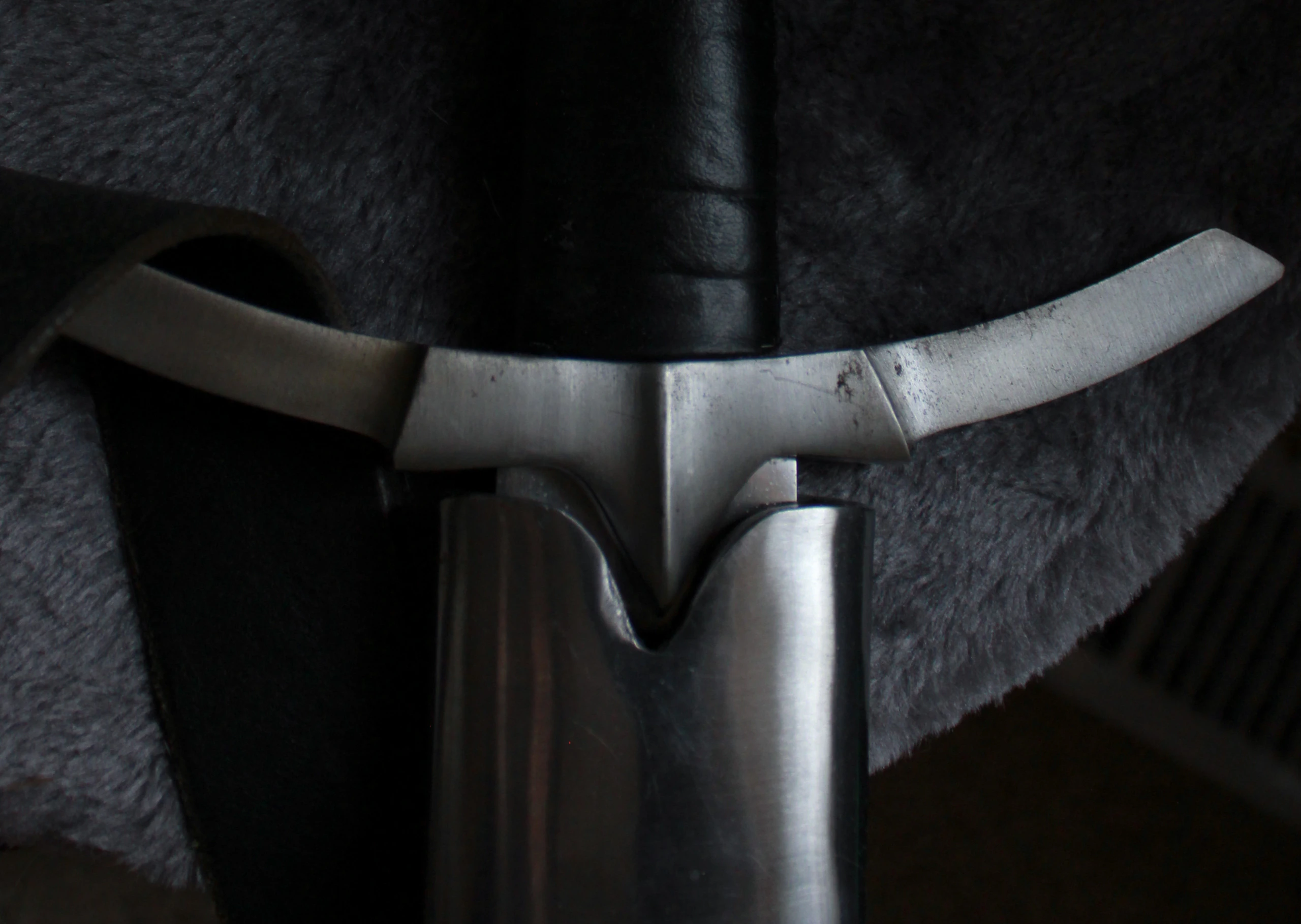
When you pick up a longsword for the first time, one of the most exciting things you discover is that there are places to put it. Not just "hold it in front of you" or "wave it about a bit." The sword has positions: ready stances that your whole body organises around, each one opening up different possibilities for what happens next. Fiore dei Liberi called these positions poste, and he gave us twelve of them.
These twelve guards are the alphabet of Fiore's longsword. Learn them, and you have the vocabulary to read and speak the language of the sword. Every technique in the system flows from one guard into another, and understanding where you are at any moment tells you where you can go next.
What is a Guard?
A guard (posta) is not a static pose you hold forever while waiting for something to happen. It is a position of readiness: a place where the sword can rest for a moment before it moves again, a starting point for specific actions, and a place you pass through on the way to somewhere else.
Fiore grouped his guards into three categories. Some are pulsativa (striking guards), loaded with offensive potential and ready to deliver powerful blows. Others are stabile (stable guards), patient and defensive, inviting the opponent to attack and then answering. And some are instabile (unstable guards), positions you cannot hold for long because they must resolve into action.
Think of it like breathing. Some guards are the inhale: gathering energy, pulling the sword back, loading the spring. Others are the exhale: extending the sword outward, occupying space, threatening. And some are the pause between breaths where everything hangs in balance.
The Twelve Guards
Tutta Porta di Ferro: The Full Iron Gate
"The first one is Posta Tutta Porta di Ferro, that is like a great fortress."
Your sword is held low, point angled toward the ground on your right side. Fiore describes this guard as a good one to wait in against any hand-held weapon, long or short, because it passes with cover and goes to the close play. It is one of the most fundamental positions in the whole system: a patient, stable guard that invites your opponent to strike downward at you. When they do, you answer with a rising parry that flows naturally into a counter-cut or thrust. Almost every session at HEMA Penzance includes this.
Porta di Ferro Mezzana: The Middle Iron Gate
Similar to the Full Iron Gate but the sword is held more centrally, with the point forward and down. This subtle shift changes everything: from here, a rising thrust becomes your natural first move. Where the Full Iron Gate says "come to me," the Middle Iron Gate says "I am already on my way to you."
Dente di Zenghiaro: The Boar's Tooth
"Makes great underhanded thrusts into the face without stepping through, and returns with a downward cut to the arms."
The sword is held low at the hip, point forward, like a boar lowering its tusks before charging. Fiore's description tells you everything you need to know about this guard: it exists to drive the point upward into the opponent's face, and when it has done that, the sword comes back down onto their arms. A guard that attacks in two directions with one motion. It teaches something essential about Fiore's system: the thrust is always dangerous, and the most dangerous thrusts are the ones your opponent does not see coming.
Posta Longa: The Long Guard
"Full of deception. She is feeling the guards of the opponents to deceive them. If she can wound with a thrust, she will do it well."
Arms extended forward, sword point aimed straight at your opponent's face. Fiore calls her deceptive: she is probing, testing, feeling out the opponent's intentions. This is the guard you pass through constantly, the position your sword finds at the end of a thrust, the checkpoint between one action and the next. It controls the centre line, and anyone standing in Posta Longa is making a simple statement: you cannot reach me without dealing with this point first.
Posta di Donna: The Lady's Guard
"This is Posta di Donna, who can do all of the seven blows of the sword, and she can cover all blows. And she breaks the other guards with the great blows that she can make."
If there is one guard that defines Fiore's longsword, this is it. The sword is held high over your right shoulder, the blade trailing back behind you. Fiore's own words say it all: she can do all seven blows, she can cover everything, and she breaks the other guards. From here you deliver the most powerful descending cuts in the system, great diagonal blows that travel a long arc and arrive with real authority. This is the guard you will use most at HEMA Penzance: it is the heart of paired practice and the position you return to again and again.
Posta di Donna la Sinestra: The Lady's Guard on the Left
The mirror of Donna, with the sword over the left shoulder. Cuts from this side are naturally less powerful for a right-handed swordsman, but this guard covers angles that Donna cannot. Moving between Donna on the right and Donna on the left is one of the most fundamental flows in the system: a figure of eight that describes the two great diagonals of the sword.
Posta di Finestra: The Window Guard
"Cunning and deception always lend themselves to it. Of covering and wounding, she is a master."
The sword is held high with the hilt near the side of the head, the blade angled forward toward the opponent. You are looking through a "window" framed by your arms and blade. Fiore calls her cunning, a master of covering and wounding. From here you threaten with the thrust while remaining ready to cut: an aggressive guard that keeps the sword active and visible, constantly reminding the opponent that the point is live.
Posta di Finestra la Sinestra: The Window Guard on the Left
Mirror of Finestra on the left side. Together with the right-side Finestra, these guards give you high coverage on both flanks while maintaining the ability to thrust from either side.
Posta Frontale: The Crown Guard
The sword is held overhead with the point up, arms raised. It looks almost like you are presenting the sword to the sky. In practice, this guard defends beautifully against descending cuts: the opponent's blade meets your crossguard and slides away, and you can transition immediately into a thrust or cut of your own. Some practitioners call it the Crown because it sits above everything else.
Posta di Coda Lunga: The Long Tail
Here the sword trails behind your body, the point reaching back and low. Your opponent cannot see where the blade is, which makes this guard wonderfully deceptive. When the sword comes forward from Coda Lunga, it travels a long path and arrives with considerable force and surprise. This is a guard that teaches you to be comfortable with the sword behind you, trusting that the distance will hold long enough for you to bring it around.
Posta Breve: The Short Guard
"Wants a long sword and is a malicious guard, but has no stability. Always move and see if you can enter with a thrust."
The sword is held close to the body, point forward and slightly down, arms compact. Fiore warns you: this guard is malicious but unstable. You cannot stand still in Posta Breve. You must always be moving, looking for the opening, pressing in with the thrust. It is a close-distance guard, suited for situations where the fight has compressed and you need quick, precise actions rather than sweeping cuts.
Posta di Bicorno: The Two-Horned Guard
Arms extended with the sword forward and high, the point angling toward the opponent's face. Similar to Posta Longa but elevated, creating a higher threat. This guard is often found in binding situations where your sword has met the opponent's and you are working to dominate the centre line from above. The "two horns" are the two hands on the grip, driving the point forward.
Where to Start
If twelve guards sounds like a lot to learn all at once, the good news is that you do not need to. Most Fiore schools, including HEMA Penzance, begin with four: Posta di Donna (the great offensive guard), Tutta Porta di Ferro (the patient defensive guard), Posta Longa (the centre line control), and Dente di Zenghiaro (the rising thrust). These four give you the fundamental vocabulary, and the other guards reveal themselves naturally as your training deepens.
The Seven Swords
Behind the twelve guards sits another of Fiore's gifts: the seven swords, which are really seven lines of attack. Every strike in the system travels along one of these lines:
Two fendente (descending diagonal cuts, one from each side), two sottano (rising cuts from below, one from each side), two mezzano (horizontal middle cuts, one from each side), and the punta (the thrust, which travels straight forward along the centre line).
Seven lines. Twelve guards. One complete system. Everything you will ever do with a longsword in Fiore's art is a conversation between these elements: a guard opens a line, a sword travels along it, and you arrive in a new guard, ready for the next exchange.
That is what makes the system so satisfying to study. It is not a collection of unrelated tricks. It is a language, and the more of it you learn, the more eloquently you can speak.
Come and Learn
We practise Fiore's complete system every Tuesday evening at Penzance Leisure Centre, 7pm to 9pm. Your first lesson is free, all equipment is provided, and no experience is necessary. Come along and see for yourself.
Fiore's words in this article are from the Getty manuscript translations at Fight Like Fiore.