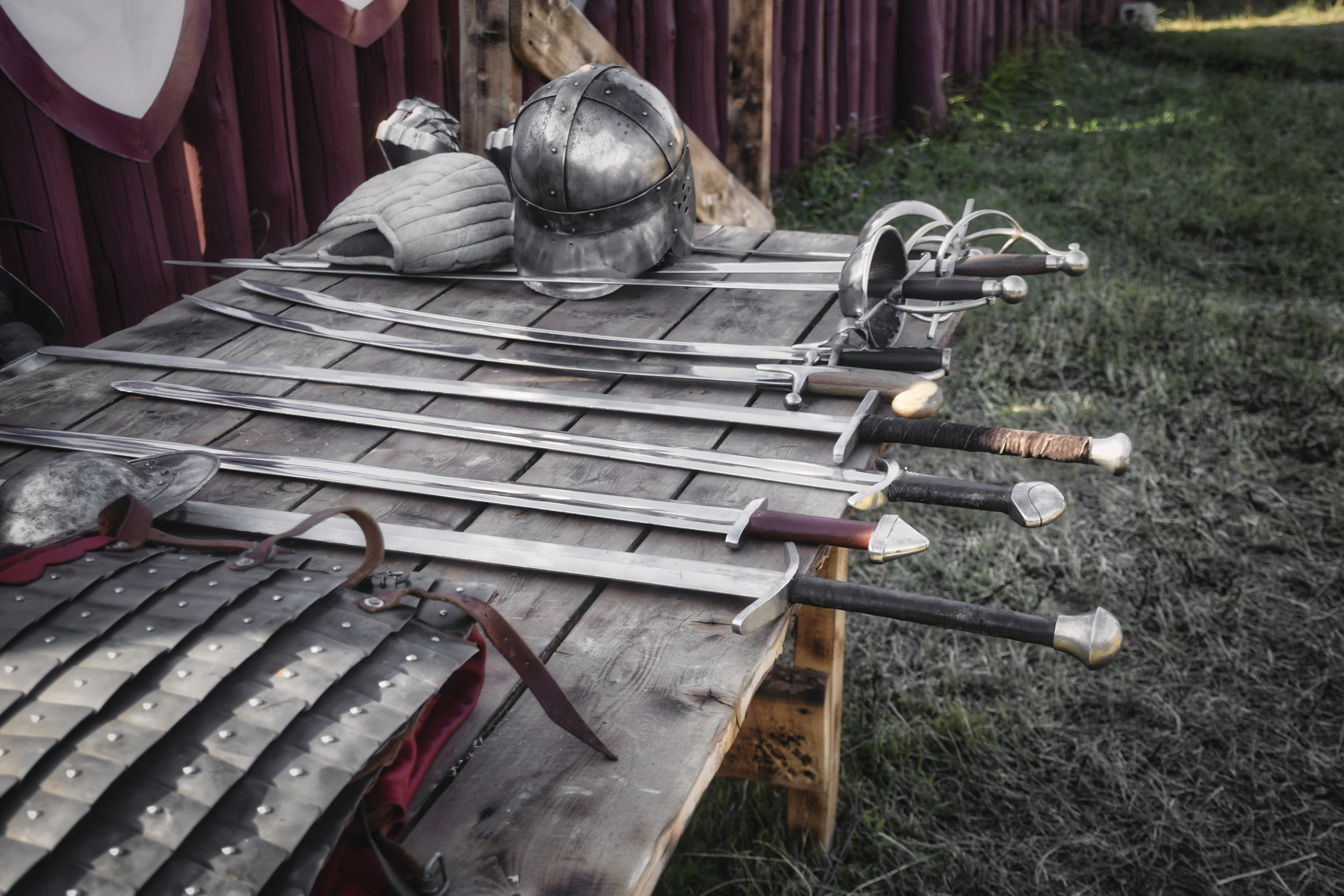
"Medieval sword" is one of those phrases that gets used as if it meant one thing, when it actually covers about a thousand years of European weapon design. A sword from 800 AD is nothing like a sword from 1500 AD. A duel-focused sword from a fourteenth-century Italian city is different again from a battlefield sword from the same decade.
This post is a friendly tour of the main sword types used across the medieval period, what each was for, and where they fit in the world Fiore dei Liberi lived and trained in. If you are reading this because you are curious about HEMA, or because you want to understand what fantasy writers are getting right or wrong, or because you simply like swords, this is the map.
The Single-Handed Swords
The Arming Sword
The workhorse sword of the high-medieval knight. A straight, double-edged blade of roughly 70-85 cm, with a cruciform hilt, a single-hand grip, and a counterweighted pommel. Weight around 1 to 1.3 kg.
This is the sword hanging from King Arthur's hip in the stories, and the sword a thirteenth-century crusading knight would actually have drawn in combat. Used with a shield (kite-shaped in the earlier period, heater-shaped later) or a buckler (small round shield held by a central grip). The arming sword was Europe's default sword from roughly 1000 to 1400, and remained common as a sidearm even into the longsword era.
The Falchion and the Messer
Single-handed swords with a curved or widened blade, often with only one edge sharpened. Designed for cutting, sometimes intimidating-looking with their broader blades.
The falchion (usually English or French) is a single-edged slashing sword, sometimes clip-pointed. The messer (German for "knife") is closer to a large sabre, used as a civilian sidearm by townsfolk and soldiers. A langes Messer (long knife) is a larger two-handed version.
These weapons were cheaper than a well-made arming sword and were common among soldiers, guards, and civilian travellers. Their curved geometry made them effective cutters against lightly-armoured opponents.
The Two-Handed Swords
The Longsword
The weapon that most people mean when they say "medieval sword" even when they don't realise it. Blade 80-110 cm, grip long enough for both hands, total length 110-140 cm, weight 1.1-1.8 kg. We have a dedicated post on the medieval longsword for the full treatment.
The longsword was the prestige weapon of the late-medieval knightly class, the weapon of the judicial duel, and the subject of Fiore dei Liberi's manuscript. It was used both armoured and unarmoured, and Fiore's armizare trains every application.
The Great Sword or Zweihänder
Larger than a longsword. Blade 120-150 cm, total length up to 180 cm, weight 2.5-4 kg. Used by specialist infantry (notably the German Doppelsöldner, the "double-pay men" of the Renaissance Swiss and Landsknecht formations) to break up pike formations.
Despite their size, great swords were not clumsy: they were still precisely made, and the trained users knew how to wield them. But they were specialist weapons, not duelling tools. Fiore does not teach the great sword; his longsword section covers the standard two-hander.
The Estoc
A specialist thrusting-only two-handed sword used for armoured combat. Long (120-140 cm blade), stiff, with a diamond or square cross-section for maximum stiffness. No cutting edge to speak of; the weapon is a giant rigid thrust-tool.
The estoc (estoc in French, tuck in English, Panzerstecher in German meaning "armour-piercer") lived in the same world as the pollaxe: armoured duels where the question was how to find the gaps in plate armour. Appears in Fiore's student Giovannino da Baggio's famous thirteen-bout armoured duel, which specifically included estoc bouts.
The Specialist and Ceremonial Swords
The Bastard Sword
A sword of in-between length that could be used either one- or two-handed, depending on what the wielder needed in the moment. Blade around 85-100 cm, grip long enough for two hands but usable with one. Weight around 1.2-1.6 kg.
Some scholars use "bastard sword" interchangeably with "longsword" (and in period sources the terms overlap). Others reserve "bastard sword" for the slightly shorter, more one-hand-oriented examples. Either way, it is a weapon of versatility.
The Rapier
Technically not quite medieval (it rises in the fifteenth and sixteenth centuries, overlapping with the late longsword era), but worth mentioning because it is often confused with medieval swords in popular imagination. The rapier is a long, narrow civilian duelling sword focused on the thrust, with a complex protective hilt. Used primarily in civilian contexts, not on battlefields.
Fiore does not teach the rapier because it postdates him. The Bolognese school of the sixteenth century is the main source for Italian rapier work.
The Sabre
Also post-medieval in most of its classical forms. A curved single-edged single-handed sword, often cavalry-focused, with various national traditions (Polish, Hungarian, British) emerging across the seventeenth to nineteenth centuries. Not in Fiore's world.
How They Relate to Armour
The great shift in medieval sword design across the period tracks the evolution of armour.
Early medieval (500-1100): Mail armour and shields dominated. Single-handed swords (arming swords) were used with shields. Cutting was generally more important than thrusting.
High medieval (1100-1300): Mail continues with reinforcing plate. Arming swords remain the norm. Polearms and bows become increasingly important on battlefields.
Late medieval (1300-1500): Plate armour develops. Longswords rise as the prestige knight weapon. Armoured combat shifts toward thrusting into gaps (the estoc, the pollaxe, and the longsword used in half-swording). Fiore's manuscript sits at the heart of this period.
Renaissance (1500+): Plate armour peaks and then begins declining as gunpowder weapons arrive. Swords shift toward civilian duelling (the rapier) and specialist military roles. The classical medieval longsword fades.
This is a simplified arc, but it captures the relationship between armour and sword design. When armour got better at stopping cuts, swords got better at finding gaps. When armour began vanishing from the battlefield, swords became duelling specialists again.
Fiore's Place in the Story
Fiore dei Liberi wrote his Fior di Battaglia at the absolute peak of the late-medieval longsword era, roughly 1400-1410. His manuscript captures the weapon when it was the most technical and most widely trained. Twenty-five years earlier, the art was less systematised; fifty years later, plate armour would push the duelling scene towards more thrust-focused weapons.
If you wanted to pick a single moment in medieval history when the longsword was most alive, both as a fighting tool and as an intellectual tradition, you would pick Fiore's lifetime. Which means that when modern HEMA practitioners train his manuscript at HEMA Penzance and clubs worldwide, we are training the weapon at its historical peak. The art we are reconstructing is not any random moment in medieval sword culture. It is the sophisticated, well-documented, knight-trained longsword work of the duel-fighting era.
Come and Hold the Real Thing
If you want to feel one of these weapons in your own hands, HEMA Penzance has training longswords available for anyone walking into their first lesson. Every Tuesday evening at Penzance Leisure Centre, 7pm to 9pm. Your first lesson is free, all equipment is provided, and no experience is necessary. Come along and see for yourself.