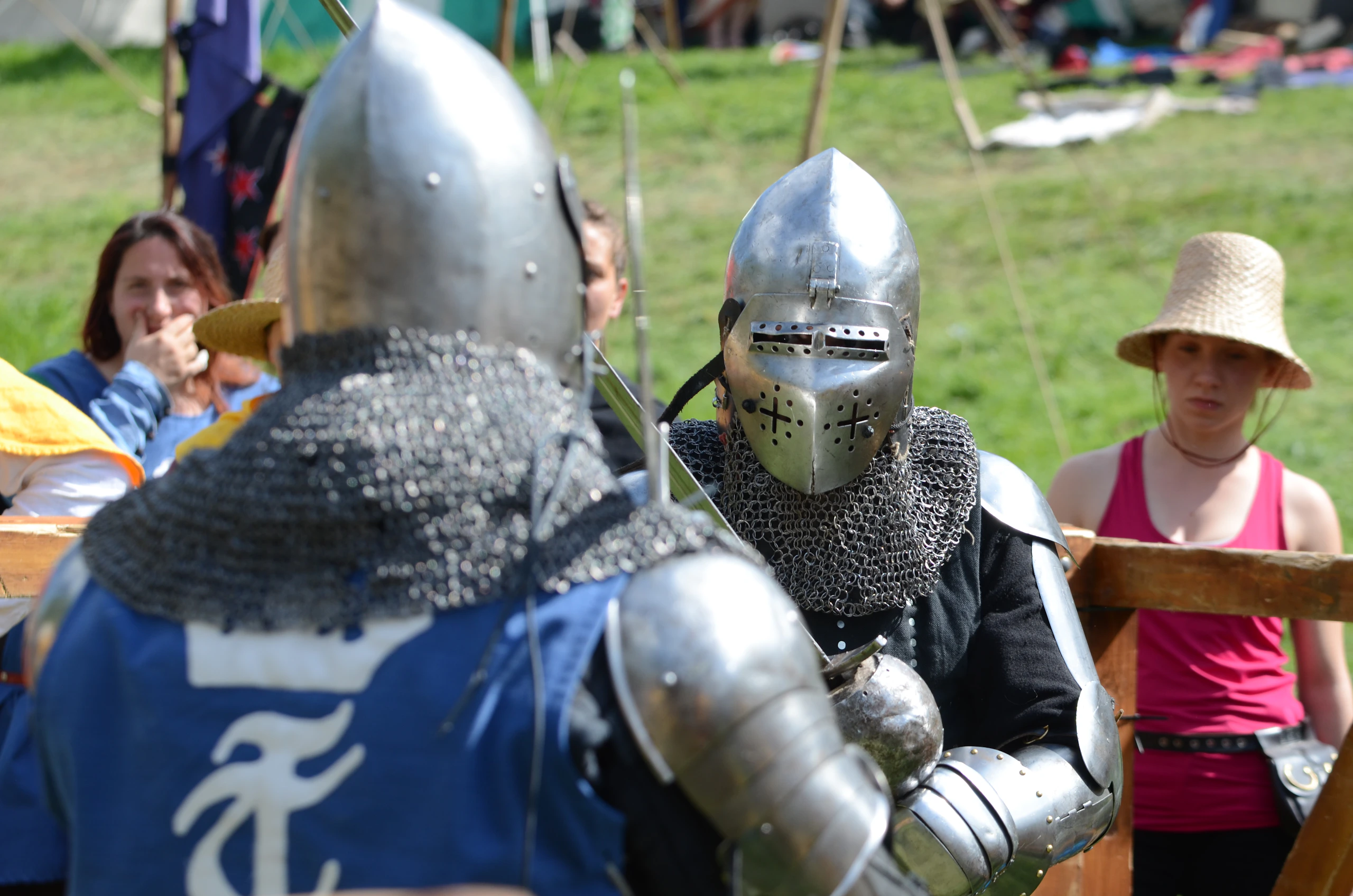
"This is Posta di Donna, who can do all of the seven blows of the sword, and she can cover all blows. And she breaks the other guards with the great blows that she can make."
So speaks the Lady's Guard in Fiore dei Liberi's early-fifteenth-century manuscript, and what she is speaking about is one particular weapon. The medieval longsword. Not the fantasy version. Not the film version. The real weapon of the real world Fiore trained in, carried by the real knights he prepared for real duels.
This post is a friendly introduction to that weapon. What it was, how it was made, how it sat on a medieval body, and how the fighting style built around it actually worked.
The Period When It Reigned
The medieval longsword was at its peak roughly from the mid-fourteenth century to the mid-sixteenth. Before that, the knightly sword was typically a single-handed arming sword (with a shield or a buckler) and the cavalry lance. After it, as plate armour evolved and then as gunpowder weapons arrived, swords shifted toward lighter specialised designs (the rapier, the sidesword, later the smallsword).
Fiore's working life (roughly 1380 to 1410) sits at the centre of the longsword era. He trained knights who duelled with lances on horseback and longswords on foot. His manuscript documents the weapon at the height of its sophistication as a duelling tool.
What the Weapon Actually Was
A medieval longsword was a two-handed straight sword with specific proportions.
Blade length: 80 to 110 centimetres. Most duelling longswords sat around 90-100 cm.
Grip length: long enough for both hands with a little space between, typically 25 to 35 cm.
Total length: 110 to 140 cm from pommel to point.
Weight: 1.1 to 1.8 kg, with most around 1.3 to 1.5 kg. (We have a whole post on longsword weight because the myth of the 20-pound medieval sword refuses to die.)
Crossguard: straight, usually 20-25 cm wide, with slight forward curves or a simple bar shape.
Pommel: counterweighted, often pear-shaped, wheel-shaped, or faceted. The pommel is a functional component, not just decoration: its mass offsets the weight of the blade so the sword balances about 5-10 cm forward of the crossguard.
Blade cross-section: usually a diamond or lenticular cross-section, ground with two cutting edges and a sharp point. The diamond cross-section gives stiffness for thrusting; the lenticular gives slightly better cutting geometry. Different longswords prioritised different tasks.
Taken together, these dimensions produced a weapon that was long enough to reach, light enough to wield all day, and tough enough to survive being hit by another sword without breaking.
How It Was Made
Medieval longsword production was a specialist craft. The bladesmith (usually a named master with an apprenticeship-and-guild lineage) worked through several stages.
The steel was forged from good-quality iron with carefully controlled carbon content. Medieval smiths understood carbon hardening experientially even if they did not use modern chemistry language. A good longsword blade had enough carbon to take a hard edge and enough toughness in the spine to bend rather than shatter.
The blade was shaped through repeated heating, hammering, and folding. Good bladesmiths could produce blades with slightly softer spines and harder edges, giving the combination of toughness and sharpness the weapon required. Some used pattern-welded (also called "Damascus") construction, layering different steels for specific properties, though this technique was more common in earlier periods.
The blade was tempered by heating it to a specific colour and then quenching it in water or oil. This produced the final hardness-versus-toughness balance. A sword that was too hard would shatter; too soft and it would bend and stay bent. The craft of tempering sat at the heart of sword-making.
The hilt was assembled separately by a hilt-maker, who fitted the crossguard, wrapped the grip in leather or wire over a wooden core, and attached the pommel (sometimes through a peening operation that compressed the pommel onto the blade's tang). A well-made hilt was as important as a well-made blade; the two components together made the weapon.
The finish was applied. Some longswords were left polished bright; others were blued or browned for rust resistance. The leather wrapping on the grip could be plain or elaborately decorated. Presentation swords might be gilded, engraved, or inlaid; working swords were usually plainer.
A good longsword was an expensive object. The raw steel, the specialist labour, the time required (dozens of hours of skilled craft) meant that a fine longsword cost the equivalent of several months' wages for a common soldier. A knight might own one or two across his lifetime, inheriting or replacing through combat loss or marriage.
How It Was Carried
A knight's longsword usually lived on his left hip when walking, suspended from a belt by a scabbard. The scabbard was leather over a wooden core, lined with fur or fabric to protect the blade and draw freely. For combat, the sword might be carried slung across the back (less common than fantasy suggests, since drawing from a back scabbard is awkward) or held in the hand, if a fight was expected.
On a horse, the longsword was usually carried on the left hip, accessible to the right hand. For armoured combat where the knight carried both a lance and a sword, the sword could ride at the hip for close work after the lance was broken or lost.
How It Was Fought With
This is where Fiore's art comes in. The medieval longsword, for all its prestige, was not a natural weapon. It required training to use effectively. A strong man given a longsword with no instruction would probably hit hard but would get outfenced by a trained opponent half his size within seconds.
The training Fiore documented (the training he gave to Galeazzo Gonzaga, Giovannino da Baggio, and his other named students) organised the weapon's use around three core ideas.
Twelve guards. The twelve poste were the positions the sword lived in between actions. Each guard had specific advantages and specific openings. Learning them gave you a spatial vocabulary for managing the weapon.
Seven blows. Seven lines of attack: two descending diagonals (fendenti), two rising diagonals (sottani), two horizontals (mezzani), and the thrust. Every blow the sword could make travelled along one of these lines.
Plays. Structured sequences of moves, each beginning with an initiating action, a cover or parry, and a counter. Fiore's manuscript contains dozens of longsword plays, each illustrated and annotated.
The full training integrated these three layers into a complete system. A trained longsword fencer thought in positions (guards), lines (blows), and sequences (plays) simultaneously, and chose between them based on reading the opponent.
This is completely different from film choreography. Film longsword fighting emphasises big dramatic swings; real longsword work emphasises measure, timing, and structure. A real exchange between two Fiore-trained fencers is often shorter, subtler, and more chess-like than cinema suggests.
The Duel vs the Battlefield
A medieval longsword was used in two main contexts, and the two looked different.
The judicial duel. One-on-one combat under formal rules to settle legal questions (usually honour-based). Both fighters were usually armoured, the weapons were usually sharp, and the duel followed a sequence that often included mounted lance, dismounted pollaxe or longsword, and dagger. This is the context Fiore's manuscript documents most fully. He trained men specifically for these duels.
The battlefield. Massed combat between armies. Here the longsword was a secondary weapon for most soldiers. Primary battlefield weapons were polearms (spears, pikes, halberds, pollaxes) and bows or crossbows. Knights carried longswords on the battlefield but drew them mostly for close-in work once the initial charges had broken up. Battlefield longsword work was often rougher and less technical than duel work because the chaos of battle rarely allowed for subtle exchanges.
Fiore's manuscript is a duel-focused training manual. It teaches the sword at its most technical. Battlefield applications are touched on (the horseback section assumes armoured mounted combat) but the heart of the training is the one-on-one fight.
Why the Weapon Still Matters
Six hundred years after Fiore wrote his manuscript, the medieval longsword is a living weapon again. Modern HEMA practitioners train with steel feders at clubs around the world, working from the manuscripts Fiore and his contemporaries left behind. HEMA Penzance is one of those clubs.
The weapon is beautiful. The art built around it is deep enough for a lifetime. The manuscripts survived against the odds. And the Tuesday-evening training halls where people now hold the weapon are one of the quieter miracles of modern historical reconstruction.
When you pick up a longsword for the first time in a club, you are holding a direct descendant of the weapon Fiore held when he trained the condottieri for their duels. The steel has been remade. The art has been preserved. The bridge between then and now runs through the pages of the Getty manuscript and through the hands of every practitioner who studies it.
Come and Hold One
If you want to feel a medieval longsword in your own hands, HEMA Penzance trains every Tuesday evening at Penzance Leisure Centre, 7pm to 9pm. Your first lesson is free, all equipment is provided, and no experience is necessary. Come along and see for yourself.
Fiore's words in this article are from the Getty manuscript translations at Fight Like Fiore.