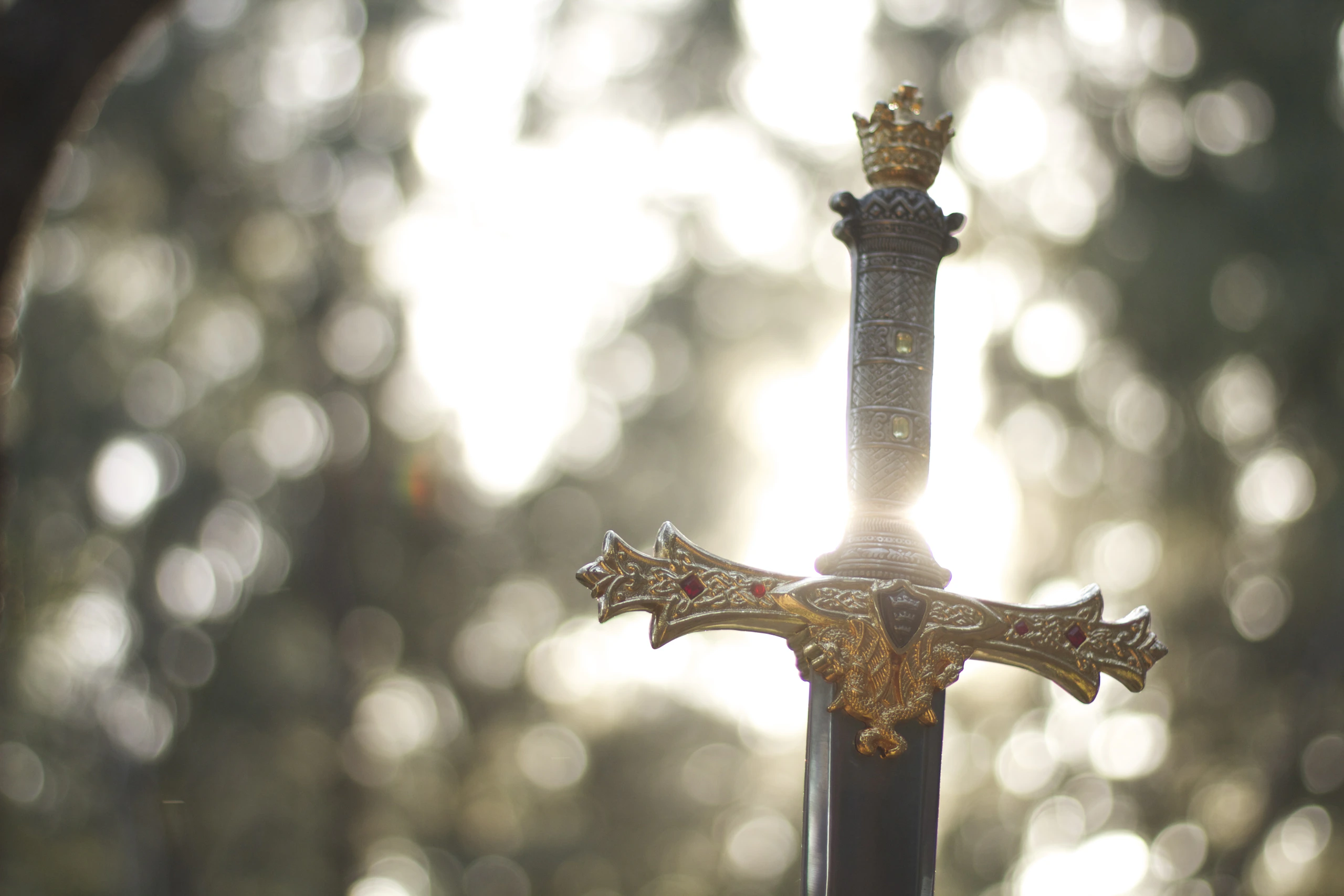
"How heavy is a longsword?"
The answer, if you have ever held one, will surprise you. A real medieval longsword, the kind a fourteenth-century knight carried into a judicial duel, weighs about the same as a bag of sugar. Usually between 1.1 and 1.8 kilograms (2.4 to 4 pounds), with most historical examples clustering around 1.3 to 1.5 kg (roughly 3 to 3.3 pounds).
That is genuinely all it is. A sugar bag. A litre of water. A medium-sized hardback novel. The idea that medieval swords were twenty-pound lumps of iron that only the strongest knights could swing is one of the most persistent pieces of nonsense in popular history, and it takes about five seconds of holding a real one to understand why.
Why the Myth Persists
The "heavy sword" myth comes from three places, and all three are worth knowing about.
Victorian reenactor swords. In the nineteenth century, as interest in medieval history revived, craftsmen started making swords to hang on gentlemen's walls or to wear at costume balls. These were decorative pieces. They were not made for a balanced grip, they used mild steel instead of properly-tempered spring steel, and they tended toward heavy because a stiff heavy lump of metal is cheaper to make than a properly-engineered blade. Many of those Victorian pieces ended up in museums, which is where writers who had never held a real medieval sword saw them, measured them, and wrote the weight down as "typical."
Hollywood prop swords. A film sword needs to look dramatic, read from the back row, and survive being dropped. It does not need to be balanced, or light, or even particularly sharp. Most film swords are made of aluminium or rubber and weigh whatever is convenient for the shot. When films depict actors struggling with medieval swords, as if the swords were unwieldy and heavy, that is the choreography, not the weapon.
The conflation of different swords. "Medieval sword" covers a lot of ground. A single-handed arming sword from the twelfth century weighs about 1 kg (2.2 lbs). A two-handed longsword from the fourteenth century weighs 1.3-1.8 kg. A much larger fifteenth-century zweihänder, the parade weapon of the Swiss and German mercenaries, can weigh 3-4 kg, but that is a ceremonial or formation weapon, not a duelling blade. When pop history says "medieval sword" and quotes a weight, it is often misapplying one category to another.
What Real Historical Swords Actually Weigh
If you walk through a serious arms-and-armour collection, here is what the historical record shows:
- Arming sword (single-handed, tenth to fourteenth century): ~0.9 to 1.3 kg (2 to 2.9 lbs).
- Longsword / hand-and-a-half sword (two-handed, fourteenth to sixteenth century): ~1.1 to 1.8 kg (2.4 to 4 lbs), most around 1.3-1.5 kg.
- Messer / langes Messer (long knife, essentially a one-handed utility sword): ~0.8 to 1.2 kg (1.8 to 2.6 lbs).
- Estoc (a stiff thrusting-only sword for armoured combat): ~1.5 to 2 kg (3.3 to 4.4 lbs).
- Zweihänder (giant formation-breaking two-hander, c. 1500): 2.5 to 4 kg (5.5 to 8.8 lbs), and these were specialised battlefield weapons, not duelling swords.
Individual historical longswords documented in modern scholarship cluster tightly around the 1.3-1.5 kg mark. The Wallace Collection in London, the Royal Armouries in Leeds, the Metropolitan Museum of Art in New York, and the Archaeological Museum of Cividale del Friuli (home turf of Fiore dei Liberi himself) all hold longswords in this range. The heavier end of the longsword spectrum, 1.7-1.8 kg, tends to be the blades designed for armoured combat, where you wanted more mass in the thrust. Unarmoured duelling longswords are lighter.
Why the Weapon Had to Be Light
A longsword is not a meat cleaver. It is a precision instrument, and the whole of Fiore dei Liberi's armizare system assumes a weapon that can be wielded nimbly by one human body.
Think about what the twelve guards require. You need to chamber the sword over your shoulder in Posta di Donna and hold that position without your arms burning out. You need to stand patiently in Porta di Ferro, the Iron Door, without tiring. You need to deliver a rising parry in a single tempo, and transition from that parry into a counter-cut that arrives on target before your opponent has recovered. You need to work for two minutes, three minutes, longer, in an intense exchange where every fraction of a second matters.
None of that works with a twenty-pound sword. A twenty-pound sword could be swung, once, perhaps, before your shoulders gave out. A sword at that weight has no measure, because measure requires the ability to extend and retract the blade quickly, and extension is where momentum in a too-heavy blade becomes dangerous to the wielder. The master who picks up a twenty-pound sword for a judicial duel dies in the first exchange, exhausted and slow.
This is the quiet secret of medieval sword design. The weapon had to be light enough to fight with, because fighting with a sword is about timing and geometry far more than it is about raw power. Fiore's own text is full of phrases about reading the opponent, finding the line, arriving in the right position at the right moment. A heavy sword denies you all of that.
The Point of Balance Matters More Than the Weight
Once you have held a few real longswords, you discover something else. The weight of the sword is not the thing you actually feel. What you feel is the point of balance.
The point of balance (POB) is the spot along the blade where the sword balances on a single finger. On a well-made longsword, the POB sits roughly 5 to 10 centimetres forward of the crossguard. That is the sword's "centre of mass", and it determines almost everything about how the weapon handles.
A sword with the POB close to the hand feels nimble. It turns quickly, recovers quickly, and delivers fast point-work. It is a duelling sword.
A sword with the POB further forward feels weighty. It commits harder to the cut, arrives with more momentum, and takes slightly longer to recover. It is a cutting sword.
Two longswords can weigh exactly the same and feel completely different to wield, because the weight is distributed along different points of the blade. This is why holding a feder at a HEMA class is such a revelation to beginners. You expected the sword to feel heavy, because of everything you have absorbed from films and games. It does not. It feels responsive. It wants to move. The weight disappears into the structure of the weapon, and what remains in your hands is a sensation of readiness that is impossible to describe until you have held one.
What a HEMA Feder Weighs
Most people reading this will end up holding a HEMA training longsword, a feder, at some point. Feders are the modern training weapon for longsword sparring, designed to flex safely on the thrust. They weigh between 1.4 and 1.7 kg (3 to 3.7 lbs), which is deliberately a touch heavier than most historical duelling longswords. The extra weight is distributed in the reinforced schilt (the little flared tip) that prevents accidental penetration of masks, and in the slightly thicker blade that safely absorbs thrust energy.
A Regenyei Standard, the most common feder in European HEMA, weighs around 1.55 kg. An Ensifer Pro sits close to 1.45 kg. An Albion Maestro Liechtenauer feder is about 1.6 kg. All of these are within the historical longsword range, and none of them will surprise you with heft when you first pick one up.
The Test You Can Do in Your Living Room
If you want a tactile sense of what a real longsword weighs, grab a 1.5-litre bottle of water. Hold it by the neck. Swing it in a slow figure-of-eight. That is roughly what a medieval longsword feels like in your hands, minus the lovely precision balance of a real blade. Heavier than a kitchen knife, sure. But nowhere near as heavy as your instincts suggest.
Now imagine a sword that weighs that much but has its mass distributed along a thin steel spine, balanced a few centimetres forward of the grip, with a long handle for both hands to control the leverage. That is the weapon Fiore trained with, fought duels with, and wrote his Fior di Battaglia about. Precision, not brute force. Geometry, not brawn.
That is why Fiore's system works. His plays assume an intelligent, responsive weapon held by a trained fighter who understands timing. The twenty-pound sword of Hollywood is a different thing entirely, and it has nothing to do with the history his manuscript preserved.
Come and Feel One
The only real way to understand what a medieval longsword weighs is to hold one. At HEMA Penzance we have loaner training longswords that any visitor can pick up on their first evening. We train every Tuesday, 7pm to 9pm, at Penzance Leisure Centre. Your first lesson is free, all equipment is provided, and no experience is necessary. Come along and see for yourself.