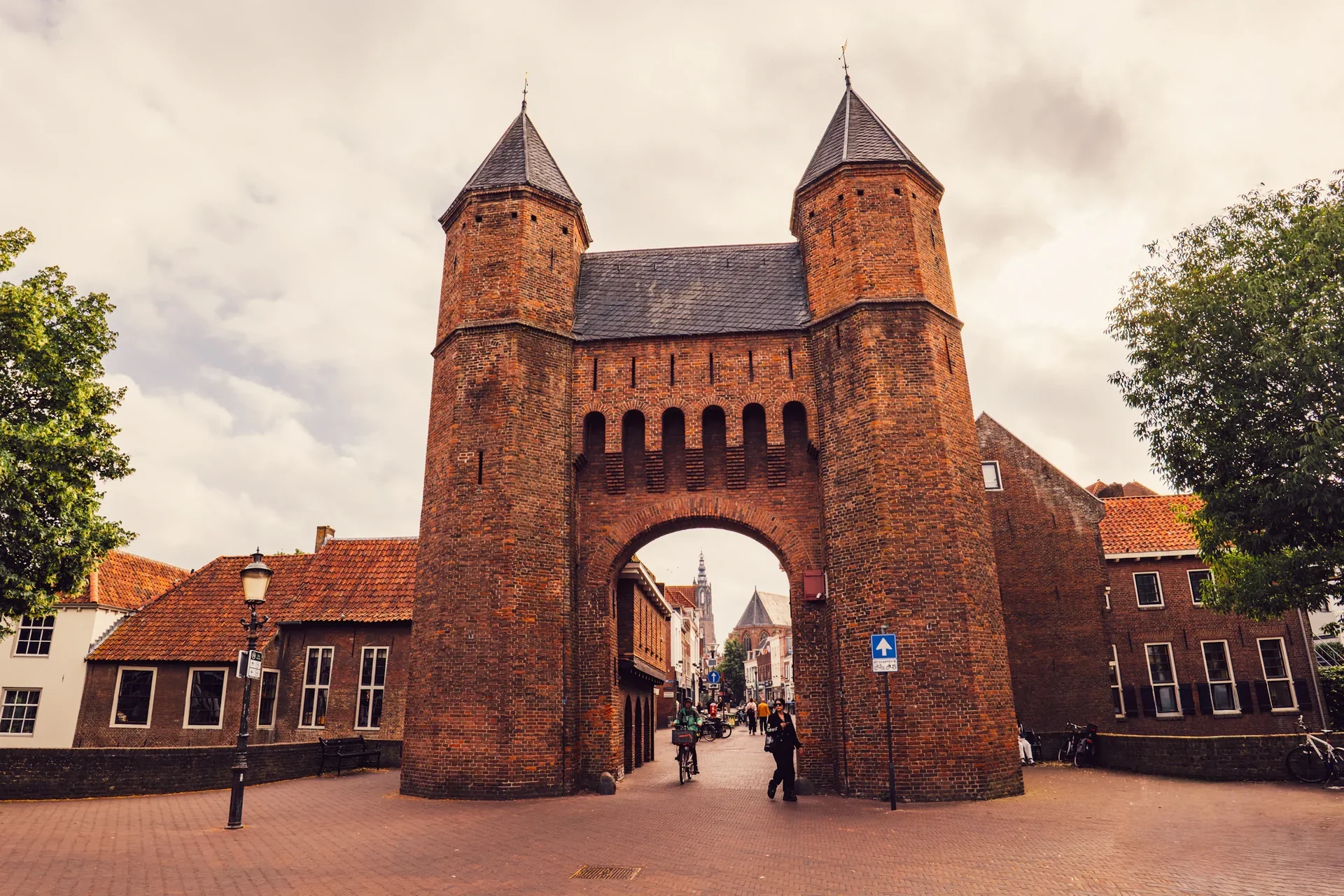
"The first one is Posta Tutta Porta di Ferro, that is like a great fortress."
Listen to how Fiore opens his description of the first of the twelve guards. Not with a catalogue of mechanics, not with a technical definition. With an image. A great fortress. A thing you approach at your peril, the stones of which have stood for generations, the walls of which will break whatever is thrown against them. That is the feeling he wants you to carry into this guard, and once you have felt it, the whole posture changes in your body.
Porta di Ferro is the Iron Door. Most English translations of Fiore render porta as "gate," and you will see the Iron Gate name in books and on websites, but the Italian porta is simply the word for door. At HEMA Penzance, Steve and Andrew call her the Iron Door, and once you have felt her in your body you understand why. A gate swings open. A door holds shut. This guard is the second of those. If Posta di Donna is Fiore's great offensive position, Porta di Ferro is her patient opposite: a low, grounded, defensive guard that dares the opponent to come forward and then breaks whatever comes. She is the fortress. She is the doorway that does not open. She is the place you wait when you are willing to let the other person make the first mistake.
How to Stand in Her
The full version (Tutta Porta di Ferro) holds the sword low, point angled slightly downward, on the right side of the body. Your hands are near your right thigh. The blade rests in the space between your feet, leaning toward the ground. Your weight is balanced across both feet, with the body settled into a low, stable stance. Your head is up, your eyes on the opponent, and your sword is hidden. They cannot easily see its tip. They cannot see which direction it will travel when it moves. They see only you, settled, calm, waiting.
The feeling is of deep rooting. A good Tuta Porta di Ferro is not a pose you hold tensely. It is a pose you inhabit. Your legs are springs. Your shoulders are relaxed. The sword is a coiled animal that can leap upward, diagonally, or into a thrust the instant you choose. From the outside, the guard looks almost lazy. From the inside, it is the most unhurriedly alert position in the whole of Fiore's system.
Why the Low Position Works
Every guard represents a choice about where the sword sits in space, and every choice trades different things off. A high guard like Posta di Donna loads power into the downward cut but takes time to reach the target. A forward guard like Posta Longa arrives quickly but cannot generate the same momentum. Porta di Ferro sits in a third position: low, back, hidden.
The low position does three things for you at once.
First, it invites the attack. Your opponent looking at you in Porta di Ferro sees a sword that cannot immediately threaten them. Their body relaxes, just slightly. Their guard softens, just slightly. They commit to an attack earlier than they would against a more obviously threatening posture. That softening is exactly the gift Fiore wants.
Second, it loads the rising cut. When your sword is already low, a sottano (a rising cut) is one foot-step and one arm-lift away from the opponent's forearms or head. The seven blows all travel from guard to guard, and the sottano lives here, waiting. An opponent who has seen only the low position is always slightly surprised by how fast the blade comes up.
Third, it stabilises your structure. Low guards are inherently more stable than high ones. Your centre of gravity is closer to the ground. Your footing is harder to disturb. When the opponent's attack meets your rising parry, your whole body is structured to receive and redirect the force. You do not stagger. You do not flinch. The fortress holds.
Tutta Porta di Ferro Against the Attack
"This guard gives those who use it great defence and does it without tiring."
Fiore is telling you something important in those last words: without tiring. Porta di Ferro is a guard you can hold for a long time. It does not burn your shoulders the way a high guard will. You can wait in her as long as your patience allows, and your patience will usually outlast your opponent's.
When the attack comes, the response is a rising parry. The sword sweeps upward along a diagonal line, meeting the descending blow and deflecting it upward and away. Your feet step off the line of attack, usually to the outside, and the parry rotates naturally into either a counter-cut or a thrust into the opening the opponent has just given you.
This sequence, wait-parry-counter, is one of the foundational patterns of Fiore's longsword. It is what "I can let you attack first and still win" looks like in practice. The Lady's Guard says I will break you. The Iron Gate says I will wait for you. Both statements are true.
Porta di Ferro Mezzana: The Middle Iron Gate
Fiore gives us a second version, held a little higher, with the sword more centred and the point forward rather than down. Porta di Ferro Mezzana.
This subtle shift changes the logic. From the Middle Iron Gate, a rising thrust is your natural first move rather than your second. Your sword is already half-loaded toward the opponent's face or chest. You are not inviting an attack so much as preparing to launch one. Where Tutta Porta di Ferro says "come to me," Porta di Ferro Mezzana says "I am already on my way to you."
The pollaxe section of Fior di Battaglia has a beautiful passage where Porta di Ferro Mezzana speaks directly about its relationship with Posta di Donna:
"If Posta di Donna and my Posta Porta di Ferro Mezana come against each other, then I know its play and mine. Again and again we have battled with sword and pollaxe. And I say that what she said she can do to me, I can do it more to her than she can to me."
Listen to the personality in that. The Iron Gate talking about the Lady's Guard as a long-standing rival, acknowledging they have fought each other many times, and then quietly insisting I can do it more to her than she can to me. That is the voice of a guard that knows its own power.
The Variations
Beyond the full and middle versions, Fiore and his inheritors also describe further variations of Porta di Ferro. Guy Windsor's scholarly work identifies six positions in the Iron Gate family, organised around three parameters:
- Stretta (with the point in line with the opponent)
- Larga (with the point down and wide)
- Alta (with the point held higher)
Each combination changes the balance of invitation versus threat. Stretta is more forward and aggressive, already threatening the centre line. Larga is more open and inviting, maximally defensive. Alta sits higher and loads a different kind of rising strike. Most modern Fiore schools, including HEMA Penzance, start with Tutta and Mezzana and treat the other variations as refinements you discover as your understanding deepens.
What She Teaches
Every beginner learns Posta di Donna quickly. The descending cut feels good; the high chamber loads something satisfying in the shoulders; the whole guard speaks to a modern idea of "attacking posture." Porta di Ferro takes longer to love. Her virtues are quieter. Patience. Settling. Trusting the structure. Letting the opponent come.
But if you train her seriously, she becomes the guard that teaches you most about fencing's deeper rhythms. She teaches you to breathe through a stare-down. She teaches you that a threat you do not immediately answer is not automatically a threat you have lost. She teaches you that the best counter is often the one that uses the opponent's own commitment as its fuel.
There is a reason Fiore's own text calls her a great fortress. Fortresses do not chase. They wait. They let the enemy exhaust themselves at the walls, and then they answer with stored force. A longsword fighter who has learned Porta di Ferro is, in the quietest way possible, one of the hardest opponents you can face.
Come and Learn
We practise Fiore's complete system every Tuesday evening at Penzance Leisure Centre, 7pm to 9pm. Your first lesson is free, all equipment is provided, and no experience is necessary. Come along and see for yourself.
Fiore's words in this article are from the Getty manuscript translations at Fight Like Fiore.