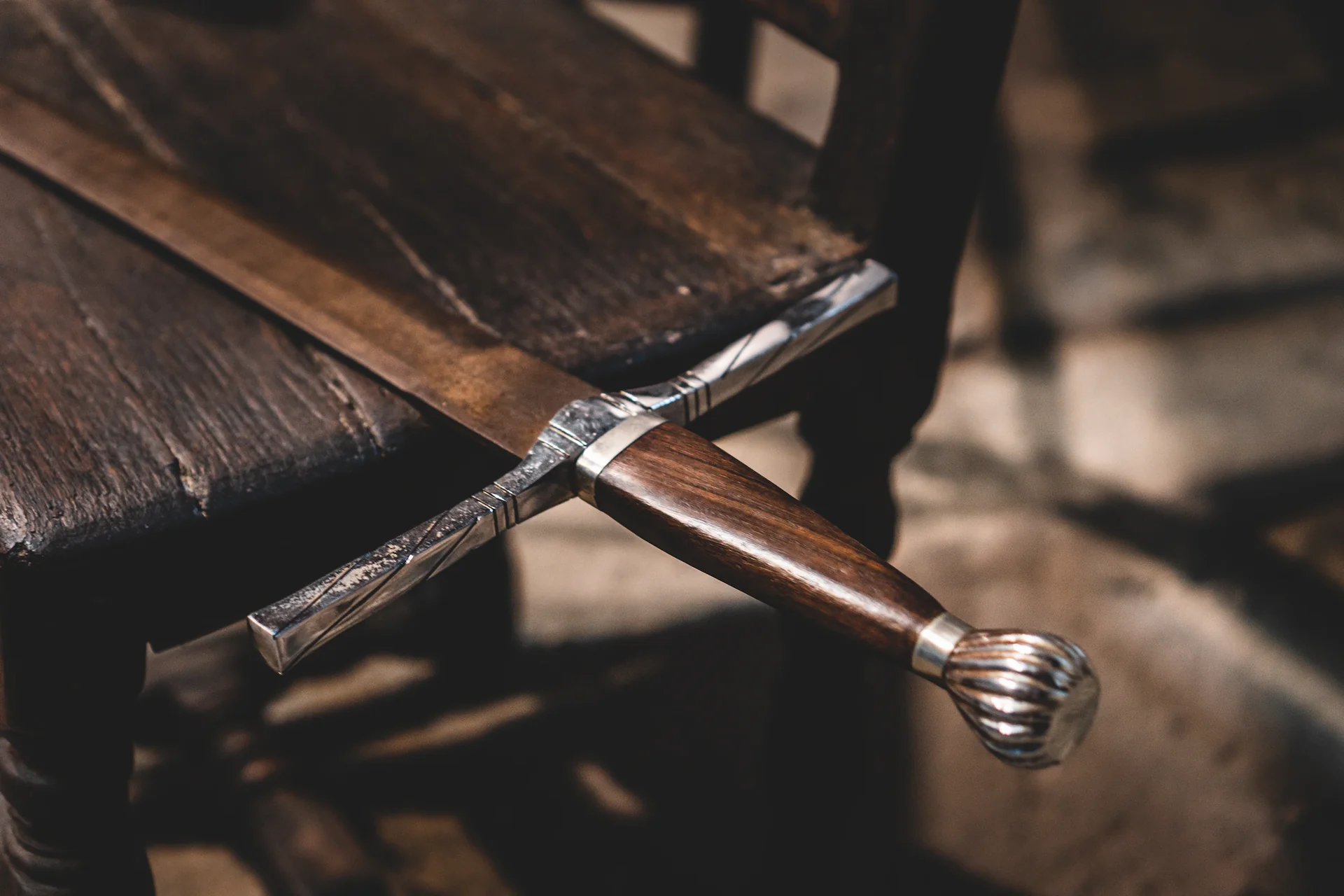
"This is Posta di Donna, who can do all of the seven blows of the sword, and she can cover all blows. And she breaks the other guards with the great blows that she can make."
Of all the twelve guards Fiore gives us, only one speaks about herself as though she were royalty. The Lady's Guard. Posta di Donna. Listen to her voice in the manuscript, and you hear someone entirely aware of what she is: the single most consequential position in the whole system, the one from which all seven blows are possible, the one that breaks the other guards with the great blows she makes.
Spend any time at all in a Fiore school, and this is the guard your body will remember first. She is the one your shoulder loads into before a fendente. She is the one your eye finds on the cover of every modern Fiore book. She is the one, when Andrew and Steve are demonstrating at HEMA Penzance, that everyone in the room ends up holding within their first five minutes of picking up a longsword.
Today we want to look at her properly. Where her name comes from, how to stand in her, why Fiore gave her four different faces, and what she is actually for when blades start moving.
Why "the Lady's Guard"?
The English translation sounds almost quaint. A lady's guard. The modern reader hears "delicate" or "soft" and wonders why Fiore would put the most powerful guard in the book under such a name.
The answer is a chivalric one. Posta di Donna invokes the knight's duty to protect the lady: the woman (sometimes the Madonna herself in medieval art) held close against the chest, guarded by the strong shield-side of the body. The sword rises high over the right shoulder, the left side of the body faces the opponent, and the whole posture is one of a man shielding something precious behind him while raising the blade to strike down whatever threatens. She is not delicate. She is the guard of the protector.
There is an older resonance too. Germanic sword traditions have a guard called Zornhut, the Wrath Guard, held in almost exactly the same position. The Liechtenauer masters gave it their word; Fiore gave it his. Same body, same shoulder, same load. Two masters looking at one truth of longsword mechanics and choosing different names. Fiore's name is the more gracious of the two. A medieval Italian would rather fight under the sign of a lady than under the sign of wrath.
How to Stand in Her
The basic shape is this. Your left shoulder points at your opponent. Your right foot is behind, your left foot is forward, or the other way around, depending on which weighting you prefer. The sword is held in both hands over the right shoulder, the blade chambered so far back that the point sits in line with (or even pointing past) your left knee. Your head turns to look over your front shoulder, eyes on the opponent, your sword entirely out of their immediate view.
The sensation is one of loading. Your shoulders are wound like a spring. The sword has travelled the long way round your body, storing every inch of that journey as potential. When you release her, you release all of it.
Why the Long Chamber?
Here is where Fiore's mechanics speak a precise truth. Turning the sword that far around the body means the blade has to travel a long way to reach the opponent. Compared to a guard like Posta Longa, where the sword is already extended toward the target, Posta di Donna is slow to first contact. The blade has to come all the way round.
But that same long path is what makes her devastating. The further the sword travels, the more momentum it gathers. A fendente delivered from the Lady's Guard is the heaviest single blow in Fiore's longsword, because it has the whole arc of your chambered shoulder behind it. This is why Fiore says she "breaks the other guards with the great blows that she can make." She does not arrive first. She arrives hardest.
That is the trade every swordsman learns. Distance versus speed. Extension versus load. The guards closer to the opponent are quicker but commit less power. The guards further away (Donna foremost among them) are slower to strike but arrive with authority. Choosing between them is choosing which side of that trade you want to be on in any given moment.
The Four Faces of the Lady
Fiore does not give us one Posta di Donna. He gives us four, and each has a character of her own.
Posta di Donna Destra: The Lady on the Right
The primary version. The one everyone thinks of. The sword chambered over the right shoulder, left side forward, weight usually on the back foot ready to surge forward.
Fiore gives us five separate illustrations of her in the Getty manuscript, which tells you how important she is. Her text is the most famous passage about any guard in the book: "she can do all of the seven blows of the sword, and she can cover all blows. And she breaks the other guards with the great blows that she can make. And to exchange the thrust, she is always ready."
Read that carefully. She can cover all blows, not just deliver them. The Lady's Guard is not a one-way offensive position. From here you can answer an incoming thrust with an exchange, stepping your front foot off the line while your back foot passes across, arriving in a new position with your opponent's weapon harmlessly past and your own point in their face. Fiore says it will hurt him "quickly and surely." It will.
Posta di Donna la Sinestra: The Lady on the Left
Her mirror. The sword chambered over the left shoulder instead of the right, the right side of the body now facing forward.
"She is always ready to cover and wound. She makes great blows and breaks the thrusts and beats them to the ground. And enters the narrow play due to her skill in traversing."
On paper, Sinestra looks functionally identical to Destra. In practice, subtle differences matter. From Sinestra, a step through with the left foot carries you straight into zogho stretto, the narrow play, where blades bind and bodies close. Your left hand, suddenly in front, can pin or grab your opponent's blade or arm, while your right hand delivers the cut. This is something Destra does not do quite as naturally.
Moving between the two, right and left, describes the fundamental figure-of-eight of longsword practice. The blade traces the two great diagonals of the body, and your shoulders learn to store and release energy from both sides. Right-handers will find Destra more natural and Sinestra slightly less powerful, but neglecting Sinestra is one of the commonest ways a Fiore practitioner remains weaker than they could be.
Posta di Donna Soprana: The High Lady
A variation of the right-side guard where the lead elbow is raised and the practitioner looks at the opponent from under the arm rather than over the shoulder.
The mechanics shift noticeably. The sword sits higher. The lead elbow makes a frame through which you sight your target. And the descending cut from Soprana is exceptionally powerful: the arm comes down from a higher starting point and gathers more momentum through the arc. Some modern practitioners treat Soprana as a stand-alone guard. Others, following Fiore more loosely, treat her as one of the weightings within Posta di Donna proper. Either way, she is worth practising in her own right. When a fendente absolutely has to get through heavy cover, Soprana is the version that often does it.
Posta di Donna (The One That Names Herself)
The most subtle point. Fiore's master of the Six Guards, the figure who stands for the longsword in the abstract, holds his sword in a guard called simply Posta di Donna, without modifier. No "destra," no "sinestra," no "soprana." Just the name by itself. She is the queen of the posta, and the master has chosen to stand in her to represent the whole two-handed sword.
This is a reminder that Posta di Donna is not any one weighting or angle. She is a family of positions organised around one principle: the sword chambered high over the shoulder, the body loaded, the great descending cut waiting to be released. Within that family, Fiore uses whichever member of her suits the situation. Your training should do the same.
What She Does in a Fight
Strip away the poetry and Posta di Donna is a practical answer to a practical question: where do you put your sword when you want the most options?
From Posta di Donna Destra:
- A fendente dritto cuts down from your right shoulder along the opponent's centre line, the heaviest blow in the system.
- A mezzano travels horizontally along the middle line, using the true edge.
- A fendente roverso travels the same diagonal, but crosses over the body, putting you in Posta di Donna Sinestra at the end.
- A punta thrusts forward if your opponent is in the right range for it.
- An exchange of thrusts covers an incoming point, steps off line, and puts your own point into their face.
All seven blows of the sword, available from this one guard. That is Fiore's claim, and the claim is mechanically true. Every major line of attack can leave the Lady's Guard naturally, without a wasted tempo, without the sword having to reset.
This is why beginners at HEMA Penzance spend so much of their first month in her. Before you learn the subtleties of Finestra or the patience of Tutta Porta di Ferro, your body needs to understand what it feels like to stand somewhere from which everything is possible. That place is Posta di Donna, and the feeling is one of readiness so complete that it almost chooses your next move for you.
A Note From the Pollaxe
One lovely detail: Fiore revisits Posta di Donna in his section on the pollaxe, and he gives her a quiet line there that deepens what we already know.
"I am Posta di Donna (Lady's Guard) and I counter Posta Dente di Zenghiaro (Boar's Tooth Guard). If he is waiting for me, I want to make a powerful blow."
Here she is not just a guard but a counter. Specifically, a counter to the Boar's Tooth, the low rising-thrust guard that threatens up into the face. Against the Boar's Tooth, Fiore tells us, the Lady's Guard answers with sheer downward force. She comes from high, the boar lunges from low, and the descending cut arrives before the rising thrust can complete. Distance and momentum, used against a guard whose strength is surprise.
This pairing appears only in the pollaxe section, but the principle is the same with the longsword. When your opponent sinks into a low guard and loads a rising thrust, Posta di Donna is one of your honest answers.
A Guard Worth a Lifetime
There is a reason so many Fiore scholars fall in love with Posta di Donna over the years of their practice. She is not the showiest guard. She is not the most deceptive. She is simply the most complete. Every time you think you have understood her, a new detail opens. The exact weighting of your feet changes the cut. The height of the sword changes the thrust. The angle of the lead shoulder changes what you can cover. She rewards slow, patient study, and she punishes the swordsman who assumes they already know her.
Fiore clearly loved her. Five separate illustrations. The most famous passage about any guard in the book. The only guard he calls by multiple names in multiple sections, always with warmth, always with that slightly proud medieval-Italian voice: she breaks the other guards.
Stand in her for long enough and you start to understand why.
Come and Learn
We practise Fiore's complete system every Tuesday evening at Penzance Leisure Centre, 7pm to 9pm. Your first lesson is free, all equipment is provided, and no experience is necessary. Come along and see for yourself.
Fiore's words in this article are from the Getty manuscript translations at Fight Like Fiore.