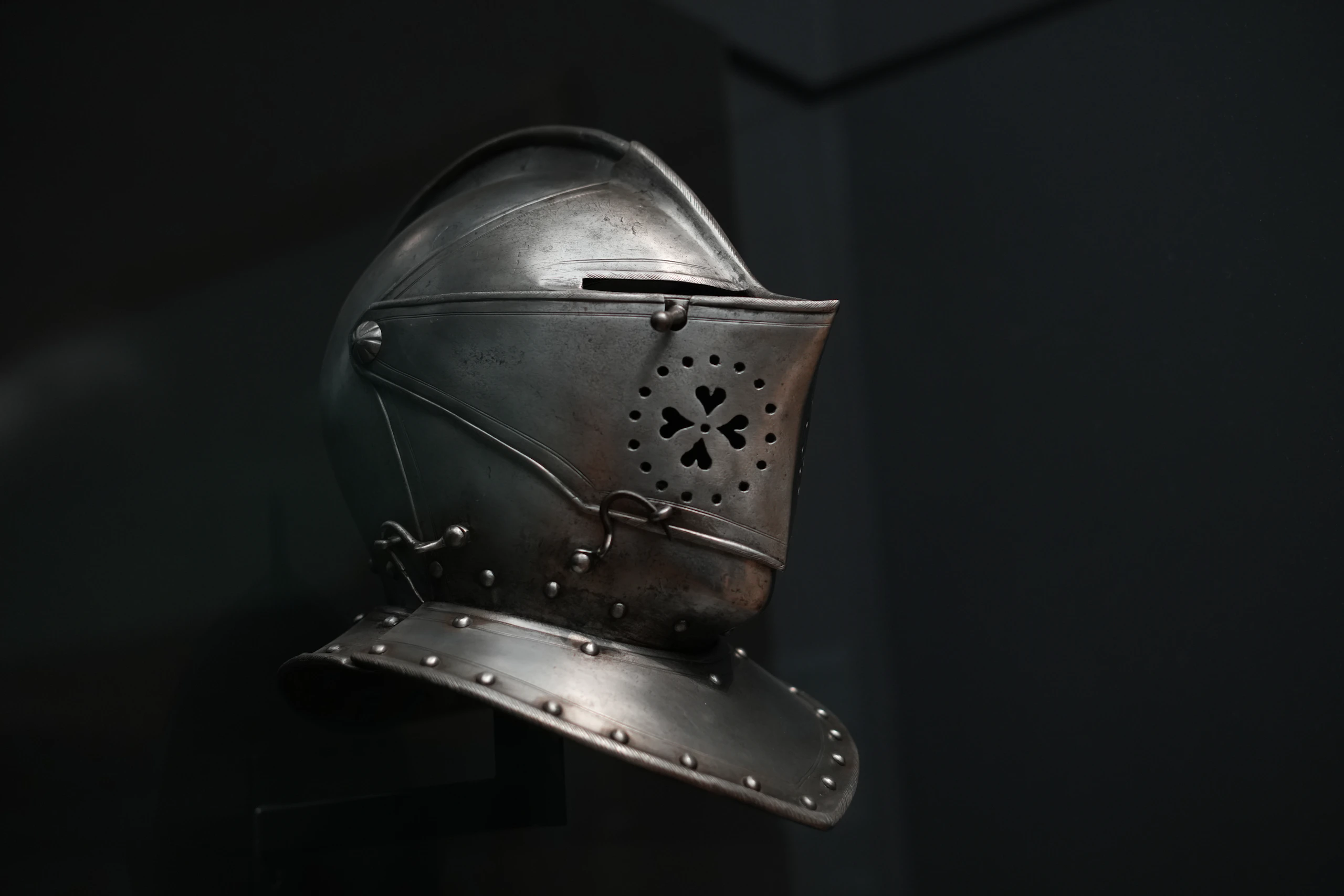
Imagine you are holding a longsword. Two hands on the grip, blade forward, familiar. Now imagine your opponent walks onto the field in full plate armour. Breastplate. Pauldrons. Vambraces. A helmet with a visor that closes to a narrow slit. Everything you know about how to cut a man with this sword has just stopped working.
What do you do?
Fiore's answer, in the section of Fior di Battaglia called spada in arme (sword in armour), is not what a modern reader expects. He does not tell you to sharpen your cuts. He does not tell you to aim harder. He tells you to hold the sword differently, and when you do, the sword transforms. The two-handed blade you know becomes something closer to a short, heavy spear. Or, in a different grip, something closer to a war hammer with a pointy beak. The weapon remains the same. The tool becomes new.
This transformation is what makes the sword-in-armour section one of the most fascinating chapters of Fior di Battaglia, and it rests on two techniques every HEMA practitioner should understand: half-swording and mordschlag.
Why Normal Cuts Stop Working
First, a reality check. A medieval cutting sword against an unarmoured body is devastating. A fendente from Posta di Donna will cleave flesh, open muscle, break bone. Against plate armour, the same blow becomes decorative. Good plate was made to turn edges. A cut that would have killed a man in a gambeson will glance off the breastplate and rattle the arm holding the sword.
This is why armoured combat asks for different weapons wherever possible: the pollaxe with its hammer head, the dagger for the armour gaps, the spear that reaches through visors. But sometimes you are in armour with only a longsword in your hands, and Fiore writes this section for exactly that moment.
The solution is to stop using the sword as a sword and start using it as a lever with a point on one end and a heavy striking head on the other. Which means: reorganise your grip.
Half-Swording
Half-swording means gripping the blade itself with one of your hands. Usually the left hand comes off the handle and grips the middle of the blade, while the right hand stays on the grip near the pommel. This gives you a short, rigid, precisely controllable weapon about half the length of the original sword.
The payoffs are enormous:
- Precision thrusts. With the hand on the blade, you can drive the point into an armour gap (the armpit, the visor, the groin, the back of the knee) with the mechanical precision of a short spear. The point becomes a surgical instrument.
- Stability in the bind. When two armoured fighters cross swords, the half-sword grip is much stronger than the normal grip. You can bind, control, and manipulate the opponent's weapon in ways that would be impossible at full length.
- Range compression. Half-swording makes the weapon shorter, which is exactly what you want in close armoured combat. The pollaxe distance and the dagger distance collapse together, and your sword now operates in both.
Fiore gives us half-swording guards throughout his spada in arme section. Posta Breve la Serpentina (the Short Serpent) is a half-sword guard. So is Posta de Vera Croce (the True Cross Guard), which Fiore tells us acts "in many ways as a short spear."
"Holding the sword in this manner practically transforms it into a very heavy dagger, or a very short spear. It is a slightly lighter version of its counterpart with the pollaxe."
Listen to that again. A very heavy dagger. A very short spear. A slightly lighter version of the pollaxe. The longsword, held at half-length, is those other weapons. This is the moment Fiore's system becomes visibly one art, expressed through a single blade behaving like three different weapons.
The Mordschlag: Murder-Stroke
And then there is the mordschlag. The name is German (Mordschlag = "murder-stroke"), though Fiore writes in Italian and does not use the term. The technique itself is clear in his plates: you invert the sword. Both hands grip the blade, one near the tip and one lower down, and the heavy cross-guard and pommel swing forward. The sword becomes, essentially, a short pollaxe. The pommel is now the hammer head. The crossguard is now a hook.
Why would you ever do this? Because the pommel of a heavy longsword, driven by both hands and the weight of an armoured body behind it, hits like a hammer. Armour that turns edges does not turn impact. A mordschlag strike to the helm concusses the skull inside. A mordschlag strike to the pauldron bruises the shoulder joint. A mordschlag strike that hooks the crossguard behind the opponent's knee or neck levers them to the ground. The sword, held backwards, becomes an armour-defeating weapon.
This is exactly the technique Steve and Andrew have us drill at HEMA Penzance when we work the pollaxe material without a pollaxe in our hands. We hold our longswords inverted, mordschlag style, and run through the pollaxe postas and plays. The mechanics are the same. The Short Serpent, the True Cross, Posta di Donna with the pollaxe, Porta di Ferro Mezana with the pollaxe, all of them translate directly. Fiore's own manuscript insists that "on a functional level, Posta de Vera Croce with a pollaxe is the same as Posta de Vera Croce with a sword in armour." We drill the proof of that claim every time we invert the grip.
Training pollaxes are on their way to the club, and when they arrive we will drill the azza with the real weapon. But the mordschlag work with the longsword teaches the same postas, the same plays, and the same understanding of what the weapon does against plate.
The Five Guards of the Sword in Armour
Fiore gives us five principal guards for the sword in armour, and every one of them is a half-sword or mordschlag variation on a guard you already know:
- Posta Breve la Serpentina (Short Serpent): half-sword grip, point drawn back to the rear hip, ready for a centreline thrust.
- Posta de Vera Croce (True Cross Guard): half-sword, point high, handle low, crossed defensive shape ready to beat and thrust.
- Serpentino lo Soprano (High Serpent): a half-sword variant with the point raised, threatening from above.
- Posta Porta di Ferro Mezana (Middle Iron Door): familiar from the longsword, here applied with the armoured grip.
- Posta Sagittaria (Archer's Guard): the bow-shape of the half-sword stance loaded for a drawing thrust.
Every one of them is a lesson in how to transform the longsword into a different category of weapon without putting the longsword down.
Why This Section Changes How You See the System
Read the sword-in-armour section of Fior di Battaglia as a modern practitioner, and several things click into place.
First: the integration of armizare. The pollaxe section, the spear section, and the sword-in-armour section are not separate weapons. They are the same grip logic applied to three different lengths of shaft. The body does the same thing. The reach changes. Fiore knew this explicitly and wrote the sword-in-armour plays to be interchangeable with the pollaxe plays. This is what armizare means as a system.
Second: the weapon's adaptability. A longsword is not one tool. It is at least three: a cutting sword at full length, a thrusting short-spear when half-sworded, a hammer-and-hook when inverted. A fighter who knows all three has a much wider repertoire than a fighter who only knows the first one.
Third: the medieval world Fiore wrote for. Armoured combat on foot was a regular part of noble life in fifteenth-century Italy. Judicial duels, tournaments, real battlefield encounters: all of them could land you in plate with a sword in your hands facing another armoured man. Fiore's sword-in-armour section is not a curiosity tucked at the back of the book. It is survival knowledge for the world he lived in.
Practising Safely
Half-swording and mordschlag come with obvious safety considerations. In modern HEMA sparring with feders, we do not grip the blade bare-handed (the blade flex and the vibration would make the grip uncertain), and the mordschlag pommel strike at full speed is a face-breaker. These techniques are practised slow, by partners who know what they're doing.
But drilled properly, they open up a whole dimension of Fiore's system that sparring with sword-on-sword at long distance never touches. The half-sword bind is a different fight. The mordschlag swing is a different weapon. When a student at the club first inverts the longsword and runs through a pollaxe posta, there is usually a moment of visible delight. The weapon has just turned into something else, and the thing it has become is interesting.
Fiore himself would have recognised the moment. The whole of spada in arme was written to produce exactly that click of recognition.
Come and Learn
We practise Fiore's complete system, including the sword-in-armour material, every Tuesday evening at Penzance Leisure Centre, 7pm to 9pm. Your first lesson is free, all equipment is provided, and no experience is necessary. Come along and see for yourself.
Fiore's words in this article are from the Getty manuscript translations at Fight Like Fiore.