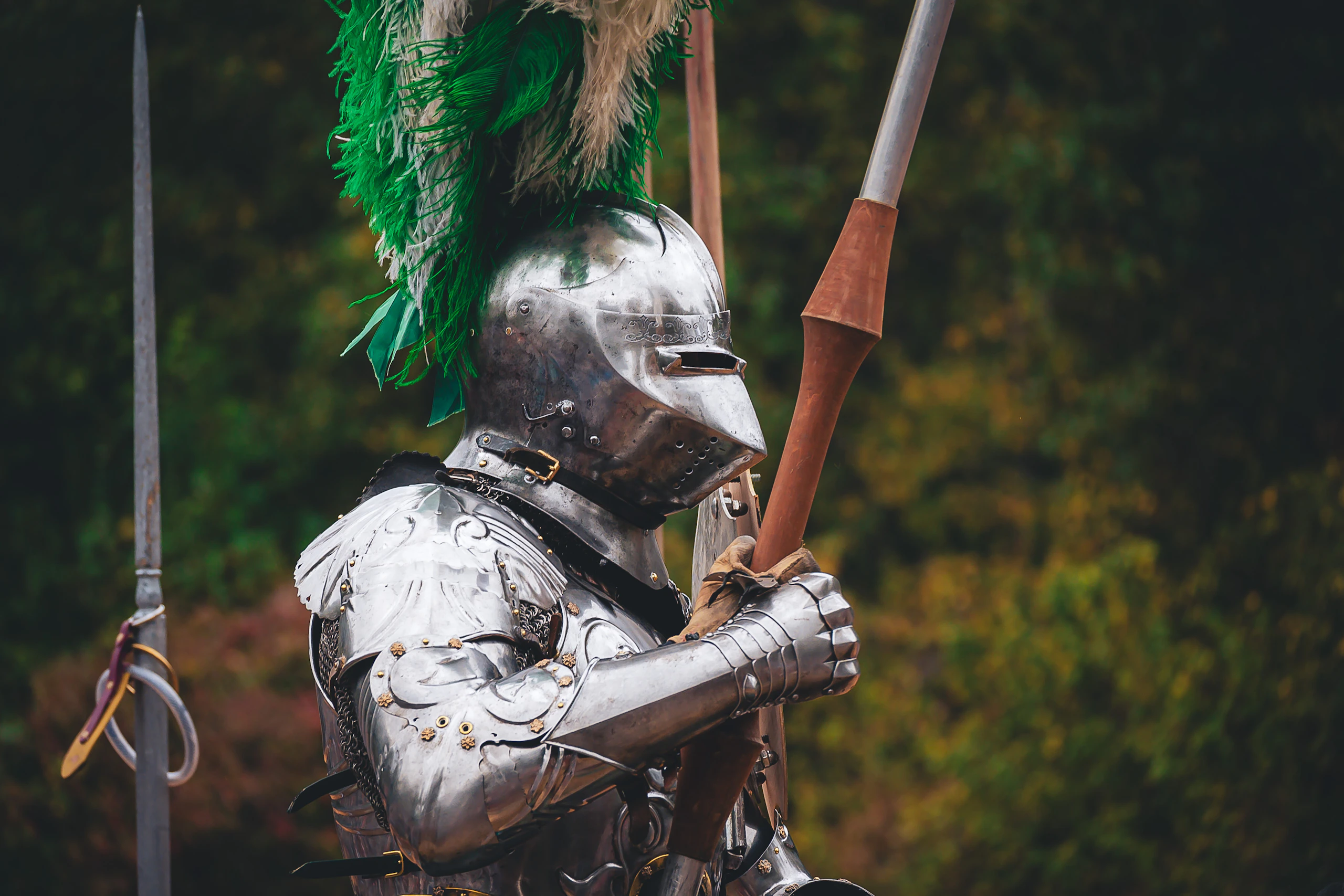
Picture two men in full plate, standing on a field, facing each other with the whole weight of the medieval world pressing on the moment. A duel of honour. Lords watching. Clergy praying. Crowds of knights and commoners around the lists. Each man carries a weapon around six feet long, with a hammer on one side of the head, an axe on the other, a spike at the top, and a butt-spike at the rear. They touch, breathe, and move, and what happens next is the reason Fiore wrote his pollaxe section.
Fior di Battaglia is a complete system. It teaches grappling, dagger, sword in one hand, sword in two hands, sword in armour. But when two armoured knights actually meet on foot in a real duel, the weapon that decides the fight is most often the azza, the pollaxe. The sword is beautiful. The dagger is terrible. The grappling is the foundation. But the pollaxe is the tool that reaches through armour, and a medieval duel that proceeds past the first contact is very often finished with it.
This is the weapon Fiore trains you in when the other arts will not be enough.
What the Azza Actually Is
A pollaxe is not an axe. It is a composite weapon whose whole purpose is to deliver different types of force into different parts of an armoured opponent.
- The hammer head concusses through plate. A steel breastplate will not split under a hammer blow, but the man inside it will feel every ounce of the impact transmitted through his ribs and chest.
- The axe blade, sharper than the hammer, is reserved for the less-armoured joints: elbows, knees, the tops of the feet, the gap at the back of the helmet.
- The top spike is a rondel-dagger-on-a-stick. It drives through visor slits, mail gussets, the armpit gap.
- The butt spike at the rear of the shaft turns the weapon into a double-ended threat. When the main head is blocked or bound, a fast reversal puts the butt spike into the opponent's face.
- The shaft itself, four to six feet of hardwood reinforced with metal strips, is a lever. Hook it behind your opponent's knee or neck and the leverage alone is enough to bring a man in full armour to the ground.
Every part of the pollaxe has a purpose, and the purposes together cover every situation an armoured knight will face. The weapon reaches like a spear, hits like a hammer, cuts like an axe, pierces like a dagger, and hooks like a quarterstaff. When you train the azza, you are training five weapons at once.
Why Armour Changes Everything
The logic of armoured combat runs opposite to the logic of unarmoured fighting. In an unarmoured duel, a sword cut is usually decisive. Against plate, a sword cut is decorative. The blade glances or slides. Even a tremendous two-handed blow from Posta di Donna will not reliably part good steel.
This is why spada in arme, Fiore's sword in armour section, teaches a completely different grip and style. The armoured swordsman often half-swords (grips the blade with one hand, holding the sword like a short crowbar), and thrusts rather than cuts. The armoured duel wants piercing points in gaps, not broad edges against plate.
And this is why the pollaxe is the armoured duel's most consequential weapon. The hammer does not need to cut armour. It transmits shock through armour. The butt spike does not need to slice through a visor. It finds the slit and penetrates. The hook does not need to reach skin. It finds the foot or the neck and levers the man down.
Fiore structures the whole book so that by the time you arrive at the pollaxe, you already know how to grapple, how to work with the dagger, how to fight with the sword both in and out of armour. The pollaxe is the culmination, not the beginning. You come to it having learned everything that makes it work.
The Six Guards of the Pollaxe
Fiore gives us six poste for the pollaxe. Most of them are direct descendants of sword guards you already know from his longsword section. This is not coincidence. Fiore tells us explicitly that the pollaxe guards are "based on those of the sword." The whole of armizare is one integrated art, and the pollaxe guards are the armoured-duel translations of the sword guards you have already trained.
Posta Breve la Serpentina (Short Serpent Guard)
"I am Posta Breve la Serpentina (Short Serpent Guard) and I put myself as better than the others. Those I give a thrust to will be well decorated by my mark. This thrust is strong enough to penetrate cuirasses and breastplates."
Listen to the confidence. I put myself as better than the others. The Short Serpent sits with the weapon drawn back to the rear hip, point angled forward toward the opponent's centre. From here comes the single most powerful thrust anyone on foot in armizare can deliver. The weight of the pollaxe, the mass of the armour driving it, the momentum of the step-through: all of it concentrates onto the top spike, and the result is a thrust that can penetrate steel. Not a thrust that might. One that will. Fiore is not exaggerating.
Steve put it as plainly as anyone at the club ever puts it: no weapon makes harder blows than the pollaxe. Once you have felt one in your hands, or felt the mordschlag equivalent with a longsword swung by a grip that turns the pommel into a hammer, you understand exactly what he means.
Posta de Vera Croce (Guard of the True Cross)
"I am Posta di Vera Croce (True Cross Guard) because with a cross I defend myself. And all the art of fencing and armed combat defends with covers of crossed weapons."
A beautiful name with a double meaning. Fiore is referencing the Christian relic of the True Cross, which any fifteenth-century Italian would have known well, but he is also teaching a principle: all defensive covers in armizare are crosses. Your weapon and the opponent's weapon meet at an angle, forming a crossing that protects your body. The Guard of the True Cross sits with the pollaxe already formed into that covering shape, ready to receive an incoming blow and then pass into a thrust.
This posta also gives us a glimpse of Fiore's integrated logic. On a functional level, Posta de Vera Croce with a pollaxe is the same as Posta de Vera Croce with a sword in armour. The pollaxe is, for this purpose, a longer, heavier sword. The sword in armour is a shorter, lighter pollaxe. The plays are interchangeable.
Posta di Donna (The Lady's Guard)
"I am Posta di Donna (Lady's Guard) and I counter Posta Dente di Zenghiaro (Boars Tooth Guard). If he is waiting for me, I want to make a powerful blow by passing the left foot forward off the line and entering with a downward cut to the head."
Here is a wonderful detail. Posta di Donna with the longsword is one of the most important guards in the whole system, but in the sword section Fiore does not specifically tell you which guards she counters. Only in the pollaxe section does he explicitly say: the Lady's Guard is the counter to the Boar's Tooth. When the boar drops low to drive upward, the Lady waits above and then crushes down with a descending blow to the head. If the Boar blocks that, the Lady diverts to the arms and hands. Either way, the Boar is unmade.
Posta Porta di Ferro Mezana (Middle Iron Door)
"If Posta di Donna and my Posta Porta di Ferro Mezana come against each other, then I know its play and mine. Again and again we have battled with sword and pollaxe."
The Middle Iron Door is one of Fiore's most versatile positions. Centreline thrusts, fast upward beats, direct counterattack. In the pollaxe section, Fiore gives her a voice with the character of a seasoned duellist: she and Posta di Donna have fought each other "again and again," and she quietly claims she can do more damage to Donna than Donna can do to her. The rivalry between these two guards is older than any modern practitioner.
Posta Coda Longa (Long Tail Guard)
"I am Posta Coda Longa (Long Tail Guard). I want to counter Posta di Fenestra and I can injure him every time. And with my downward blows I will beat both pollaxe and sword to the ground, and powerfully close to the narrow play."
The Long Tail holds the pollaxe trailing back behind the body, point hidden, almost invisible. From this disguised position, the pollaxe can sweep forward with enormous momentum, beating the opponent's weapon toward the ground and immediately closing into zogho stretto, the narrow play where grappling and finishing techniques live.
Posta de Fenestra Sinistra (Window Guard on the Left)
The sixth guard, the Window on the Left, is held high and deceptive, the pollaxe angled forward as if ready to attack, but concealing which direction it will actually travel. Fiore describes it as unstable (you cannot hold it long) but wonderfully useful for feints. "You will think I am going to attack with a downward cut," the guard says, and then does something else entirely.
The Pollaxe Teaches the Whole System
Once you have understood that the pollaxe is a longer, heavier, more armour-piercing translation of the sword, the pollaxe section of Fior di Battaglia reveals its secret: it is a review course of everything that came before.
The guards mirror the sword guards. The plays resolve into grappling the way the sword plays resolve into grappling. The exchange of thrusts appears here as it does in the sword section. The zogho stretto logic of closing distance and finishing close is the same. Fiore is showing you that armizare, the whole art, is one body of knowledge expressed through different instruments. Sword, dagger, pollaxe, spear: each is a lever applied to the same fundamental mechanics.
When modern practitioners skip the pollaxe section (because most of us do not train in full armour and do not own a pollaxe), we miss something important. We miss the section where Fiore confirms, in his own proud voice, that the whole book is a single integrated art.
This is where Fiore's genius of integration reveals itself in a way you can feel in your own hands. In his sword-in-armour section, Fiore teaches you to hold your longsword like a pollaxe. One hand on the grip, the other hand gripping the blade itself (this is half-swording), the whole sword turned into a short, heavy, spear-and-axe hybrid. Or, in the mordschlag ("murder-stroke") grip, you invert the weapon entirely: you hold the blade in both hands and swing the crossguard and pommel like the head of a hammer. The pommel becomes a blunt striking beak. The crossguard becomes a hook. The whole sword, held this way, is mechanically identical to a pollaxe.
And that is exactly what Fiore says. The sword-in-armour postas are the same postas as the pollaxe. Posta Breve la Serpentina, Posta de Vera Croce, Porta di Ferro Mezana, all appear in both sections, nearly interchangeable. The plays are interchangeable. On a functional level, Posta de Vera Croce with a pollaxe is the same as Posta de Vera Croce with a sword in armour. The pollaxe is a longer, heavier sword; the armoured sword is a shorter, lighter pollaxe.
This is one of the ways we train the pollaxe at HEMA Penzance today. We hold our longswords in the mordschlag grip, exactly as Fiore instructs in his sword-in-armour section, and we work the pollaxe postas and plays with that grip. We worked this very section of the manuscript this week. Training pollaxes are on their way to the club, and when they arrive we will drill the azza with the real weapon in our hands, but in the meantime the longsword held mordschlag lets us practise every play Fiore gives for it. Every grin on every face in the room afterwards told you exactly why Fiore chose to keep the pollaxe in his book. The principles clarify what the sword has been teaching all along.
The Weapon of the Duel
If you ever watch the records of historical armoured duels (and Fiore personally trained men for several of the most famous ones), the pollaxe is almost always present. When the initial spear or lance encounter ends, the combatants draw axes. When the swords prove insufficient against plate, the axes come out. In the 1399 duel between Giovannino da Baggio and the German squire Sirano, a duel Fiore himself trained Baggio for, they fought three bouts of mounted lance, then three bouts each of dismounted pollaxe, estoc, and dagger. The pollaxe was a required weapon of the armoured duel, not an afterthought.
This is the world Fiore was writing for. A world where knights met on foot in plate, where honour was resolved by weapons, and where the azza in your hands was very often the thing that decided how you would walk off the field. He knew that world intimately. His pollaxe section is that knowledge, preserved in ink and illustration, handed to you six centuries later with the confidence of a master who has seen what the weapon actually does.
Come and Learn
We practise Fiore's complete system, the pollaxe included where time and space allow, every Tuesday evening at Penzance Leisure Centre, 7pm to 9pm. Your first lesson is free, all equipment is provided, and no experience is necessary. Come along and see for yourself.
Fiore's words in this article are from the Getty manuscript translations at Fight Like Fiore.