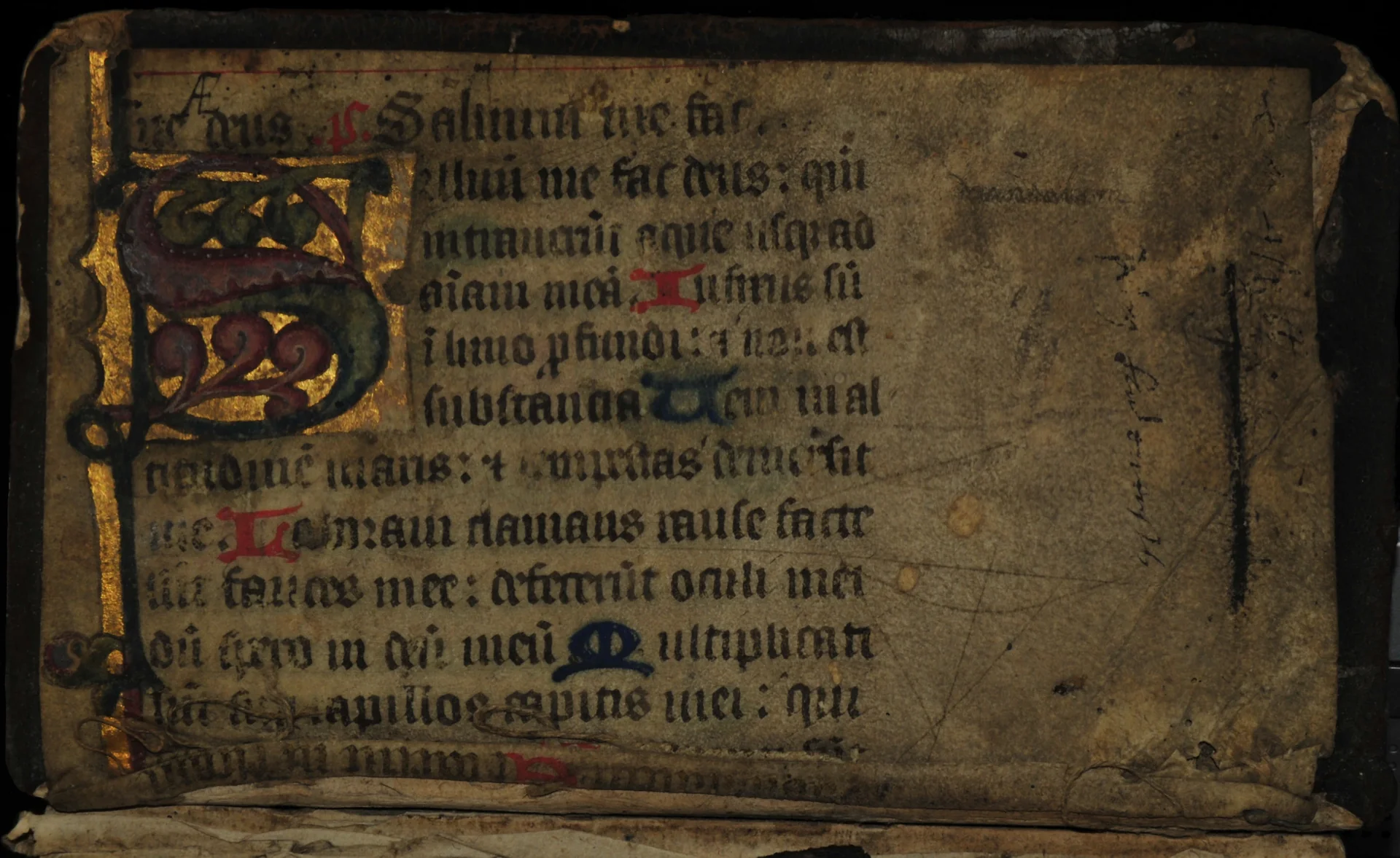
There is a particular pleasure in reading Fiore dei Liberi. Six hundred years after he set his pen down in the early 1400s, his voice is still on the page. Proud, precise, occasionally funny, occasionally chilling, always confident. You can hear a fourteenth-century Italian knight talking directly to you, and that voice is half of why we keep coming back to his manuscript.
What follows is a small gallery of his most striking passages. His own humility, his animals speaking, his guards introducing themselves, his dagger warning, his grappler's pride, his pollaxe confidence. Nearly every one is quotable, memorable, and impossible to paraphrase without losing what makes it alive. We offer the quotes in his order of appearance, with a thin ribbon of context to tell you where each one sits in the book.
The Master Himself
Before any technique, before the first animal or the first guard, Fiore is Fiore. An Imperial knight. A master of forty years. A man entirely aware of what he has built, and entirely willing to tell you about it.
"I, Fiore, knowing how to read and write and draw and having books about this art which I have studied for a good 40 years and more, even now I am not a perfected master in this art."
Read that twice. Forty years of study. Still not a perfected master. This is the man at the centre of the book, setting the register. Confidence without arrogance; a lifetime of work described with the quiet humility of someone who knows how much further the art reaches.
The Four Animals of the Segno
At folio 32r sits the Segno page, the symbolic heart of Fior di Battaglia. A scholar stands at the centre, four animals attached to him like the virtues he must carry into combat. Each animal speaks.
"No creature sees better than me, the Lynx. And I always know my angles and distance."
At the scholar's head, the Lynx. Prudence. The vision that reads the fight before the fight begins. The four virtues all begin here, with the eye that sees.
"I am the Tiger, so quick to run and turn that lightning from the sky cannot overtake me."
At the weapon hand, the Tiger. Speed. The hand that commits when the eye has read. Fiore's medieval bestiary knew the tiger by reputation rather than sight, and the reputation was pure velocity.
"There are none more than me, the Lion, to bring a daring heart, for I invite all to do battle."
At the heart, the Lion. Boldness. Read that second line again: I invite all to do battle. Not "I will fight if I must." The Lion seeks the fight. Lion is the virtue that actually commits the sword when the moment arrives.
"I am the Elephant and I carry a castle for my load. And I do not kneel or lose my footing."
At the feet, the Elephant. Fortitude. A creature bearing a castle on its back and still refusing to stagger. A virtue with the mass of everything the art has taught you, unshakeable under pressure.
The Guards Speaking
The twelve guards of the longsword each have a voice. Some introduce themselves with images. Others declare their temperament. Reading these lines in sequence is like being introduced to twelve characters who are about to stand up and demonstrate their personalities.
"The first one is Posta Tutta Porta di Ferro, that is like a great fortress."
The Iron Door opens the gallery, and she opens it with an image no one who reads it forgets. A great fortress. A thing you cannot easily breach. The tone is set.
"This is Posta di Donna, who can do all of the seven blows of the sword, and she can cover all blows. And she breaks the other guards with the great blows that she can make."
The Lady's Guard, the queen of the twelve, declaring her breadth. This is Fiore's most famous passage about any guard, and it is a claim that reveals itself to be mechanically exact once you have trained her. She really does break the others. She really does cover every line.
"Makes great underhanded thrusts into the face without stepping through, and returns with a downward cut to the arms."
The Boar's Tooth speaking without introduction, describing what she does rather than what she is. Fiore often lets his most aggressive guards describe their action rather than their posture. She drives upward, she rakes downward. The sentence is the technique.
"Full of deception. She is feeling the guards of the opponents to deceive them. If she can wound with a thrust, she will do it well."
Posta Longa, the Long Guard, the probing forward extension. Listen to "full of deception." That is not the language of a neutral stance. The Long Guard is a scout, testing the opponent's defences, disguising her intentions, waiting for the instant her point can find home.
"Cunning and deception always lend themselves to it. Of covering and wounding, she is a master."
Posta di Finestra, the Window. Another deceiver. Fiore repeatedly uses the language of cunning and deception for the high guards that can simultaneously cover and thrust. A good HEMA fencer starts to see why: these are the positions from which the sword can do two things at once, which is exactly what "deception" means in swordplay.
"Wants a long sword and is a malicious guard, but has no stability. Always move and see if you can enter with a thrust."
Posta Breve, the Short Guard. Listen to that: malicious but unstable. Fiore does not soften his descriptions for us. A guard is called malicious because that is what it is, and the warning that follows (you must always be moving) is the practical truth of why.
The Seven Blows Speaking
After the guards come the seven blows. Each line of attack introduces itself like a child reciting its name at school.
"We are the fendente. And in the art we cut skillfully from the teeth down to the knees."
The descending cut. Fiore cannot resist a pun: fendere gli denti, cleaving the teeth. From above the head to below the knees, the cleaving line.
"We are the colpi sottani, and we go from the knees to the middle of the forehead in the same path that are made by the downward cuts."
The rising cut. Same line, reversed. A precise piece of mechanics disguised as a verse.
"We are the colpi mezani, so called because we go through the middle of the downward blows and the under blows."
The horizontal cut, splitting the diagonals.
"We are the thrusts, cruel and deadly. And our path is in the middle of the body between the groin and the forehead."
And the thrust. No other blow in the seven receives language like cruel and deadly. Fiore gives the thrust its own emotional register, and six centuries later that register still carries. A cut wounds the surface. The thrust penetrates.
The Dagger's Warning
After the swordwork, Fiore turns to the dagger. Before a single technique he pauses to warn you.
"Doubt yourself when against anyone with the dangerous knife. The arms, the hands and the elbows must immediately go against it."
Doubt yourself. That is the master's first word to the student who is about to learn knife defence. This is not a pep talk. This is correct calibration. The knife is dangerous, and the practitioner who treats it as anything less will learn the lesson the hard way.
And then, having felt the fear properly, the dagger itself speaks:
"I am the noble weapon called the dagger, that in the narrow play roams all over. Whoever knows my malice and my art will have a good understanding with any weapon."
Hear the pride in the noble weapon. Not the desperate weapon, not the vulgar one. The noble one. Medieval Italy understood the rondel dagger as a full member of the warrior's kit, and the master teaches it with the respect it deserves.
The Grappler's Pride
Four parts of Fiore's five things are grappling. Each one gets its own verse, and each is unashamed about the work.
"Because I carry the dagger in my right hand, I show my art. It is well deserved, because for anyone that will draw a dagger against me, I will take it from your hand. And with that I will hurt you well."
On taking the weapon.
"The broken arms I carry tell my art. I say without a lie that I have broken and dislocated many arms in my life."
On breaking the arms. That is Fiore without embellishment. I have broken and dislocated many arms. He does not soften it. He does not apologise. It is the work.
"I am the master of unlocking and also locking the arms of those who go against me. I will put you in great trouble and can depend on the way my binds and breaks work."
On the locks and binds.
"You ask me how I put this man under my feet. Thousands have gone there, trying to match my art of grappling. For my victory I carry the palm in the right hand, because none can withstand my grappling skills."
On the throws. Thousands have gone there. Read that and hear a man who has thrown a great many people to the ground over forty years of practice, and who is quietly confident about what number he has reached.
The Pollaxe's Confidence
The pollaxe section is full of guards who introduce themselves like lords at a court.
"I am Posta Breve la Serpentina (Short Serpent Guard) and I put myself as better than the others. Those I give a thrust to will be well decorated by my mark. This thrust is strong enough to penetrate cuirasses and breastplates."
The Short Serpent, claiming openly to be the best. And she is. The pollaxe thrust from this guard is the most powerful thrust in armizare, and Fiore knows it.
"I am Posta di Vera Croce (True Cross Guard) because with a cross I defend myself. And all the art of fencing and armed combat defends with covers of crossed weapons."
The True Cross Guard, educating you on defensive principle while introducing herself. Fiore's pollaxe guards are not shy.
"If Posta di Donna and my Posta Porta di Ferro Mezana come against each other, then I know its play and mine. Again and again we have battled with sword and pollaxe."
The Middle Iron Door speaking about her rivalry with the Lady's Guard. Again and again we have battled. A duelling relationship that has continued across centuries.
Closing
When you read Fior di Battaglia carefully, you come away with the impression of a complete person behind the work. Someone whose humour, pride, patience, and precision are all present on the page. A master who insists on his own humility while demonstrating his confidence. A knight who names his enemies and his students alike. A writer whose voice is unmistakable.
That voice is, in the end, what makes studying Fiore different from studying a more anonymous tradition. You are not learning techniques from a school. You are learning techniques from a man, and the man is willing to speak to you from across six hundred years if you will listen.
At HEMA Penzance we spend a lot of time listening. Every session at the club begins with a demonstration of a play from the manuscript, and somewhere behind the demonstration stands a Friulian knight with a sword in his hand, smiling at the idea that we are still reading him. Armizare is the word he gave to his art. These quotes are the voice in which he gave it. The least we can do is pass both along warmly.
Come and Learn
We practise Fiore's complete system every Tuesday evening at Penzance Leisure Centre, 7pm to 9pm. Your first lesson is free, all equipment is provided, and no experience is necessary. Come along and see for yourself.
Fiore's words in this article are from the Getty manuscript translations at Fight Like Fiore.