Open Fiore's manuscript to folio 32r and you will meet four animals before you meet a single sword. A lynx crowns a scholar's head, carrying a compass and speaking of vision. A tiger crouches near his weapon hand, declaring itself faster than lightning from the sky. A lion guards his heart, inviting all to battle. An elephant stands at his feet, its back built into a fortress, refusing to kneel or lose its footing.
This is the Segno page, the symbolic heart of Fiore's Fior di Battaglia, and before any of the seven blows or twelve guards are explained, Fiore pauses to tell us what a complete fighter must carry inside themselves. Four virtues. Four animals. One swordsman.
"This Master with these swords signifies the seven blows of the sword. And the four animals signify four virtues, namely, sighting, speed, fortitude and boldness. And who wants to do well in this art must have all parts of these virtues."
And then, in turn, each animal speaks.
The Lynx at the Head: Prudence
"No creature sees better than me, the Lynx. And I always know my angles and distance."
Medieval bestiaries told readers that the lynx could see through stone, through clouds, even into the future. Its eyes were the sharpest on earth. Fiore puts the lynx at the scholar's head, where its vision sits in place of his own, and then gives it a compass to hold. Angles and distance. The geometry of the fight.
This is prudence, and Fiore places her first. Before your sword moves, your eye must read. Where is your opponent's weight? Which foot is forward? What guard are they loading? How far away is their point, and how far away is the edge of your own reach? A good swordsman sees the fight two tempi before it happens. A bad one is always reacting, always catching up to what has just occurred.
The Lynx is the animal of patience as well as precision. When you watch experienced Fiore practitioners spar at HEMA Penzance, you notice that they often look almost still. Their swords are in guard. Their feet are in a comfortable measure. Their eyes are doing most of the work. They are reading. When their swords finally move, the movement feels inevitable, because the Lynx saw the opening before the Tiger took it.
There is a modern training truth inside this. The biggest step forward most HEMA beginners make is not a new technique. It is the moment their eyes stop panicking. The opponent's sword stops being a single terrifying blur and resolves into a shape, a position, a loaded possibility. That moment is the Lynx waking up behind your eyes. Once she is awake, she will not go back to sleep.
The Tiger at the Weapon Hand: Speed
"I am the Tiger, so quick to run and turn that lightning from the sky cannot overtake me."
At the scholar's weapon hand sits the Tiger. Not the powerful arm, not the heavy striker, but the speed of the hand that holds the sword. Fiore's medieval world knew the tiger by reputation rather than sight, and that reputation was built entirely on quickness. Faster than lightning. Faster than a falling star. The creature that cannot be caught.
There is a subtle teaching in putting the Tiger here rather than at the legs or the shoulders. Speed in swordsmanship is not about how fast your muscles can contract. It is about how quickly your hand can commit to a decision. The sword does not move until the hand tells it to. If your hand hesitates (and the hand usually hesitates because the Lynx has not finished reading yet) then no amount of muscular power in the shoulders will save you.
Train the Lynx first, and the Tiger follows naturally. The eye that sees clearly releases the hand that acts decisively. Try it the other way round, with speed but without sight, and you get a fighter who commits early, commits wrong, and discovers their mistake at the point of their opponent's sword. Fiore knew this. That is why his Tiger sits not at the feet or the sword arm's bicep, but at the hand itself, the narrowest and most precise place where decision becomes action.
The Lion at the Heart: Boldness
"There are none more than me, the Lion, to bring a daring heart, for I invite all to do battle."
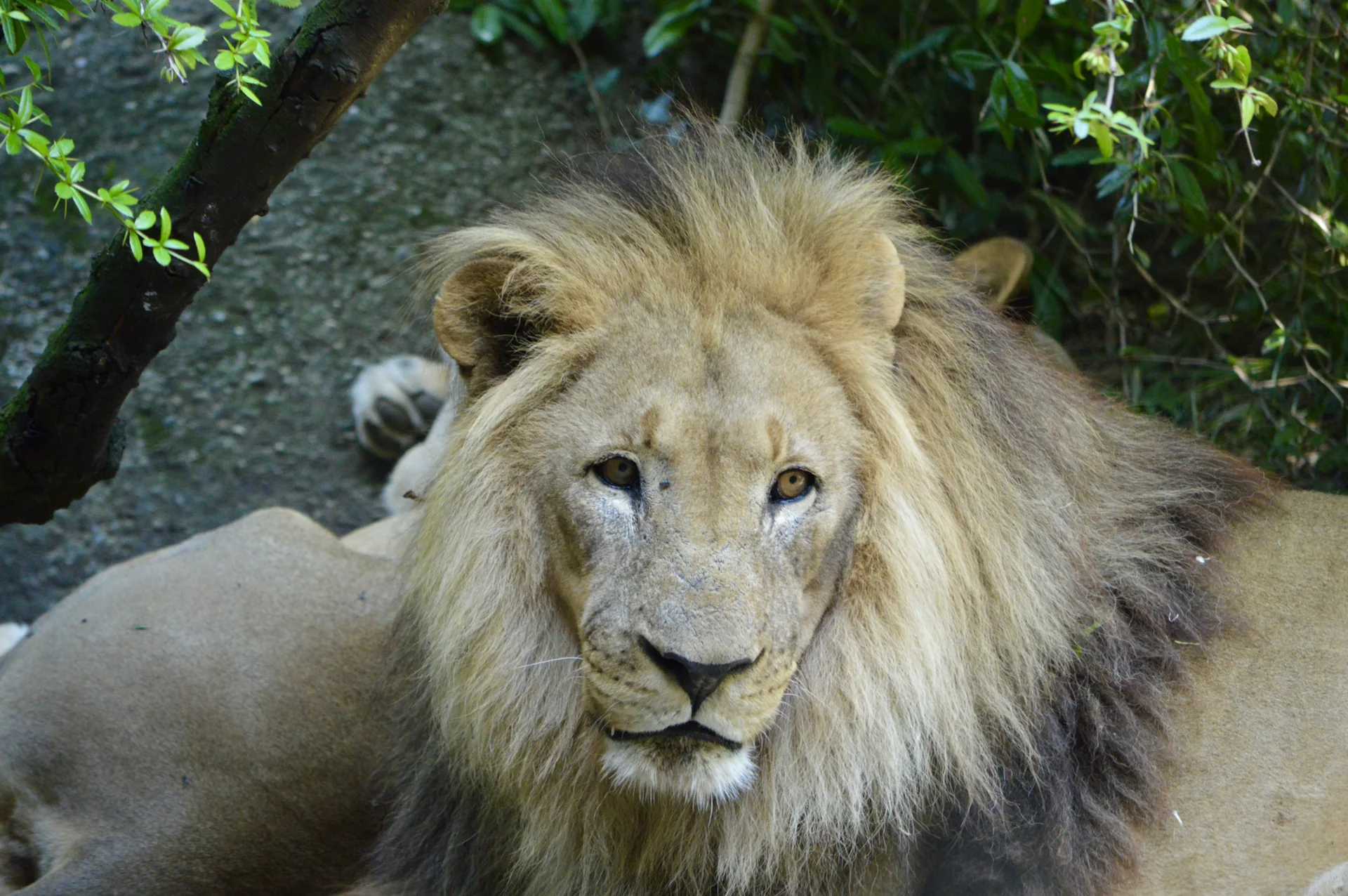
At the scholar's heart, the Lion. The medieval symbol of courage, placed where courage actually lives. And the Lion's speech is magnificent: I invite all to do battle. Not "I am prepared to fight if I must." The Lion seeks the fight, welcomes it, sees it as the place where the Lion is most fully the Lion.
This is the virtue most often mistranslated into modern terms. We hear "boldness" and think of recklessness, of the fighter who charges in without thinking. That is not what Fiore means. Fiore's Lion does not act without prudence, because the Lynx is already on the job. The Lion does not act without speed, because the Tiger sits one hand away. What the Lion adds to the picture is commitment. Once the Lynx has seen the opening and the Tiger is ready to move, the Lion is the virtue that actually lets the sword go.
Watch a nervous beginner at their first serious drill and you can see the Lion sleeping. Their eyes are open. Their hands are ready. But at the crucial moment, the commitment is not there. The cut goes half-distance. The thrust stops an inch short. The parry is tentative. Fiore's medieval wisdom is painfully relevant here: a shoddy technique delivered with great intent beats a precise technique delivered with none. Half a sword moving boldly is a better weapon than a whole sword moving timidly.
The Lion does not come from nowhere. You train the Lion by putting yourself in situations where commitment is demanded and then committing. Paired practice. Sparring. Uncomfortable speeds. Each time you commit, the Lion wakes up a little more. Each time you flinch, the Lion goes back to sleep. Over time the Lion becomes a habit of the heart, and the sword starts to move when it is supposed to.
The Elephant at the Feet: Fortitude
"I am the Elephant and I carry a castle for my load. And I do not kneel or lose my footing."
And at the feet, the Elephant. Fiore's manuscript shows it with a castellated howdah on its back, a medieval fighting tower from which archers and soldiers could rain missiles down on the enemy. The image is not subtle. The Elephant is bearing a castle and still standing steady. That is fortitude.
Fortitude in Fiore's system is not the same thing as strength. It is the refusal to kneel or lose your footing. The feet are the foundation, and if your feet panic, everything above them panics with them. Stable footwork, stable structure, stable presence under pressure. These are not flashy virtues. They are the ones that decide whether the other three virtues survive the exchange.
This is the virtue that shows up most slowly in training, and the one that most separates experienced practitioners from newer ones. When an incoming cut comes faster than expected, the beginner flinches. The knees unlock. The centre collapses. The Lynx stops seeing, the Tiger stops moving, the Lion stops committing, because the Elephant has forgotten his castle. Every fight that ends badly tends to end that way: with the footwork going first, and everything else falling down on top of it.
The Elephant also carries the modern interpretation of fortitude as endurance. Fiore's duels could run long. A sparring session at the club runs long too, physically and mentally. The ability to keep your structure in the third hour, when your shoulders are tired and your eyes are starting to lose focus, is the Elephant doing his quiet work at the foundation.
Four Animals, One Swordsman
Here is the beautiful thing about Fiore's arrangement. The four virtues are not a list you work through one at a time. They are a simultaneous requirement. The scholar in the middle of the page has all four animals attached to him at once: the Lynx at his head, the Tiger at his hand, the Lion at his heart, the Elephant at his feet. Remove any one of them and the whole system breaks.
- A fighter with Lynx but no Lion sees everything and acts on nothing.
- A fighter with Lion but no Lynx commits bravely to the wrong moment.
- A fighter with Tiger but no Elephant moves fast but falls over.
- A fighter with Elephant but no Tiger stands firm but never arrives.
You can see this in yourself in any given session. One night the Lynx is sharp but the Lion is timid. Another night the Lion roars but the Elephant staggers. Training is not "do I have these virtues or not." Training is the ongoing conversation between which of them is in form tonight and which of them needs more attention. Fiore's teaching is that you must cultivate all four, because the fight will test all four, and the weakest one will be the one that decides the outcome.
The Crown the Scholar Does Not Quite Wear
One last detail worth noticing. The scholar at the centre of the Segno page wears a crown, but the crown is drawn slightly off his head, hovering just above him. He is not the master yet. He is the striving master, working toward perfection, never quite claiming it.
Fiore himself felt this. Forty years into the art, he said he was still not a perfected master. The four animals around him are not a medal he has earned but a standard he aspires to meet. Every lesson tries. Every sparring match tests. Every time the crown almost fits, and every time it lifts back up into the air, waiting for tomorrow's training.
This is the honest spiritual shape of a martial art. You become a better fighter by spending decades in the company of four animals who remember what you forgot and remind you of what you still need to practise. The Lynx keeps sharpening your eye. The Tiger keeps training your hand. The Lion keeps finding new places to test your heart. The Elephant keeps asking whether your foundation can bear the next castle.
Walk into Penzance Leisure Centre on a Tuesday evening and you walk into a room where those four animals are working. Not just on the walls. In the bodies of the people training. In the way they watch, the way they move, the way they commit, the way they stand. That is armizare, the art of arms that Fiore taught. And that is what you come to learn.
Come and Learn
We practise Fiore's complete system every Tuesday evening at Penzance Leisure Centre, 7pm to 9pm. Your first lesson is free, all equipment is provided, and no experience is necessary. Come along and see for yourself.
Fiore's words in this article are from the Getty manuscript translations at Fight Like Fiore.