Close the book at the end of Fiore's pollaxe section and you might think the master has given you everything. Grappling, dagger, sword in one hand, sword in two hands, sword in armour, pollaxe, spear on foot. That is already more than any other medieval fencing manuscript attempts.
But Fiore is not done. He has one more section, and it is the one most modern HEMA practitioners never train. He takes you up into the saddle.
A Knight's Art Does Not Stop at the Ground
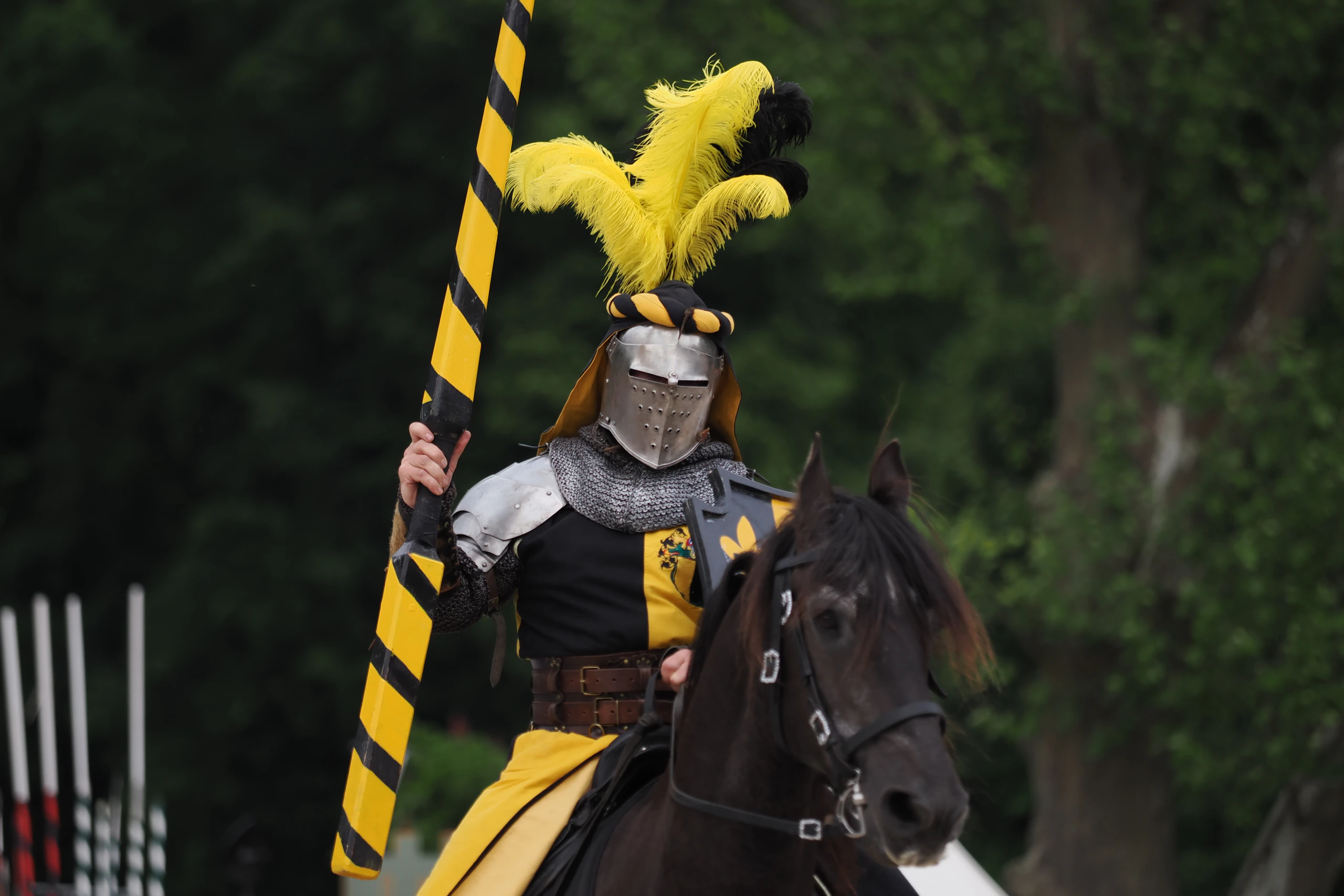
The final part of Fior di Battaglia covers mounted combat: lance against lance, sword against lance, grappling in the saddle, even spear-on-foot defending against a charging cavalryman. This is the section that confirms, if any confirmation were needed, that Fiore dei Liberi is writing the complete education of a medieval fighting man. The knight of his world fought on foot and on horse, armoured and unarmoured, in duels and on battlefields. Armizare, the art of arms, covered it all.
Fiore's own life put him in exactly the places where horseback combat mattered. He trained the mercenary captain Galeazzo Gonzaga of Mantua for a duel in Padua in 1395 that was meant to begin with spears on horseback (Boucicaut, the French opponent, lost patience and dismounted to attack early, but the mounted opening was the expected form). Fiore trained Giovannino da Baggio for his 1399 duel with the German squire Sirano, which began with three bouts of mounted lance before the combatants dismounted to fight with pollaxe, estoc, and dagger. Horseback combat was not the exotic edge of fifteenth-century martial arts. It was the expected opening of a noble duel.
So Fiore teaches it, and he teaches it with the same clarity he brings to everything else.
The Structure of the Horseback Section
Fiore gives us eight masters of mounted combat, each demonstrating a specific situation. The sections are short compared to the longsword plays, but they are dense with practical knowledge.
Lance Against Lance
The first three masters all address the classic mounted duel: two riders closing with couched lances. Fiore treats this as a puzzle of measure and timing, the same puzzle that underlies all of his swordplay, only now at the speed of two galloping horses.
First Master. You carry your lance in Posta Dente di Zenghiaro, the Boar's Tooth, because you are well armoured and your lance is shorter than your opponent's. As you close, you sweep your lance diagonally upward, catching their point offline, while your own point, driven by the momentum of your horse, finds their body. The short lance beats the long lance if you time the beat correctly. That is the play.
The counter, Fiore quietly points out, is that the longer lance arrives first. Two riders in the same Posta Dente di Zenghiaro, and the one with the longer lance wins the exchange because the timing of the beat cannot be made to work when the opposing point arrives before you can reach their shaft.
Second Master. Your lance is still short, but now you carry it in Posta di Donna la Sinistra, the Lady's Guard on the Left, high and back over the shoulder. As your opponent commits their line of attack, you sweep your lance diagonally downward, knocking their point offline, and the momentum of your horse drives your own point home.
Fiore does something lovely here: he tells you this play is an exchange of thrusts. The same technique that works with longsword against longsword, with sword in armour, with pollaxe, with spear on foot, also works from horseback with a lance. Cross-reference is one of the pleasures of reading Fiore. The art is one thing, expressed through different instruments.
Third Master. Same posta as the Second Master, but this time your opponent is not couching a lance against you. They are throwing a spear. The same defensive motion, the diagonal downward beat from Posta di Donna Sinistra, swats the thrown weapon out of the air. Fiore notes that this defence works with almost any weapon to hand: a baton, a short sword, whatever you are carrying. The principle is the beat, not the specific tool.
The Unarmoured Rider
Fourth Master. A beautiful play. You are unarmoured but riding a fast courser. You are being pursued. Your opponent is armoured and riding a larger warhorse. You cannot stand and fight, because your lack of armour guarantees you will lose a sustained exchange.
So you do something clever. You flick the point of your lance back over your shoulder, stabbing at your pursuer's face or their horse's head as they close. This slows them, disrupts them, buys you space. Each time they try to close, you throw the point back again. When you judge they have dropped far enough behind, you execute a full turn to the right, drop into either Posta Dente di Zenghiaro or Posta di Donna la Sinistra, and let their own momentum carry them onto your point.
This is a play of patience and mobility, and it is remarkably modern in its tactical thinking. Fiore understood that an unarmoured rider survives by controlling the distance, not by winning the clash.
Sword Against Spear on Horseback
Fifth Master. The sword has arrived. You are on horseback, carrying a single-handed sword in Posta di Donna la Sinistra, and your opponent is charging you with a spear.
Fiore notes a practical constraint: because you are sitting squarely on your horse, the sword cannot chamber as far behind the body as it would if you were standing. You lose some torque. But, Fiore says, the momentum of the horse more than compensates. From here you cut diagonally downward over the horse's head, beating the spear aside, and your blade finds the opponent's body.
This same posta, he adds, works as a general defence on horseback against any hand-held weapon: pollaxe, staff, another sword. One position, many answers.
The counters to the Fifth Master are worth noting because they show you the other side of the exchange. One counter: carry your lance low and strike the horse instead of the rider. The rider's sword cannot beat a low spear attack aside, and a lance driven into a horse's chest with the combined momentum of both animals will drop the horse dead and take the rider out of the fight with it. Medieval warfare was brutal in ways that squeamish modern imagination does not want to dwell on, and Fiore does not dress it up. He simply tells you what works.
Grappling from the Saddle
Beyond the lance and sword work, Fiore gives us a set of grappling plays on horseback. Two riders pass each other closely, or end up in a clinch, and the techniques return to pure abrazare adapted to the saddle. You can still lock an arm, lever at an elbow, pin a wrist, or throw your opponent off their horse using the same leverage principles that work on foot. The horses add speed and danger, but the physics is the physics.
One play in particular: you reach across, hook your arm around your opponent's neck, and use the rotation of your own body (braced against your saddle) to spin them off their mount. This is a first-class lever where your shoulder is the fulcrum, applied at the moment two horses pass shoulder-to-shoulder.
Spear Versus Cavalry
Finally, Fiore flips the perspective. He teaches you how, standing on foot with a spear, to defeat a charging horseman. The spear on foot wins against cavalry because it reaches first, and because a good spearman can aim for the horse instead of the rider. The plays here are direct: take a firm stance, angle the spear to receive the charge, and target the horse's chest. The charging knight has committed to their line; they cannot easily divert once their horse is at speed.
This is a democratising section of the manuscript. The armoured mounted knight was the apex predator of medieval warfare, but Fiore shows a well-trained foot soldier with a spear that he is not invincible. Timing, angle, and reach, the same principles that govern his longsword plays, apply to the infantry pikeman facing down cavalry.
Why Modern Practitioners Rarely Train This
Horseback combat requires horses, and most HEMA clubs do not have stables. Training the mounted section of Fiore is expensive, dangerous, and logistically fiddly in ways that longsword drilling is not. A few specialist groups around the world do it: mounted HEMA enthusiasts, historical reenactment troops, the occasional film fight choreographer. The rest of us read the section with respect and move on.
But reading it still matters, because the horseback plays confirm something about Fiore's art. His system is not a collection of loose techniques. It is one coherent philosophy applied across every situation a medieval knight could find himself in. The same Posta di Donna that you chamber in a longsword drill at HEMA Penzance is the same guard used to beat a lance out of the air from horseback. The same exchange of thrusts that appears in the sword section appears in the pollaxe section appears in the mounted lance section.
When Fiore tells you the guards are "based on those of the sword," he means it literally. The sword is the core, and everything else (dagger, pollaxe, spear, lance, mounted sword) is the same core expressed through a different instrument.
The Last Page Is the Endpiece
When the horseback section closes, the manuscript ends. Fiore signs off with a brief endpiece, thanking the reader and commending the art. Six centuries later, you can still almost hear his voice there: an old master, forty years into his study, offering the whole of what he has learned to whoever was willing to pick up the book and read.
Horseback combat is the last section before that signing-off. It is Fiore's final demonstration of the completeness of his art. There is nothing a knight could face that he has not already thought about, tested, and written down for you. The book ends because the art is complete.
Come and Learn
We practise Fiore's system every Tuesday evening at Penzance Leisure Centre, 7pm to 9pm. The horseback section is one we read together rather than train under open skies (we have yet to acquire the horses), but the principles it preserves run through every sword drill we do. Your first lesson is free, all equipment is provided, and no experience is necessary. Come along and see for yourself.
Fiore's words in this article are from the Getty manuscript translations at Fight Like Fiore.