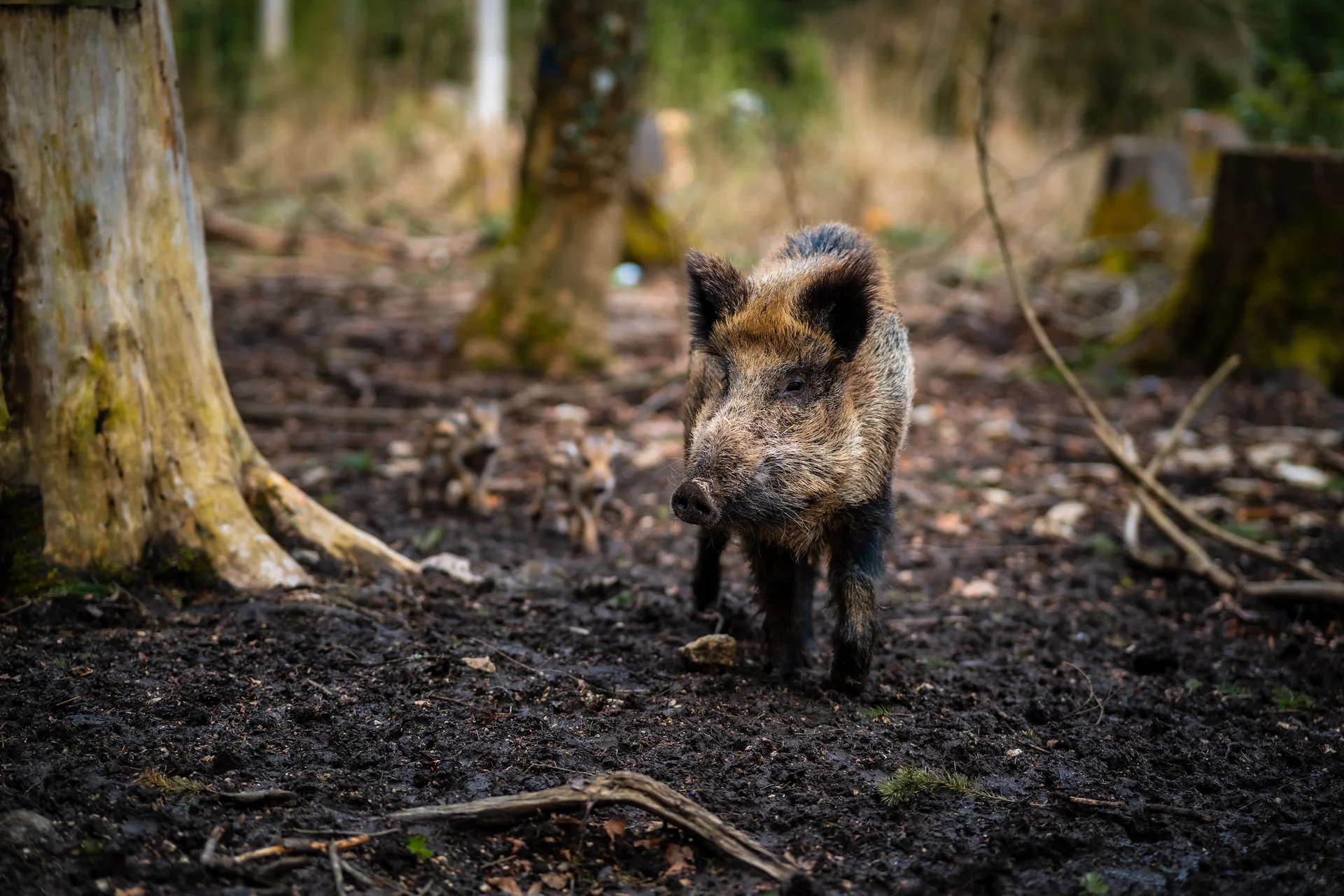
"This is Posta Dente di Zenghiaro (Boar's Tooth Guard), because the wild boar uses this method to strike. It makes great underhanded thrusts into the face without stepping through, and returns with a downward cut to the arms."
The wild boar charges with its head low. Its tusks (in the Italian, the denti, the teeth) sit near the ground, hidden until the last moment, and when the beast strikes, the tusks drive upward into whatever unfortunate thing stands in its path. A hunter who has been through a boar hunt will tell you this is the most dangerous motion in the animal kingdom: hidden, low, rising, terrible. Fiore took one look at this and thought that is a guard I want to teach.
The Lady's Guard delivers the great descending cut. The Iron Door waits like a great fortress. The Boar's Tooth does something else entirely. She is the low, quick, rising threat that punishes opponents who step into her range without understanding what she can do from there. At HEMA Penzance we call her by the name Steve and Andrew use: the Boar's Tooth, not the Boar's Tusk, because the Italian dente is simply "tooth," and a boar drives its teeth into you much the same as any other animal that bites.
How to Stand in Her
The Boar's Tooth is held on the left side of the body (for a right-handed swordsman), with the sword low at the hip, point forward and slightly up, aimed at the opponent's centre. Your right foot is forward, your left is back, and your weight is on the front foot. The sword sits close to the body, driven directly by the hips. Fiore tells you this is a stable guard: you can wait in her comfortably, she does not tire your shoulders, and she offers a very specific triangle of readiness.
"A line from the toes of the right foot to the point of the sword form the base of a long isosceles triangle, with the left foot forming the triangle's apex."
That geometry is not decorative. It tells you how your structure connects. The sword is braced through the hip into the back leg, and any force that arrives on the blade is received by the whole of the body rather than by the arms alone. This is what Fiore means by stable. You are not holding the sword against the force of the opponent. You are letting your skeleton do the work.
What She Does
Three actions live in the Boar's Tooth, and all three share the same line.
The Upward Thrust
The primary action. You drive your left hip forward, which drives the sword point upward along a diagonal line, straight into your opponent's face. You do not have to step. The technique works without a pass. "Makes great underhanded thrusts into the face without stepping through," Fiore says, and that phrase is worth lingering on. Most thrusts in longsword fencing commit you to a step, and a step commits you to a direction. The Boar's Tooth thrusts without stepping. You stay where you are, and suddenly the point is in their face.
This is what a boar does. It does not need to charge. It can drive upward from where it stands, and the tusks reach higher than anyone expected.
The Return Cut
"And returns with a downward cut to the arms."
After the thrust goes up, the sword comes down. The same diagonal line, reversed. A fendente that arrives on the opponent's exposed forearms before they can recover from the first action. This is the signature of the Boar's Tooth: the double motion, up and then down, along the same line. It is fast because the sword never leaves its working axis. It is surprising because most opponents are still thinking about the thrust when the cut arrives.
The Advanced Thrust
And the third variation, for when you do want to step:
"Sometimes it thrusts to the face and it goes with the point high, and in thrusting, steps forward with the front foot, immediately returning with a cut to the head or arms, then returns to this guard and immediately makes another thrust with an advance of the foot."
Thrust, step, cut, return, step again, thrust again. A cycling rhythm that walks the fencer forward relentlessly, each repetition carrying the Boar deeper into the opponent's measure. You can see how a swordsman who has committed to this pattern becomes very hard to back away from. Every step you retreat, they thrust. Every parry you make, the cut is already on your arm.
Defence Against the Narrow Play
Fiore gives us one more detail, and it matters:
"Also it defends against the narrow plays."
The Boar's Tooth works at zogho stretto, the narrow play, the range where swords bind and bodies close. Because the sword is already close to the body and the point is already oriented toward the opponent, the Boar's Tooth gives you a stable position to defend from when the fight has compressed. Many high guards lose effectiveness at narrow distance (the sword has too far to travel, the arc is too long). The Boar's Tooth does not. She was built for this range.
The Middle Boar's Tooth
Fiore gives us a second version, Posta Dente di Zenghiaro Mezana, the Middle Boar's Tooth. Same principle, but held closer to the centre of the body with the point more directly on the centre line. This variant shifts the logic slightly toward pure centre-line control. Where the standard Boar's Tooth is an angled, off-line threat, the Middle Boar's Tooth sits directly on the axis between you and the opponent, making it harder to step around.
Both share the same DNA: low, stable, built for the upward thrust, rewarded by the return cut.
The Counter: The Lady's Guard
One of the most beautiful pieces of Fiore's pollaxe section is the explicit pairing of the Boar's Tooth and the Lady's Guard. They counter each other directly. When the Boar drops low and loads the rising thrust, the Lady waits high and loads the descending cut, and the two moves meet in the middle with a different outcome depending on timing and distance.
"I am Posta di Donna (Lady's Guard) and I counter Posta Dente di Zenghiaro (Boar's Tooth Guard). If he is waiting for me, I want to make a powerful blow by passing the left foot forward off the line and entering with a downward cut to the head."
From the Lady's Guard, the answer to the Boar is to come down from above with everything you have, before the rising thrust can complete. Distance and momentum used to beat surprise and speed. Fiore writes this in his pollaxe section, but the logic carries straight back into the longsword. The two guards are a matched pair, studying them against each other teaches you a great deal about the vertical axis of the fight.
What She Teaches
Every beginner learns Posta di Donna early. The great descending cut is the most satisfying motion in longsword training, and the Lady's Guard is where it lives. The Boar's Tooth is often learned a little later, and she feels different: compressed, low, hiding. Many new practitioners are surprised by how much is possible from such a small-seeming position. The hips drive the sword. The upward thrust happens without a step. The return cut arrives before you have settled from the first motion.
Train her patiently and you start to understand a piece of Fiore's mind that the high guards do not teach you. Not every weapon has to be chambered far back. Not every threat has to announce itself. Sometimes the most dangerous thing on a field is the opponent who looks like they are doing nothing. The boar, waiting low, watching, tusks just above the grass. And then the tusks move, and the fight is already over.
Come and Learn
We practise Fiore's complete system every Tuesday evening at Penzance Leisure Centre, 7pm to 9pm. Your first lesson is free, all equipment is provided, and no experience is necessary. Come along and see for yourself.
Fiore's words in this article are from the Getty manuscript translations at Fight Like Fiore.