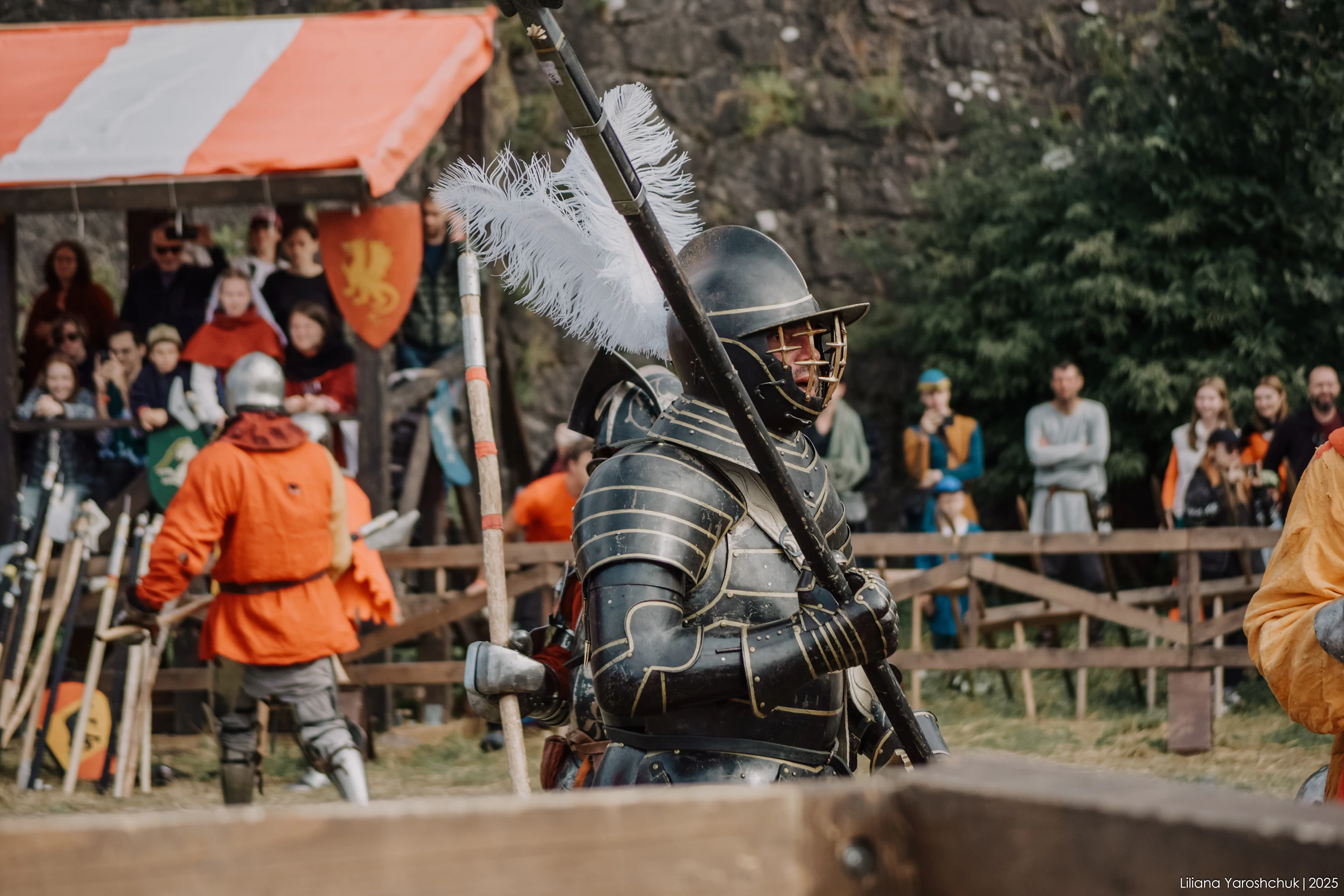
"We are three masters in guards with our spears, and they are based on those of the sword. And I am the first in Tutta Porta di Ferro (Full Iron Gate). I am placed to quickly beat the spear of the player, that is, I pass with the right foot and traverse off the line and in doing so, his spear will be beaten to the left."
The spear is the oldest weapon in Fior di Battaglia and the shortest section in the book. Fiore gives us a handful of guards, a clean sequence of plays, and the underlying truth of the weapon: reach decides everything. In a spear-on-spear encounter, the fighter who can cover and counter in a single tempo lives to meet the next opponent. The one who has to make two motions (defend, then attack) does not.
This is why the spear section feels so minimalist. Fiore does not need to give us a long catalogue. The spear solves its own problems, if you know where to stand and when to step.
Why the Spear Matters in Armizare
By the time you reach the spear pages of Fior di Battaglia, you have already absorbed the book's logic through grappling, the dagger, the sword in one hand, the longsword, and the pollaxe. Fiore saves the spear for near the end, after sword in armour and before horseback combat. Why?
Because the spear's principles are the same principles you have been learning all along. Read what Fiore says in the opening line of his spear section: the spear postas are based on those of the sword. The guards are not new. They are familiar positions, adapted to a weapon whose length changes the geometry but not the underlying mechanics.
The lanza, the spear, is simply a very long version of the sword, held in two hands. Step off line. Cover with a crossing. Counter with a thrust. All of that is familiar. What changes is the timing, because reach lengthens and shortens the tempi between actions.
The Three Guards of the Spear
Fiore shows three main guards on the right side of the body. All three mirror on the left.
Posta Tutta Porta di Ferro (Full Iron Gate)
The spear held vertically with the point up, shaft held near the body. A patient, waiting stance. The First Master says:
"I am placed to quickly beat the spear of the player. I pass with the right foot and traverse off the line and in doing so, his spear will be beaten to the left. If I pass and beat in a single step, I will wound. This is something I cannot fail to do."
A single step, a single sweep, a single wound. Something I cannot fail to do. This is spear combat reduced to its essentials. The length of the spear means the sweep covers the whole body in one motion, "something like a sliding door," closing the line to the attack and immediately rotating into a counter-thrust. There is no two-tempo defence. There is no parry followed by riposte. One motion handles both, because the spear's length allows it.
The same Iron Door logic you know from the longsword is here in the spear, with the lever-arm of reach doing more of the work.
Posta Mezza Porta di Ferro (Middle Iron Gate)
Slightly altered: the point is held offline to the right rather than on the centre. Fiore gives the Middle Iron Gate a proud little speech:
"Beating and wounding is always my custom. Come whoever wants. With a short spear or staff, the beat with a step will not fail to wound, and all guards which step off line with short spear and short sword are enough when facing any long hand held weapon."
And then, a technical note worth memorising:
"Those which cover from the right, cover with a pass and a thrust. And the guards on the left side cover, beat and injure with a strike but cannot thrust well."
Right-side spear guards thrust cleanly. Left-side spear guards sweep and strike but thrust less effectively. This is the same handedness asymmetry you find in the longsword's seven blows, applied to a longer weapon. Fiore's system is consistent across its instruments.
Posta di Fenestra (Window Guard)
The Window Guard held with the spear, rear weighted, the shaft angled with the head above and forward. Fiore calls her noble in his spear section:
"I am the noble Posta di Fenestra Destra (Window Guard on the right), and for beating and wounding I am always ready, and I care little against a long spear."
I care little against a long spear. Hear the confidence. Even when your opponent has the reach advantage, the Window Guard claims she can handle it. The reason is mechanical: the Window Guard is ideally suited to exchanging the thrust. As the opponent's point comes forward, you slide your front foot offline, pass through, and your own point arrives along a different angle into their face. The length of the opponent's spear works against them, because their commitment to the thrust cannot be recalled in time.
The Minimalist Counter
Fiore gives us one beautifully concise teaching that applies to all three right-side guards, delivered by a single scholar:
"The three guards that are drawn above, that is, the tutta porta di ferro, the mezza porta di ferro and posta di fenestra, should all finish in this play, which is their art. Like this I strike for them."
And then the teaching:
"Slide your front foot offline, and sweep your spear across your body as you step through. There is no need to push it off to the side. You are better off using the spear to control the centre line and stepping around it."
This is the minimalism of armizare at its purest. You do not need to beat the opponent's spear hard to the side. You simply need to step offline and let your own spear dominate the centre as you pass. The opponent's attack misses because you are no longer where they aimed. Your thrust arrives because you own the centre line between you and them.
One motion. One step. One thrust. The whole spear section is a meditation on this single truth.
The Counter to the Counter
Fiore is not content to leave you with a single play. He also gives us the counter, told from the perspective of the attacker who has been countered:
"When the masters believe my spear is pushed out of the way, I turn my spear back and strike with the butt, which has a good iron tip."
A reversal of the weapon. The master thinks they have beaten your spear aside and is stepping in for their counter-thrust. You add to the momentum they have given your point, drive the butt of your spear up through the centreline, and strike them in the face with the iron-shod butt before their thrust can complete. The spear has two ends. A good medieval spear had iron on both. This gives you a second weapon on the same shaft, and Fiore's counter-play weaponises exactly that.
The Boar's Tooth With a Spear
Fiore also gives us a left-side variation: Posta Dente di Zenghiaro, the Boar's Tooth, applied to the spear. The spear held low, point angled slightly up, ready to drive an upward thrust. The same logic you learned in the longsword section applies, with more reach. The boar hunts from low and the spear reaches first.
Across all of armizare, the guards reappear in different weapons because the body positions are universal. Whatever you have in your hands (sword, dagger, pollaxe, spear), the question of how to stand, how to extend, how to close the line is the same question. Fiore is teaching one art expressed through many instruments.
Reach and Tempo
The single most important thing to understand about the spear, as a HEMA practitioner holding one for the first time, is that reach collapses tempi. Actions that would take two steps with a longsword may take one step with a spear. The defensive sweep that would require a full parry with a sword requires only a brush of the shaft with a spear, because the lever arm is longer.
This is why Fiore's spear section is short. Less has to be said. The long weapon does more work. The fencer's job is to know where to stand, when to step, and which guard to finish in. The rest is reach.
Ancient battlefields favoured the spear for a reason. In a press of infantry, the weapon that reached first killed first. Fiore knew this well (he was, after all, a knight who served in real campaigns), and his spear section preserves exactly the right amount of material for a fighter who has already learned the rest of his system. If you can cover and counter with a longsword, you can do it with a spear. You just have to respect what the reach gives you and what it demands.
Come and Learn
We practise Fiore's complete system every Tuesday evening at Penzance Leisure Centre, 7pm to 9pm. Your first lesson is free, all equipment is provided, and no experience is necessary. Come along and see for yourself.
Fiore's words in this article are from the Getty manuscript translations at Fight Like Fiore.