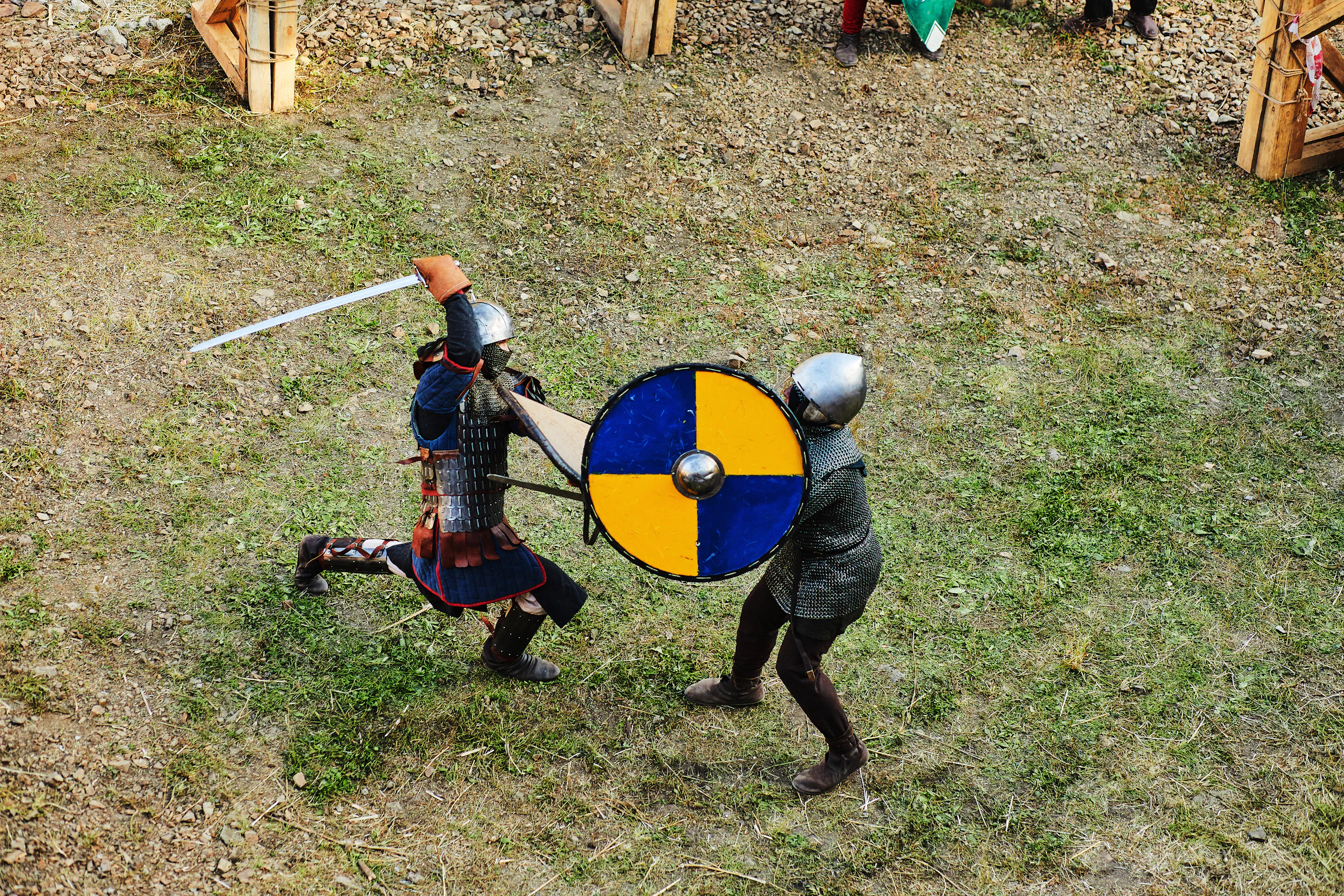
Of all the techniques Fiore dei Liberi teaches, one of them appears in almost every section of his manuscript. Longsword. Sword in armour. Pollaxe. Spear. Even horseback combat with a lance. The same shape, the same principle, the same elegant solution to the same terrifying problem. Fiore calls it scambiare di punta. The exchange of thrusts.
The problem it solves is simple and deadly. Your opponent commits a thrust directly at your face. Their point, at full extension, is one tempo from your eye. You have no time to parry, no time to step back, no time for anything clever. What do you do?
Fiore's answer is the exchange. You step off the line of their thrust (a small step with the front foot, while the back foot passes across), and in the same motion you extend your own point along the new line their body now occupies. Their sword goes past your head. Yours arrives in their face. The thrust they threw becomes the template for the thrust that ends them.
This is one of the most beautiful techniques in all of European martial arts, and it is worth understanding slowly.
Why the Thrust Needs Its Own Answer
Fiore reserves particular language for the thrust. When he introduces the seven blows of the sword, six of them (the two descending fendenti, the two rising sottani, the two horizontal mezzani) get reasonably matter-of-fact descriptions. But when he reaches the punta, he says:
"We are the thrusts, cruel and deadly. And our path is in the middle of the body between the groin and the forehead."
Cruel and deadly. No other blow in the seven is given emotionally-weighted language. Fiore is warning you. The thrust is the blow that penetrates. A cut wounds the surface of the body. A thrust finds the vital organs and the major arteries. In an era without antibiotics, a thrust wound was a probable death sentence even for the fighter who walked off the field.
This is why the thrust needs its own specific answer. You cannot simply cut back against a thrust; the geometry is wrong. You cannot reliably parry a thrust at full extension; the timing is terrible. You have to do something better, and Fiore's scambiare di punta is what that something looks like.
The Mechanic
At its core, the exchange of thrusts is three actions happening at the same moment.
Step One: Move off the line. Your front foot steps slightly off to one side, usually diagonally forward. Your back foot passes across, following the front. This passing step is the same passing step that underlies most of Fiore's footwork: the body travels as a single unit, weight transferring smoothly from back to front.
Step Two: Cover with the sword. As your feet move, your sword rotates from its starting guard (often Posta di Donna, sometimes Posta di Vera Croce in armour or with a pollaxe) into a forward-angled cover. Your crossguard moves into a position that intercepts your opponent's blade as it passes beside your body. The cover does not try to stop their thrust; it redirects it past you.
Step Three: Extend the point. Your own blade, now covering their line, extends forward along the new angle your feet have created. Their point goes past your head. Your point arrives at theirs.
All three actions happen in a single tempo. The step, the cover, and the thrust are one motion, not three separate moves. This is what makes the exchange so deadly: by the time your opponent realises their thrust has missed, your thrust has already arrived.
The Lesson of Posta di Donna
Fiore's clearest description of the exchange comes in the longsword section, standing in Posta di Donna destra. He writes:
"And to exchange the thrust, she is always ready. The foot which is in front steps off the line and that which is behind passes across. And the opponent will be unprotected and this will hurt him quickly and surely."
Read that carefully. Quickly and surely. Fiore is not promising you a probabilistic outcome. He is telling you that if the mechanics are right, the thrust lands. Because your footwork has taken your body off the line of their attack, and your blade has extended along the new line created by the passing step, the geometry of the encounter guarantees that your point arrives on target.
This is the kind of sentence only a master with hundreds of repetitions behind him writes. There is no qualification, no "if you are lucky," no "with practice this might work." Quickly and surely.
The Exchange Across Every Weapon
The technique becomes even more striking when you notice that Fiore describes the same exchange, under the same name, across multiple weapon sections of the manuscript.
In the longsword section, the exchange flows from Posta di Donna. In the sword in armour section, it flows from Posta de Vera Croce, the Guard of the True Cross, where the sword's crossguard is already formed into a defensive structure. In the pollaxe section, it appears again with the heavier weapon. In the spear on foot section, it is one of the foundational plays. And in the horseback combat section, the Second Master uses the same mechanic with a lance from Posta di Donna Sinistra, beating the opponent's couched lance offline while driving his own point home through the momentum of the charge.
When Fiore writes about a horseback play that "you should recognise this as an exchange of thrusts", he is reminding you that the art is one thing, not eight. His entire armizare system is built around a small number of deep principles that repeat across every weapon and every context. The exchange of thrusts is one of the core principles. Learn it with the longsword and you will find it everywhere.
The Counter: Breaking the Thrust
Because Fiore's system is complete, he also teaches you what to do against the exchange. The counter to scambiare di punta is called rompere di punta, the breaking of the thrust.
The breaking works like this. If your opponent has set up to exchange with you (passing step, cover, counter-thrust), and you see this happening, you do not complete your original thrust. Instead, you rotate your blade down and across, "breaking" the geometry of their exchange by striking their blade downward. Your point that was heading for their face now drives their sword toward the ground. From there you can immediately strike with a descending cut or close into narrow play and finish with grappling.
So the exchange is defeated by the break, and the break is defeated by an opponent who commits to the thrust with enough decisiveness that the break cannot form in time. This rock-paper-scissors of thrust, exchange, and break is the heart of Fiore's longsword logic at thrusting distance.
What the Exchange Teaches
Train the exchange of thrusts for a few months and you start to understand something deep about how Fiore thinks about combat. His system does not ask you to be stronger than your opponent, or faster than your opponent, or better reflexed. It asks you to be in a better position.
The exchange works because the step off the line and the cover and the counter-thrust are all aspects of a single better position. Your opponent's thrust is powerful, committed, dangerous. But it is aimed at the space where you were, not the space where you are. Your new position makes their attack miss and your counter hit, in the same instant. You have not out-muscled them or out-quicked them. You have out-positioned them.
This is the quiet genius of Fiore's art. Position is everything. A fencer who understands position wins against a fencer who does not, regardless of strength, regardless of reach, regardless even (within limits) of skill. The exchange of thrusts is the single technique that most cleanly demonstrates this truth.
It is also one of the most satisfying techniques to land in sparring, because when it works, it works beautifully. Your opponent commits. You move. Their blade is behind you. Yours is in front of them. Four hundred and fifty milliseconds of motion, entirely informed by six hundred years of recorded martial knowledge, and the exchange has done its work.
Quickly and surely, as Fiore said.
Come and Learn
We practise the exchange of thrusts, among every other key Fiore technique, every Tuesday evening at Penzance Leisure Centre, 7pm to 9pm. Your first lesson is free, all equipment is provided, and no experience is necessary. Come along and see for yourself.
Fiore's words in this article are from the Getty manuscript translations at Fight Like Fiore.