The zweihander is the sword everyone imagines when they think "huge". It is as tall as a person, it has a crossguard like a set of antlers, and in games it usually hits like a falling tree. So how heavy was it really?
Heavier than a longsword, yes. But nowhere near as heavy as the legend, and the reasons are interesting.
The Short Answer
A fighting zweihander from the sixteenth century usually weighed between 2 and 3.5 kilograms, roughly 4.5 to 7.5 pounds. Overall length ran from about 1.5 to 1.8 metres. The blade alone could be well over a metre.
A Scottish two-handed claymore, the big Highland sword of the same era, was typically around 2.5 kg and about 1.4 metres long.
For comparison, a medieval longsword weighs 1.3 to 1.8 kg and an arming sword about 1.1 kg. So the two-hander is roughly double a longsword. That is a real difference, but it is a long way from the 10 or 20 kilogram monsters of popular imagination.
Why Some Museum Examples Are Much Heavier
If you look up zweihander weights you will find a few examples at 4, 5, even 6 kilograms or more. Those are almost always parade swords. They were carried in processions by town guards or at ceremonies, made to look impressive, and never meant for a fight. Some have decorative flame-shaped blades and oversized fittings, and a lot of that extra steel is ornament.
The fighting swords are the ones that stayed near 3 kg. You can tell them apart by their balance and by blades that were clearly made to cut and thrust rather than to catch the light.
What a Two-Hander Was For
The zweihander belongs to the sixteenth century and the German Landsknechte, the mercenary foot soldiers. Men who carried it were paid double, which is where the name Doppelsöldner comes from. Their job was dangerous: working at the front of the pike formations, beating aside pikes and halberds, and fighting in the gaps.
Because of that job, the sword had features a longsword does not. There is usually a long unsharpened section above the guard called the ricasso, often wrapped in leather, so the fighter could grip the blade with one hand and shorten the weapon for close work. Just above the ricasso there are often small side lugs, the parrying hooks, which stopped an opponent's blade from sliding down onto the hands.
All of that is steel, and it adds weight. It also moves the balance forward. A zweihander feels heavier than its number because more of its mass is out along the blade.
Can You Fight With One?
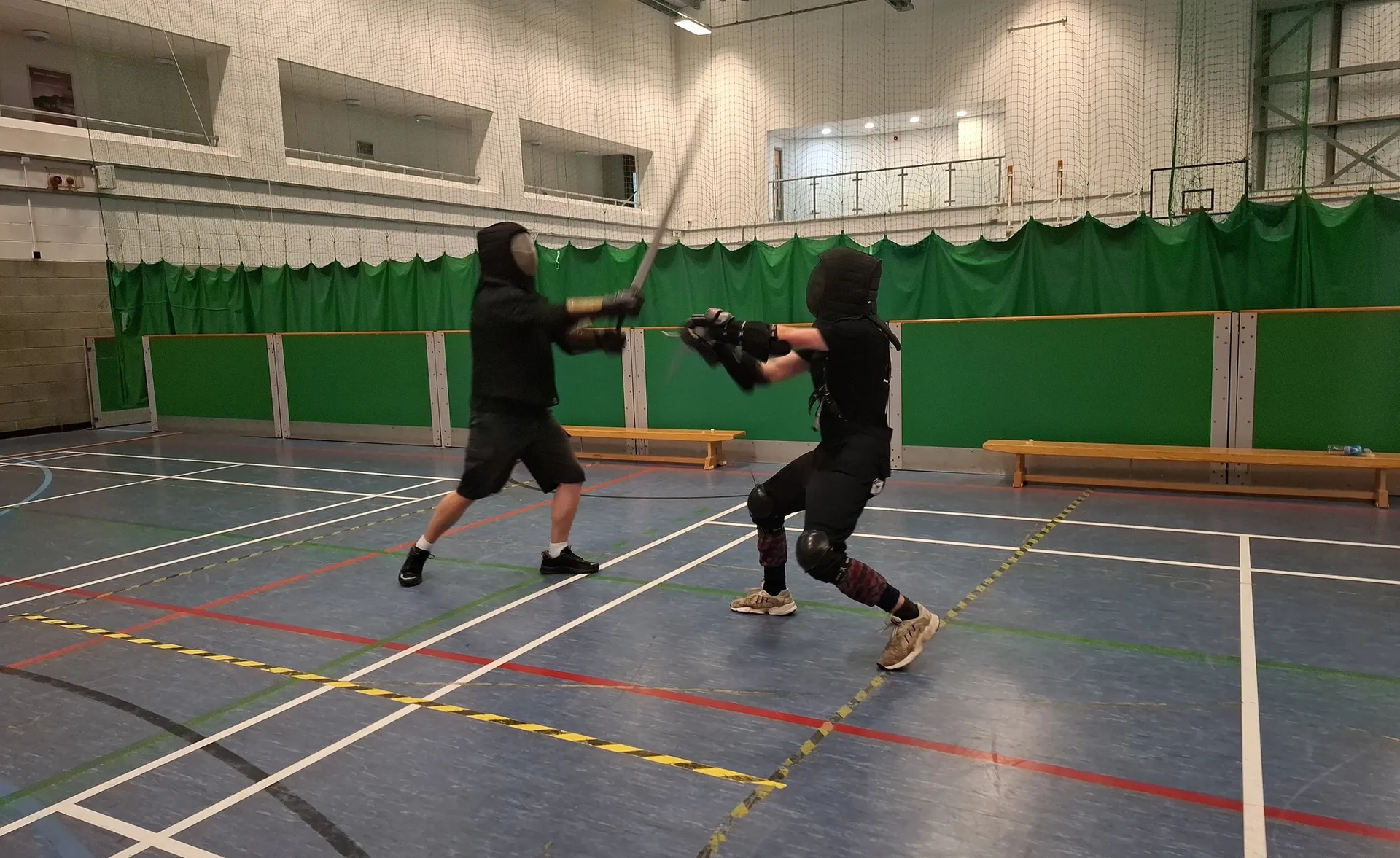
Yes, and people do. There are surviving German treatises on the two-handed sword, and HEMA groups around the world train it. It moves with the whole body, with big turning cuts and a lot of footwork, and it rewards timing over muscle just as a longsword does. A strong person who swings it with the arms alone gets tired in a couple of minutes. Someone who moves it with the hips and the feet can keep going for a long time.
Where It Sits Beside Fiore
Our master, Fiore dei Liberi, wrote in 1409, a century before the zweihander took its classic form. His two-handed sword is the longsword, the spada a due mani, and at HEMA Penzance that is the weapon we train every week. If you want to see how a sword of a kilogram and a half moves in the hands of people who know it, the twelve guards of Fiore's longsword are a good place to start.
And if you want to hold one, come along on a Tuesday. The first lesson is free, and the club lends the kit.