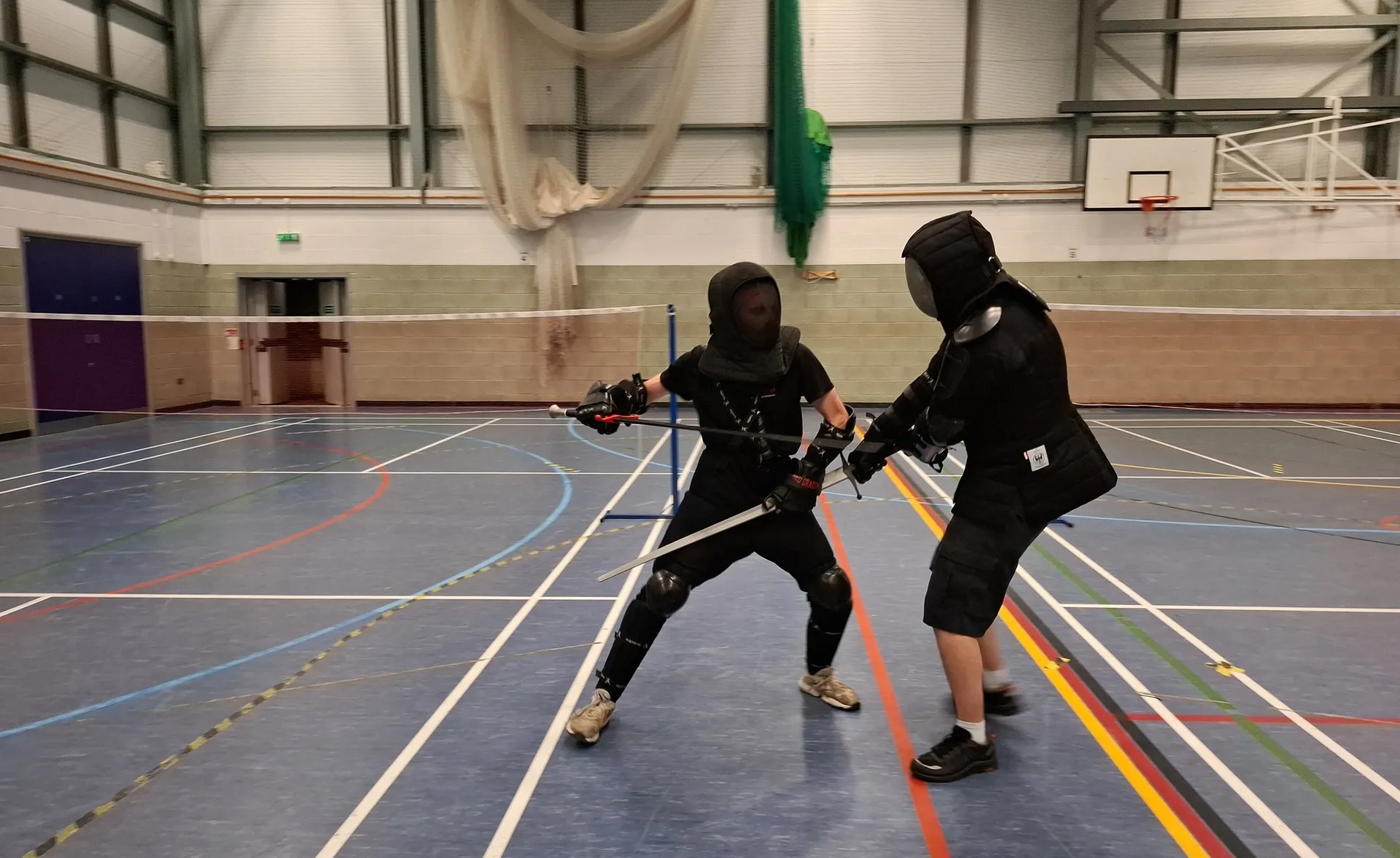
At HEMA Penzance the longsword is the heart of what we do, and Fiore dei Liberi's art stays at the centre of every session. Since September 2026 we have also been training Polish sabre. People who come from one to the other often say the same thing: it is still fencing, and almost everything feels different.
Here is what changes.
One Hand Instead of Two
The obvious difference is the grip. A longsword has a long handle for two hands, and the space between the hands is a lever. The top hand guides, the bottom hand pulls, and the tip moves fast because the hands work against each other.
A sabre is held in one hand. There is no lever between two hands, so the speed has to come from somewhere else: the wrist and the fingers. Sabre grip is loose until the moment of contact, with the thumb and forefinger doing most of the steering and the other fingers helping to drive the blade.
The free hand matters too. In a longsword fight it is on the sword. In sabre it is behind you, and it helps your balance, especially on the lunge.
The Cut
A longsword has weight and leverage, so it can cut with the whole body behind it and still be quick. A sabre is lighter and curved. It cuts best when it is moving fast and slicing, which means the cut comes from the wrist, uses the last part of the blade near the tip, and is shallow. We have written more about why in sabre weight and in the myth of Polish cross-cutting.
The result is that sabre cuts are small and quick, and they finish in a position that covers you. A longsword cut can be broader, because the sword is heavy enough to hold its line through a bind.
Distance and Footwork
With a sabre you are usually fencing from further away than with a longsword, and you close that distance with a lunge: the foot goes forward, the arm is already extended, and the hit lands before the foot does. We cover it in how to lunge with a sabre. When the lunge is not enough, there is the fleche, a running attack.
Longsword footwork in Fiore's art uses passing steps, stepping through with the back foot, as well as smaller steps. It is often closer, and it runs naturally into grappling and close play, which Fiore teaches in great depth.
Defence
In Fiore's longsword, the guards are positions of the whole sword, and you move from one to another. In sabre the defence is closer to the body. The classic right-side guard covers your whole sword side just by sitting there, and the parries are small movements of the hand and wrist, with the arm bent rather than thrust out.
One thing is the same in both. Andy, one of our instructors, put it in Fiore's words when we started sabre: your sword is your shield, and when you attack you move from guard to guard so that you are covered as you go. That idea is at the heart of both weapons.
Which Should You Learn?
Both, if you can. They teach each other. The longsword teaches you structure, leverage and the bind. The sabre teaches you speed, distance and economy. At our club Fiore's longsword comes first and sabre sits beside it, taught with our clubmate Jake's help, and we are all learning it together.
The club lends longswords, sabres and all the protective kit. Come along on a Tuesday and try both. Your first lesson is free.