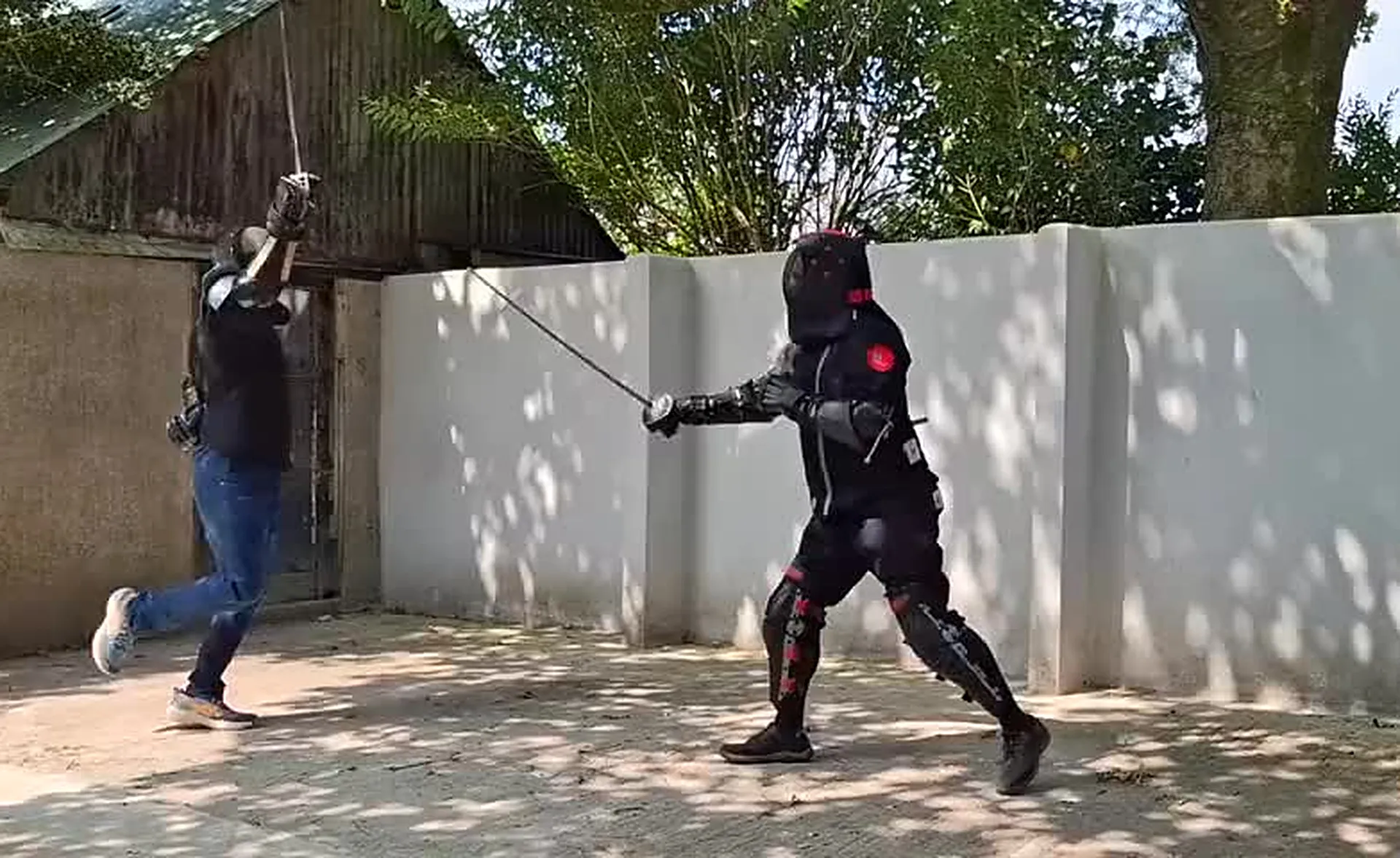
The lunge is the attack that gives a sabre its reach. Done well, it closes a gap you would never cross with a step, and your opponent finds the blade already on them before they have decided what to do. Done badly, it leaves you stretched out, off balance and easy to hit.
Here is how it works in Polish sabre, as reconstructed by Akademia Szermierzy, and as we are learning it at HEMA Penzance.
The Order of Things
The sabre lunge has a clear order.
The arm begins it. The sword arm starts moving towards the target just before anything else, smoothly rather than with a jerk. The blade is already extended along your line as you go, so the lunge covers you while it travels.
The front foot goes forward. It is a long, low step, the heel landing first.
The hit lands before the foot does. This is the part people find strange. The cut or thrust arrives while the front foot is still in the air. By the time the foot lands, the attack is already finished.
The back foot follows. It slides along the floor behind you rather than staying planted, which carries you further and keeps you balanced. The whole thing feels closer to a jump than a step.
The Body
Chest proud, hips forward. It is tempting to lean over and stick your backside out to reach further. That gives you a little reach and a lot of instability. Keeping the hips forward and the chest up gives you more reach and a stable landing.
The free arm goes back. Your other arm swings behind you as you lunge. It looks like a flourish from the sport-fencing world, and it is the opposite of decoration: it is a counterweight. It balances the extended sword arm and lets you land the lunge without toppling forward.
The diagonal. Your sword arm and your front leg are on the same side, but the power comes across the body, from the back leg through the torso to the arm. Moving on that diagonal uses the whole trunk, which is where the reach comes from.
After the Lunge
Hold the landing for a moment so you are stable, and then recover. You can come back out to your guard by pushing from the front foot, or, if your opponent retreats, follow up. Whatever you do, keep the sword in front of you and your line covered. The moment after an attack is when you are most likely to be hit.
Common Mistakes
Stepping first and hitting after. If the foot lands and then the blade moves, your opponent sees you coming.
Lunging from too far. A lunge has a range. Beyond it you land short and exposed. Distance comes first, and it is worth drilling one distance until it becomes automatic.
Winding up. Any big preparation before the lunge, a pulled-back arm or a lean, tells your opponent what is coming. The best lunges start from stillness.
Where It Comes From
The lunge and its running cousin, the fleche, came from the sabre traditions. Sport fencing inherited them. So if a Polish sabre lunge reminds you a little of the Olympics, that is because the Olympics borrowed it, and not the other way round. You can read more about the art in a short history of the szabla and on our Polish sabre page.
At HEMA Penzance Polish sabre is taught with our clubmate Jake's help, and the club is learning it together. We start with footwork, then guards, then the cut, and the lunge comes early. The club lends sabres and all the kit. Come along on a Tuesday. Your first lesson is free.