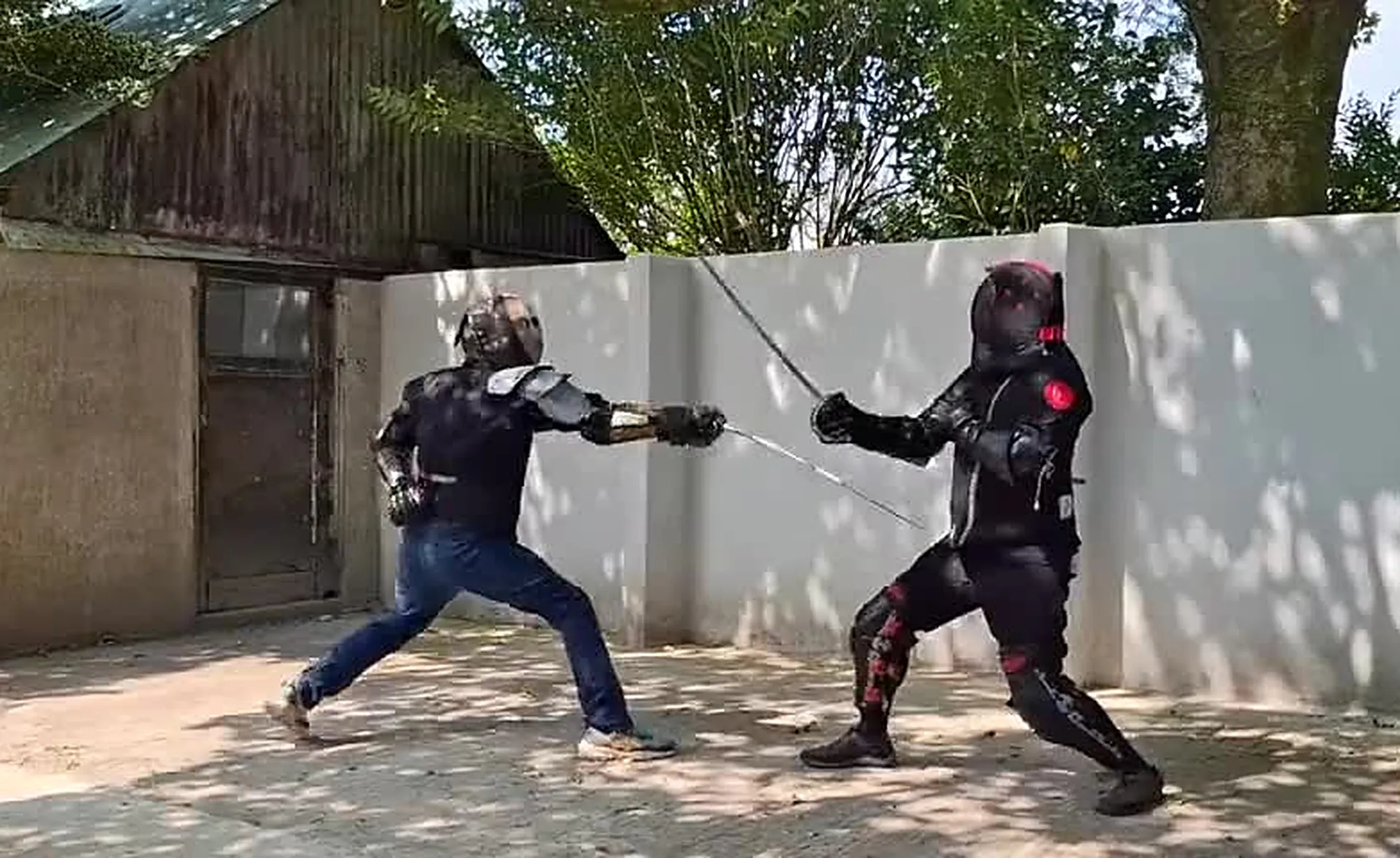
Ask anyone who has read a little about Polish sabre what made it special, and there is a good chance they will describe the cross-cut. The story goes that Polish swordsmen whirled their sabres in continuous figure-of-eight patterns in front of them, a spinning wall of steel that nobody could get through.
It is a great image. It is also not how the art was fenced.
Where the Idea Probably Comes From
Almost every fencing tradition has a diagram of the cuts. Fiore dei Liberi has his segno, with the lines of the seven blows drawn across the figure. The German masters have their own versions. These diagrams are maps: they show the directions a cut can travel, from high to low, from left to right, diagonal and straight.
The most likely story is that a Polish diagram of this kind was seen by later writers outside Poland and read as a routine. Instead of "here are the lines a cut may follow", it was taken as "here is the sequence of swings", back and forth, crossing and recrossing. Put that together with the circular wrist movements a sabre fencer really does use to bring the blade around, and you have the cross-cutting legend.
Why It Would Not Work
Imagine actually fencing like that. A blade spinning continuously in front of you is always moving, but it is only ever in one place at a time, and your opponent can see exactly where it is going next. A good fencer would simply wait for the moment the blade was on the wrong side and hit your hand or your head. Worse, a big sweeping cut from the shoulder is slow, and while you are winding it up you are the easiest target in the room.
The reconstructed art does the opposite.
What the Reconstructed Art Does
Polish sabre, as reconstructed by Akademia Szermierzy from the surviving sources, is economical. The cut is made from the wrist, with the fastest part of the blade, the last inches near the tip. It is shallow: an inch across the forearm is enough with a sharp sabre. It arrives quickly and it finishes in a position that covers the fencer, so the answer coming back finds steel in its way.
The big cut from the shoulder, the one people imagine, is not in the sources either. What is there is smaller, faster, and much more dangerous.
The Circle That Is Real
There is one grain of truth in the legend. Sabre fencers do use circular movements of the blade, turning it around the wrist to change the line of attack or to come around an opponent's parry. It looks like a flourish if you have never seen it. It is actually the quickest way to move a curved blade from one line to another without exposing the arm.
So the circles are real. The endless figure of eight is not.
Learn the Real Cut
At HEMA Penzance we train Polish sabre as reconstructed by Akademia Szermierzy, taught with our clubmate Jake's help, and the club is learning it together. We start with footwork, then the guards, then the cut. You can read more about it on our Polish sabre page, or read a short history of the szabla.
The club lends sabres and all the protective kit, so come along on a Tuesday. Your first lesson is free.