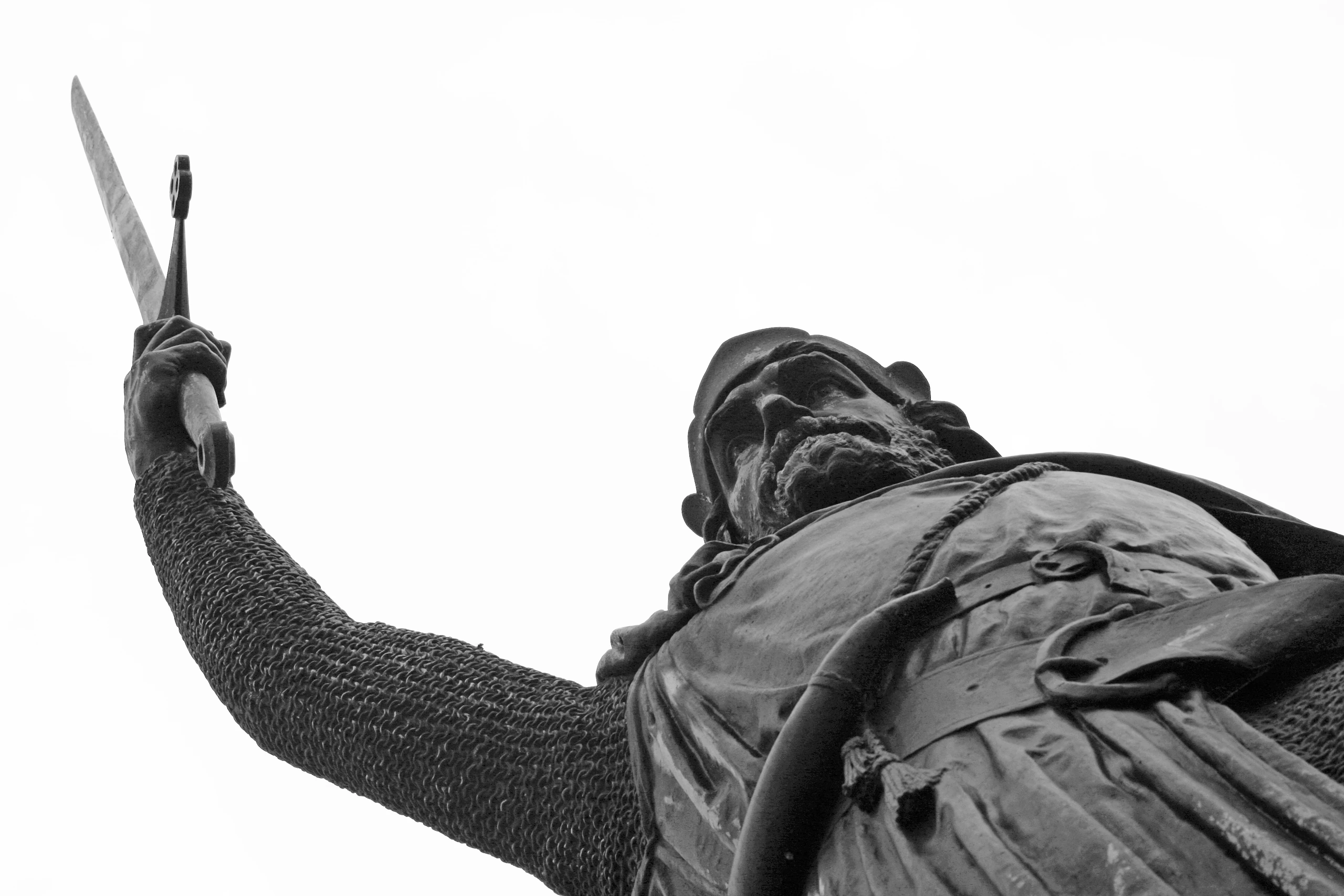
Raise a longsword overhead, hands at roughly forehead height, the blade pointing straight up toward the ceiling, the crossguard held horizontal just above your eyes. Your arms form a triangle with the sword at its apex. If someone walked past you like this, they might think you were offering the blade up to the sky.
This is Posta Frontale. Most modern Fiore practitioners call her by her other common name, Posta di Corona, the Crown Guard, because of her shape: a sword held up like a crown on the head of the swordsman. She is the quiet king of defensive positions in Fiore's longsword, and she is worth understanding carefully.
The Shape of the Crown
Stand with your feet in a comfortable stance, weight slightly on the back foot. Raise the sword overhead with both hands, arms extended upward but not locked, so that the hilt is roughly at the top of your forehead and the blade rises straight up from there. The crossguard sits horizontal just above your eyes.
From the front, you are looking at your opponent past the shape of your own crossguard. The blade rises directly above your head. Your body is relatively open below the sword but completely protected above.
The guard feels odd at first. Most other positions in Fiore's system hold the sword either in front of you (like Posta Longa), behind you (like Coda Lunga), high on the shoulder (like Posta di Donna), or low on the hip (like Porta di Ferro). Frontale is the only one that puts the sword above you, and that geometric oddity is part of her gift.
What the Crown Is For
Posta Frontale does one thing extraordinarily well: she defends against incoming descending cuts.
When your opponent swings a fendente down at your head, their blade travels along a diagonal line from their shoulder down to your upper body. In most guards, your response to that cut is to meet it with your own blade, parrying and countering in a single tempo. This works, but it requires precise timing: meet the blade too early and you get pushed aside, too late and the cut lands.
Frontale solves the timing problem by being already in the path of the cut. Your sword is already overhead. Your crossguard is already horizontal above your eyes. The opponent's descending blade, travelling its natural arc, has to pass through the shape your sword is making before it can reach you. When it does, your crossguard catches it, your blade guides it aside (down your own blade and off to one side), and you are left with a free line to thrust or cut in response.
This is one of the most reliable defences in Fiore's repertoire. The Crown makes descending cuts almost impossible to land on your head, and that certainty alters the whole shape of an exchange.
The Defence That Becomes an Attack
The beauty of Frontale is that once she has received the cut, the follow-up is short and deadly.
With your sword overhead and the opponent's blade sliding down your crossguard to one side, your body is already in the geometry it needs for a counter. A small rotation of the wrists turns your upward-pointing blade into a descending thrust that drops into the opponent's face before they have finished their own follow-through. Alternately, you can drop the hilt forward while stepping off line and deliver a descending cut from the inside of their guard, now that your blade has been freed by the deflection.
Either way, the defence flows into the attack in a single tempo. The opponent committed to a cut. Your Crown received it. Your sword is now in a position to finish them.
Why She Is "Instabile"
Fiore classifies his guards into three categories: stabile (stable, hold-as-long-as-you-like), pulsativa (beating, loaded for striking), and instabile (unstable, cannot hold for long).
Posta Frontale is instabile. Her hands are raised overhead, her arms are working against gravity, and within thirty seconds or so your shoulders start to burn. You cannot stand in Frontale indefinitely. She is a guard you arrive at (usually in response to an incoming cut) or a guard you hold for the key tempo of an exchange, not a guard you wait in patiently.
This matters tactically. Frontale is a response, not a resting state. You pass through her at the moment her geometry serves you, and you leave her as soon as the exchange resolves. Standing in Frontale for two minutes as your opponent circles is a losing strategy. Standing in Frontale for two seconds as your opponent's cut is committing is a winning one.
Where She Comes From
Frontale is not a starting posture for most exchanges. She usually emerges from one of the high guards, most often Posta di Finestra or the transition from Posta di Donna. As your opponent commits to a descending blow, you rotate your blade upward and forward into Frontale's shape, meeting their cut at the highest point of its arc.
Alternatively, Frontale can emerge directly from a rising cut. As your sottano finishes its path, if the opponent is still threatening from above, you can keep the sword's momentum carrying it up into the Crown position, covering the next exchange before they can commit a new blow.
Training this transition is where Frontale really comes to life. Most beginners find her by being shown a static version first and then learning to flow into her from other guards as their vocabulary grows.
The Modern Controversy
There is a small scholarly debate about whether "Posta Frontale" and "Posta di Corona" are exactly the same guard, or whether Fiore distinguishes between them in subtle ways across the manuscript. Different interpreters read the plates slightly differently.
For a practising student, this debate does not matter much. The guard with the sword held overhead, point up, crossguard horizontal, is the guard this post is about, whatever name your particular school uses. At HEMA Penzance we tend to call her the Crown because the image is immediate, but you will see "Posta Frontale" in older English HEMA literature and "Posta di Corona" in more modern references. Same guard. Same work.
What She Teaches
Train Frontale for a while and you start to understand a principle that runs through much of Fiore's higher-level work. Being in the right place before your opponent commits is worth more than reacting quickly after they have.
The Crown works because she is already there. She does not parry by racing to meet an incoming cut; she parries by being pre-positioned so that the cut meets her. This is the same logic that underlies the exchange of thrusts (you are already offline, your point is already aimed, your opponent thrusts into geometry you have already prepared) and many of the advanced sword-in-armour plays.
Once this principle starts to settle in your body, your whole game changes. You stop trying to be fast. You start trying to be in position. And when you are in position, the speed of your opponent stops mattering.
A Quiet Favourite
Frontale is not the most dramatic guard in the system. She does not load a devastating cut like Posta di Donna. She does not deceive like Coda Lunga. She does not declare herself like the Iron Door.
But she is the guard that reliably solves the most common and frightening problem in longsword fencing: an opponent throwing a fast descending cut at your head. For that reason, she is one of the guards most experienced Fiore practitioners come to love over time. The Crown is not flashy. She is just reliable, and reliability at the sword is its own kind of elegance.
Come and Learn
We practise Fiore's complete system every Tuesday evening at Penzance Leisure Centre, 7pm to 9pm. Your first lesson is free, all equipment is provided, and no experience is necessary. Come along and see for yourself.
Fiore's words in this article are from the Getty manuscript translations at Fight Like Fiore.