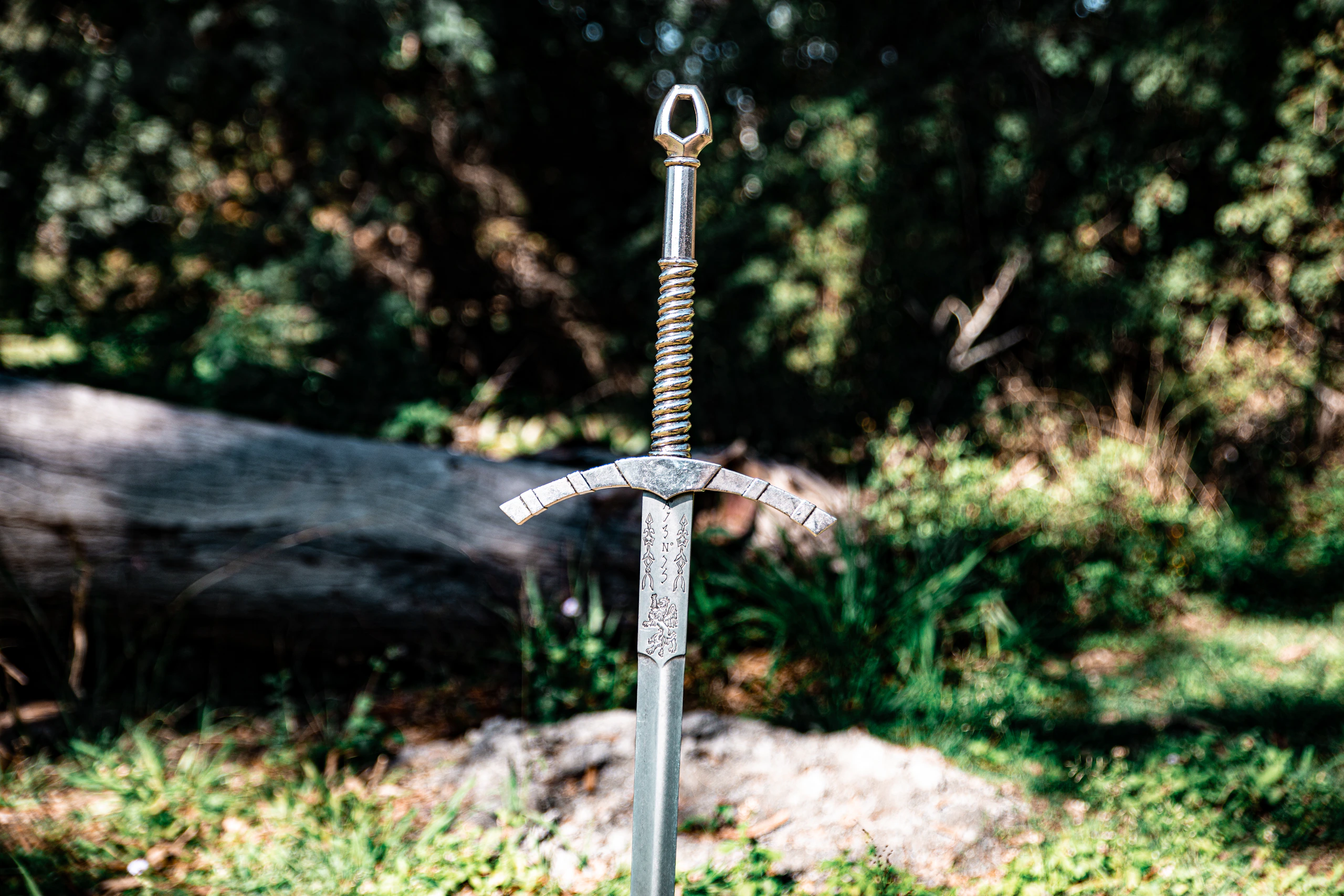
Of Fiore's twelve guards, one has a shape that surprises most beginners when they first see it. The sword is not held in front of the body. It is not chambered over the shoulder. It is hidden behind the body entirely, the point trailing backwards and low, as if the swordsman had forgotten the weapon was there.
This is Posta Coda Lunga. The Long Tail Guard. And far from being an oversight or a lazy position, she is one of the most deceptive and powerful guards in the entire system.
The Shape of the Long Tail
Stand with your right foot back and your left foot forward. Hold the sword in both hands, and let it trail behind your body along your right side, the point reaching back and low, parallel to the ground or angling slightly toward the floor. Your left forearm rests across your body, close to your hip, as a kind of anchor. Your right arm extends the sword behind you.
From the front, your opponent sees a body in a relaxed-looking stance with no sword visible. The blade is there, of course, but they cannot see it, cannot read its angle, cannot predict which direction it will travel when it moves.
That invisibility is the whole point.
Why Hiding the Sword Helps
Every other guard in Fiore's system shows the opponent something. Posta di Donna shows the chambered load over your shoulder. Porta di Ferro shows a settled low sword. Posta Longa shows an extended point in the opponent's face. Coda Lunga shows nothing. The sword is simply absent from the front of your body.
This creates three problems for your opponent.
They cannot predict your angle of attack. Because they cannot see the sword's starting position, they cannot easily reason about whether you will cut from high or low, diagonal or horizontal, straight or curving. They have to wait until the blade actually starts moving, and by then you have already committed to a line they have to read in motion.
They cannot predict your timing. With a high chambered guard, the opponent can see the coil in your shoulder and sense the moment it starts to release. With a trailing guard, there is no coil visible. The first time they see the blade is the first time it is close to arrival.
They often over-commit. A swordsman facing an unclear threat tends to act conservatively, probing gently. A swordsman facing an apparently absent threat tends to act boldly, because the opponent looks unprepared. This boldness is what Posta Coda Lunga invites them into. The guard looks like an opening. It is not. The sword behind your body is further back than theirs, which means it travels a longer arc, which means it arrives with more momentum and, if the footwork is right, from a direction they did not expect.
The Long Path, the Heavy Blow
Fiore's descriptions of Coda Lunga emphasise the same quality that makes Posta di Donna powerful: the sword travels a long distance from start to target, and along that distance it gathers momentum.
When you release a blow from Coda Lunga, the sword comes forward along a wide diagonal, pivoting around your hips as you step through. The combined rotation of shoulders, hips, and stepping foot gives the cut serious authority. A fendente from Coda Lunga is comparable in power to a fendente from Posta di Donna. The routes are different (one chambered high and back, one trailing low and behind) but the payoff in momentum is similar.
The difference is in the angle. Donna's fendente arrives on a steep descending diagonal from above. Coda Lunga's cut arrives more horizontally, as the trailing sword whips around the body into the opponent's flank or arms. Neither is better than the other; they are two routes to similar power, and having both available gives you options your opponent has to account for.
The Transition Into Narrow Play
Fiore specifically notes that Coda Lunga is excellent for transitioning into zogho stretto, the narrow play. Here is why.
Because the sword begins behind your body, a step forward with your back foot (passing through) carries you deep into measure before the sword has to commit. As your body arrives, the sword can then come around from the trailing position directly into a cover, a bind, or a close-quarter cut. Your opponent, dealing with your sudden arrival in their measure, does not have the room to use a long weapon effectively against a weapon that is already closing.
Posta Coda Lunga is the guard that most naturally feeds the "sudden aggressive entry" play style in Fiore's longsword. If you like pressing into close range and resolving fights with grappling or short cuts, this is your starting position.
The Pollaxe Echo
Fiore's pollaxe section includes a Coda Lunga guard as well, with the same trailing-back position applied to the heavier weapon. Here Fiore is more explicit about what the guard does: "with my downward blows I will beat both pollaxe and sword to the ground, and powerfully close to the narrow play."
So the trailing guard is not just a longsword idiosyncrasy. It is a universal Fiore technique, adapted across weapons. When you recognise Coda Lunga's trailing shape with the pollaxe, you see more clearly what the longsword version is doing: the weapon behind the body loads a sweeping arc that beats the opponent's blade downward and simultaneously closes the distance.
The Two Tails
Like Posta di Donna and Posta di Finestra, Posta Coda Lunga has a right and a left version. The primary form trails the sword behind the right side of the body. The mirror trails it behind the left. Left-side Coda Lunga is less common in Fiore's plates but still appears, and some practitioners find it especially natural for certain counters.
The left version works beautifully against opponents who habitually cut from their own right side (your left). The trailing sword on your left can sweep up along a rising diagonal that intercepts their descending cut while your body steps offline. It is one of the less-trained configurations in modern Fiore but worth exploring once you have the right-side version secure.
The Philosophical Point
Coda Lunga teaches a lesson that modern sparring often needs to rediscover. Your opponent's lack of information is a weapon you wield.
Everything about a guard, in Fiore's system, communicates something to your opponent. A patient guard communicates patience; a chambered guard communicates a loaded threat; an extended guard communicates a probe. A trailing guard communicates nothing, and nothing is occasionally the most dangerous thing you can communicate.
The swordsman who stands in Coda Lunga is choosing to give the opponent no data. "Come and find out," the guard says. "Guess what I'm going to do. Take your chances with the guess."
And then, whichever way they guess, the sword emerges from behind the body on a line they did not predict, with more momentum than they expected, closing to a measure they did not choose.
What She Teaches
Train Coda Lunga seriously for a while, and you start to understand the value of invisibility in swordplay. Modern sparring culture rewards big readable motions; tournament scoring systems encourage clear, committed cuts that the judges can see easily. Coda Lunga resists all of that. She is hard to see on purpose. She asks you to be comfortable with your own sword being somewhere your opponent cannot track.
The comfort is the hard part. Most beginners feel exposed holding a sword behind their body. The weight of the blade is pulling on your arm, the opponent can see that you are not visibly defended, and every instinct says bring the sword to the front.
Resisting that instinct is the practice. The sword behind the body is not exposed. It is loaded. The opponent's gaze, searching for a visible threat and finding none, is the opening you are waiting to exploit.
Stand in her for long enough, and you begin to prefer fights where your opponent cannot quite read you. The Long Tail rewards that taste.
Come and Learn
We practise Fiore's complete system every Tuesday evening at Penzance Leisure Centre, 7pm to 9pm. Your first lesson is free, all equipment is provided, and no experience is necessary. Come along and see for yourself.
Fiore's words in this article are from the Getty manuscript translations at Fight Like Fiore.