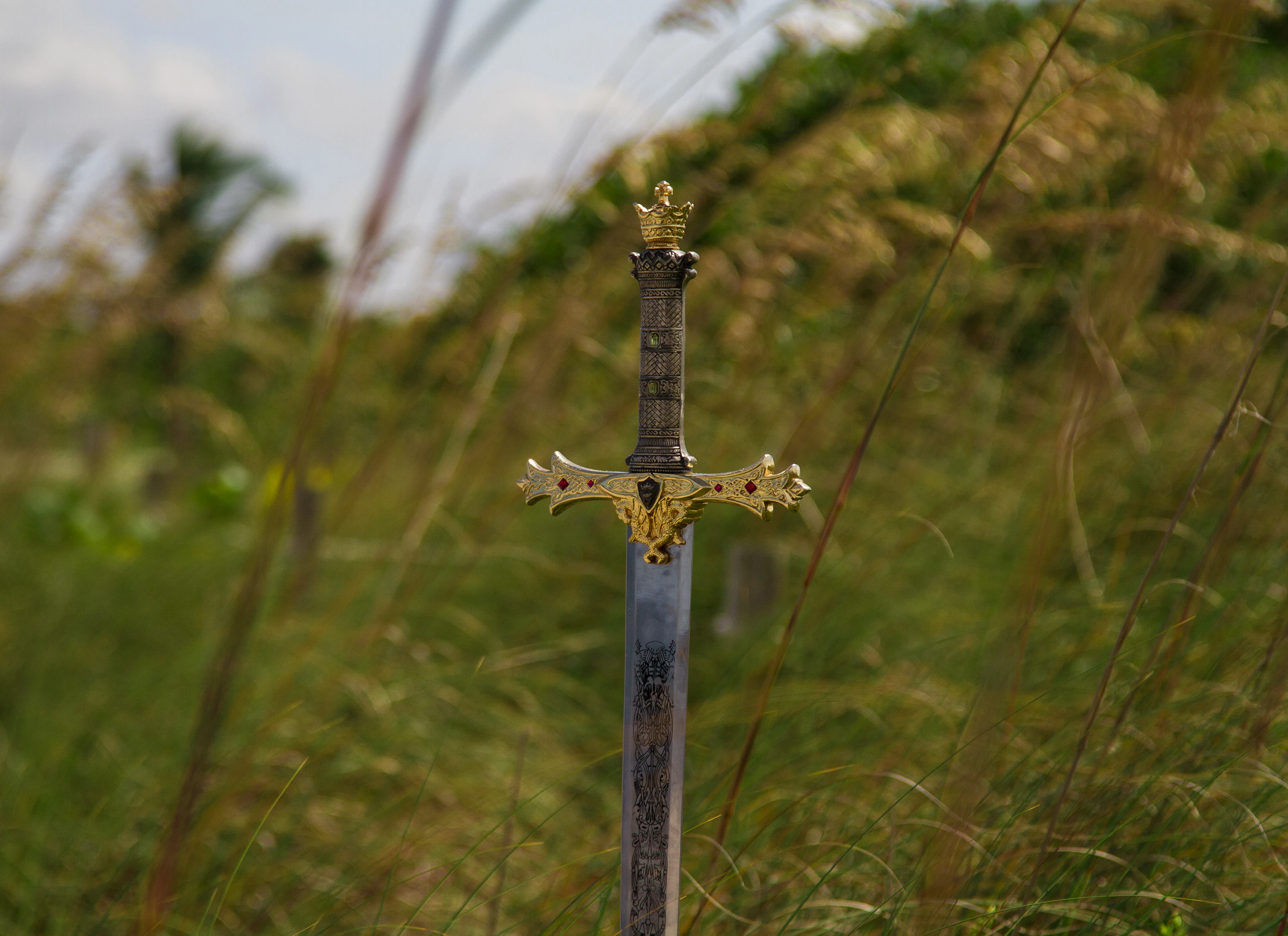
"Full of deception. She is feeling the guards of the opponents to deceive them. If she can wound with a thrust, she will do it well."
Stand in Posta Longa, the Long Guard, and you are the opposite of every other dramatic guard Fiore gives us. Your sword is not chambered behind your shoulder like Posta di Donna. It is not settled low and patient like the Iron Door. It is not loaded into any kind of spring. It is simply out there, arms extended, the point aimed steadily at your opponent's face.
She looks like nothing. Her shoulders are not coiled. Her hips are not wound. She does not appear to threaten you with anything dramatic. And yet, of all twelve of Fiore's guards, Fiore calls her the one full of deception.
Spend some time in her, and you understand why. Posta Longa is the guard that makes the fight about the point, and a fight about the point is a fight your opponent rarely knows how to win.
The Shape of Her
The basic posture is almost comical in its simplicity. You stand in a balanced stance, your weight roughly centred. Your arms extend forward, both hands on the grip, the sword pointed horizontally or slightly downward at your opponent's face. The blade is straight. Your body is relaxed. Your eyes are on the point of your own sword, aligned with the opponent beyond it.
There is no drama here. No chambered load, no dramatic shoulder turn, no coiled spring. Just a straight line from your shoulders to the point of your sword, and from there to your opponent. If a stranger walked into the room, they would assume you were demonstrating how to hold a sword, not how to fight with one.
That blandness is the whole trick.
What "Deception" Means in the Long Guard
When Fiore says a guard is full of deception (piena de inganno in his Italian), he does not mean trickery in the sense of hiding something. He means something more specific. Posta Longa is feeling the opponent, as he tells us himself. The extended point tests their intentions. The apparently unthreatening shape of the guard invites them to commit to an attack that looks safer than it is.
The deception is this: the opponent, looking at Posta Longa, sees a sword they could beat aside. It is right there, extended, unguarded. They start to think about cutting the blade out of the way, or angling their own point around it, or stepping off the line and attacking from an angle your extended arms cannot easily cover. Each of those thoughts is the gift Posta Longa is waiting to receive.
Because the instant the opponent commits to one of those answers, your point moves. Not a long chambered cut. Not a dramatic swing. A single short thrust, often just an extension of the arms with a small step, and your sword is already most of the way home. Posta Longa is already at full extension. She does not need to travel far to score. She needs her opponent to commit to the attack she has invited, and then she completes the geometry they have set up.
This is the "deception" Fiore is warning you about. The Long Guard does not look dangerous. That is why she is dangerous.
The Probe
Read Fiore's line again: "She is feeling the guards of the opponents to deceive them."
That word feeling is doing a lot of work. Posta Longa is not a passive guard. She is actively probing. Her point, extended into the space between you and your opponent, is testing how they respond. Do they flinch and step back? Do they try to beat her aside? Do they step forward to close the measure? Each response gives you information, and each response opens a different counter.
Good Fiore practitioners at HEMA Penzance use Posta Longa as a kind of sensor. The sword is doing research on the opponent's nervous system. A fencer who steps back from the extended point is a fencer who can be pressed. A fencer who cuts at the point is a fencer who is committed and can be counter-cut. A fencer who steps forward to ignore the point is a fencer who can be thrust before they arrive.
The guard is not asking a question politely. It is demanding an answer, and reading whichever answer comes back.
The Checkpoint of the Sword
There is a deeper truth about Posta Longa that only becomes clear once you have trained the seven blows of the sword for a while. Every thrust ends in Posta Longa.
When you drive the point forward, whether from Posta di Donna's high chamber or from Dente di Zenghiaro's low coiled position, the sword arrives at full extension with the point reaching toward the opponent. That arrival shape is Posta Longa. She is the natural terminus of every thrust in the system.
This means the guard is not really a starting position so much as a transit point. You pass through Posta Longa constantly. Every time your sword leaves one guard and travels through a thrust to reach another position, it passes through the Long Guard on the way. Recognising her in your own movement is one of the quiet milestones of learning Fiore. You realise that the position you thought was rare is actually where your sword spends more of its time than any other single shape.
Standing deliberately in Posta Longa, then, is choosing to live at that transit point for a moment. You are camping at the crossroads. Every direction the fight might move, you are ready to move with it, because your sword is already at the point where it would be if the fight had just resolved.
The Instability Problem
There is a cost to all of this, and Fiore does not hide it. Posta Longa is what he calls an instabile guard. You cannot hold her for long.
The reason is physical. Your arms are extended in front of you, holding a 1.4-kilogram longsword. Gravity pulls the point downward. Your shoulders tire. Within a minute or two, your structure starts to sag, and the extended sword that felt effortless at the start of the exchange starts to feel like a dead weight.
This instability is why Posta Longa is not the guard you wait in to begin a long encounter. She is the guard you arrive at or pass through. If you chose to begin in Posta Longa, you would be betting that your opponent commits quickly enough for you to exploit her deceptive power before your shoulders give out. Sometimes that is the right bet. Often it is not.
The mature Fiore practitioner uses Posta Longa tactically: stepping into her for a beat to probe the opponent, then transitioning out of her into a more sustainable guard once the probe has done its work. Posta Breve, the Short Guard, lives close by and offers a similar forward threat with the arms pulled in; moving between Longa and Breve is one of the natural rhythms of close-range Fiore play.
Posta Longa and Posta di Donna: The Two Poles
If you want to feel the shape of Fiore's whole system in a single comparison, hold Posta Longa and Posta di Donna in mind together.
Posta di Donna is loaded and hidden. The sword is chambered far behind the right shoulder, out of the opponent's immediate sight, ready to release into a tremendous descending cut. She is slow to first contact but devastating when she arrives. She wants the opponent to commit to something she can break.
Posta Longa is extended and visible. The sword is forward, in the opponent's face, point already at most of the way to target. She is fast to first contact but has little additional power to add. She wants the opponent to commit to something she can simply finish.
Together, they are the two poles of Fiore's longsword. Power versus speed. Chambered versus extended. Hidden versus declared. The great descending cut versus the simple short thrust. Most of the other ten guards sit somewhere between these two on the spectrum, borrowing some of each.
Training them together teaches you the whole logic of the system. The sword is either loading or delivering. Posta di Donna is maximum load. Posta Longa is maximum delivery. Every exchange you will ever have with a longsword is some variation on that cycle.
What She Teaches
Spend serious time in Posta Longa and you learn something that no other guard in the system teaches quite as clearly. The point is the most dangerous part of the sword.
Fiore says this more bluntly in his description of the seven blows, where the thrust is called "cruel and deadly" and given the only emotionally-weighted language of the seven. But it is Posta Longa that teaches the lesson in your body. When your point is extended, when your opponent has to deal with it before they can reach you, when every decision they make has to account for a sword already occupying the centre line, you understand what Fiore is telling you.
A cut wounds the surface. A thrust penetrates. And a thrust from Posta Longa, already at full extension, arrives with the smallest possible warning. You step in half a pace, commit the shoulders forward, and the point is on the opponent's face before they have finished choosing their own answer.
That is the art of the Long Guard. Simple, extended, deceptive. The guard that wins by being already there.
Come and Learn
We practise Fiore's complete system every Tuesday evening at Penzance Leisure Centre, 7pm to 9pm. Your first lesson is free, all equipment is provided, and no experience is necessary. Come along and see for yourself.
Fiore's words in this article are from the Getty manuscript translations at Fight Like Fiore.