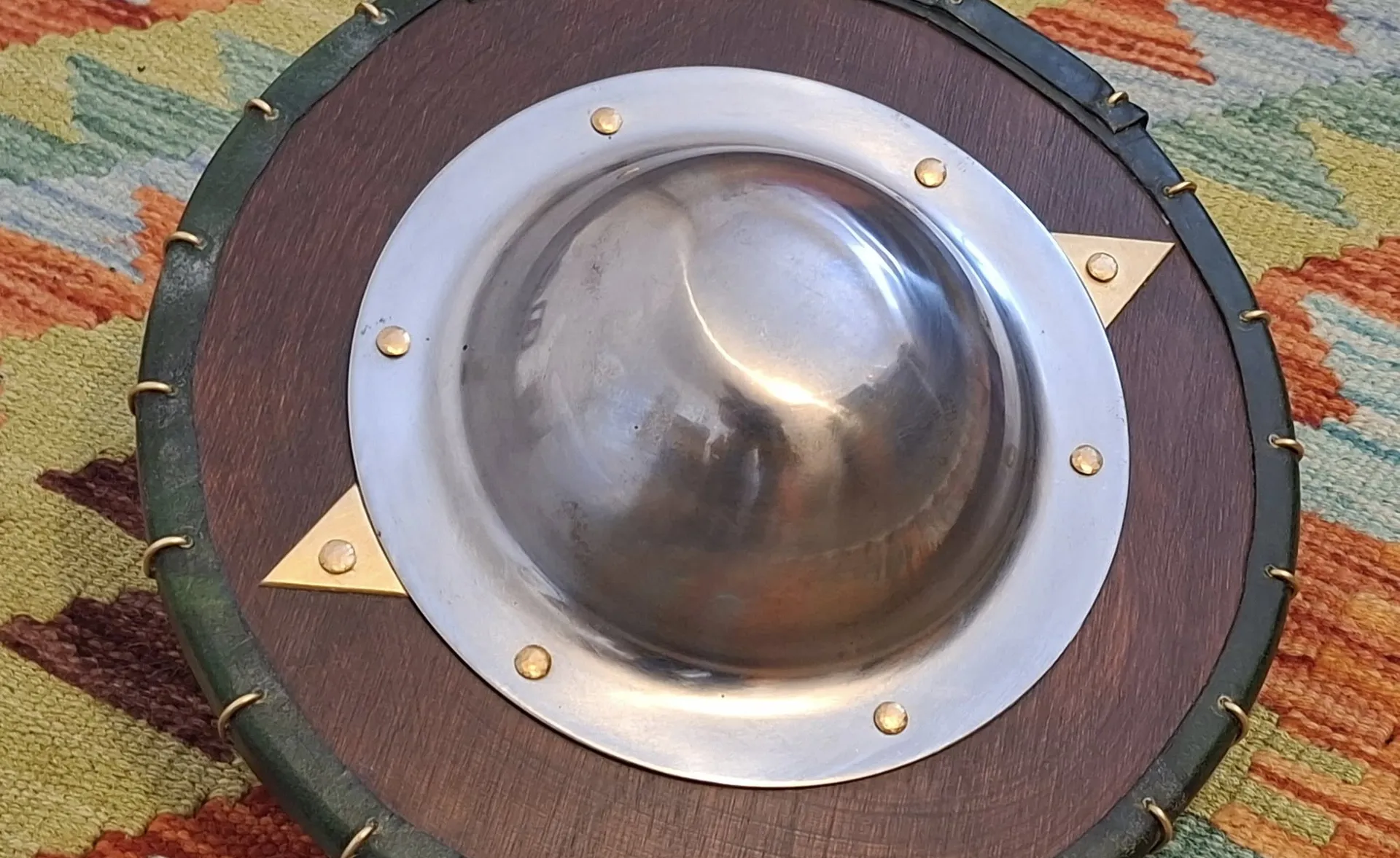
A buckler is a small round shield, held in the fist by a single grip behind its centre. It is usually somewhere between the size of a dinner plate and a bicycle wheel, and for about four hundred years it was the most common shield in Europe. Knights had big shields for war. Almost everyone else, from townsmen to students to soldiers off duty, had a buckler.
How Big Was a Buckler?
Most bucklers were between 20 and 45 centimetres across. The small ones are barely wider than a hand. The larger ones cover the forearm when held out. They weighed very little, often well under a kilogram, which mattered because you held one all day on your belt and all fight at arm's length.
How a Buckler Is Built
Look at the back of a buckler and you will find a single bar or handle running across the centre. You hold it in your fist like a torch. On the front, over that hand, sits a raised metal dome called the boss. The boss protects your knuckles from anything that lands in the middle.
Around the boss is the face, made of wood, steel, or wood faced with leather, and often an edge bound in metal or rawhide to stop it splitting. Some bucklers were all steel. Some had rings or spikes. Some, especially later on, were shaped rather than round, with notches and points that could catch a blade.
How It Was Used
This is the interesting part. A buckler is not a wall. You do not hide behind it the way you might behind a large shield. It is too small for that, and any fighter who tries gets hit around the edges.
Instead, the buckler works with the sword. It is held out towards the opponent, usually covering the sword hand, because the hand is the nearest target and the easiest one to hit. As the sword moves, the buckler moves with it, closing the line the sword has just left open. It can also bind an opponent's blade, trap their sword hand, or punch.
The oldest fencing book in Europe, Royal Armouries MS I.33, written around 1300, is entirely about the sword and buckler, and its central position, the halpschilt or half-shield, holds sword and buckler together in front of the body. Later, the Bolognese masters of the sixteenth century wrote whole systems for the sword and buckler too.
Who Carried Them
Everyone, more or less. Bucklers turn up in town records, in paintings of markets and fairs, and in complaints about young men swaggering about with sword and buckler looking for trouble. Some towns banned them. In England, "swashbuckler" originally meant someone who made a noise by clashing his sword against his buckler, showing off.
Learning Sword and Buckler
It is a wonderful weapon combination to learn. The arming sword is light, the buckler is lighter, and the whole thing moves quickly. Some of our members at HEMA Penzance love it, and you can see it in our gallery, where one of them spars with sword and buckler against a longsword. We have written up the art from I.33 on our sword and buckler page.
If you would like to try it, come along on a Tuesday. Your first lesson is free.