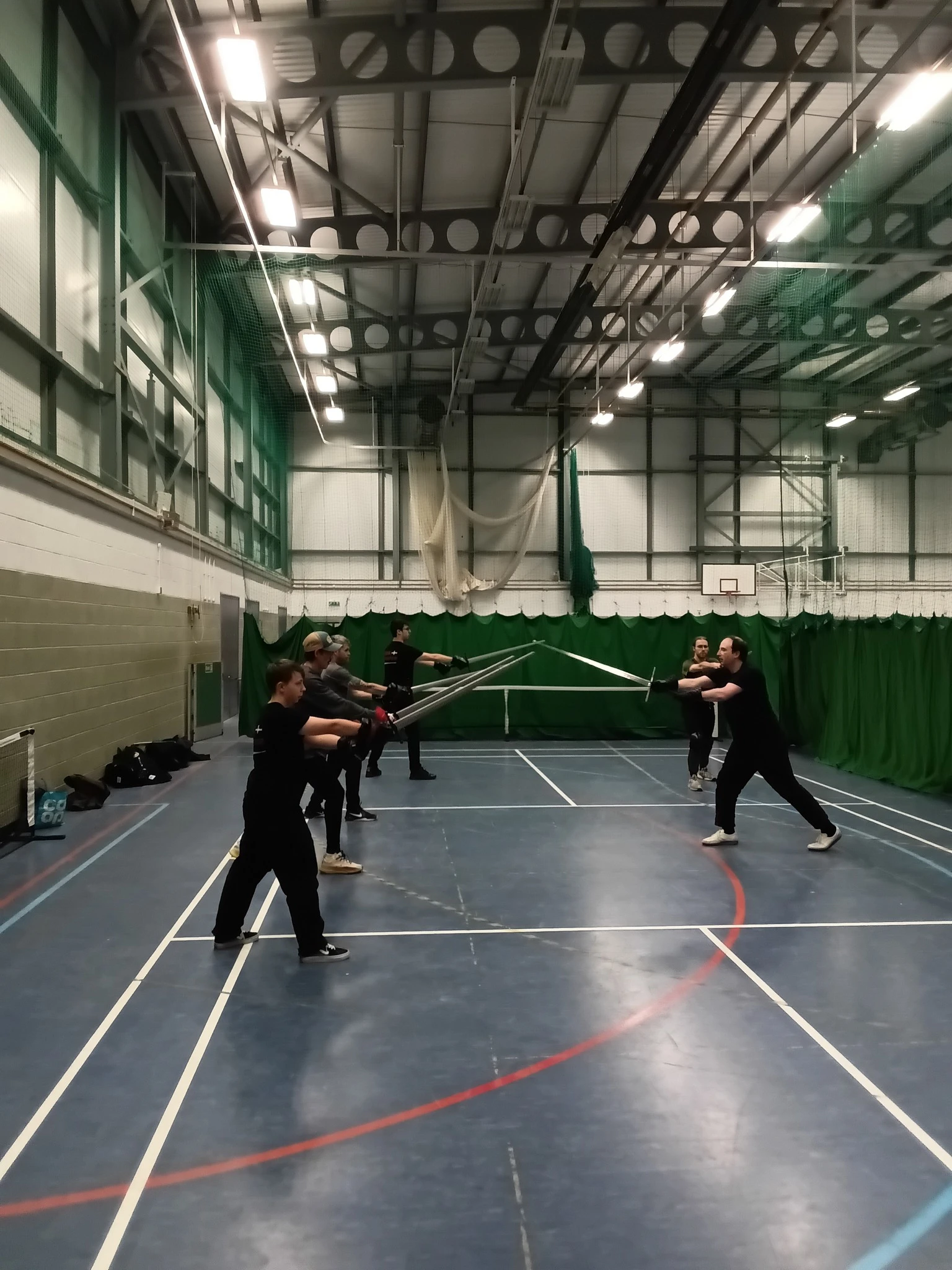
You have found us online, you have read about the guards and the cuts, and now you are wondering what actually happens if you walk through the door on a Tuesday evening. Good. That is exactly the question this post is here to answer.
The short version: you will learn to use a longsword in the tradition of a medieval Italian master, and you will have a genuinely good time doing it. The longer version follows.
Before You Arrive
You do not need to bring anything except yourself and a willingness to try something new. We have spare training swords and safety glasses you can borrow while you are getting started. Wear comfortable clothing. There are no rules for what you can wear. Trainers or indoor sport shoes are what everyone wears, or if you want to come in swordsman boots, by all means do so.
Your first lesson is free, so there is no commitment. If you would rather watch a session before joining in, you are welcome to do that too. No pressure at all.
The First Hour: Learning the Art
"I, Fiore, knowing how to read and write and draw and having books about this art which I have studied for a good 40 years and more, even now I am not a perfected master in this art."
If Fiore dei Liberi could study this art for forty years and still not consider himself perfect, then none of us need to worry about being beginners. That is the spirit of the room on a Tuesday night: everyone is learning, from the newest member to the most experienced.
The first hour is all about technique. Steve and Andrew, who have been running the club since 2014, demonstrate a play from Fiore's manuscript, break down the mechanics, and then everyone pairs up to practise it. You alternate attacking and defending sides, get a feel for the movement, and then you learn the remedy: what to do when your opponent tries that technique on you. Then comes the counter to the remedy, then alternate versions. Your technique evolves over the course of the session, and by the end of the hour a single play has opened up into something you can really feel working.
A "play" in Fiore's system is a sequence of actions that begins in one guard, travels along one of the seven lines of attack, and resolves into a new position. Every technique you practise on a Tuesday evening was written down by a master-at-arms over six hundred years ago, tested in judicial duels and on battlefields, and preserved in manuscripts that we can still read today. When you drill a play from the Fior di Battaglia, you are practising the same movement that Fiore taught to the knights and mercenary captains of medieval Italy. That is a genuinely incredible thing to be part of.
As a beginner, you will start with the foundations: the guards, the basic cuts, how to hold the sword, how to move your feet, how to manage the distance between you and your partner. All of this is done at whatever speed you are comfortable with. Nobody is swinging at full force on their first night, or even their tenth. Steve and Andrew circulate through the pairs as you work, giving you individual corrections and adjustments. It is personal, direct instruction in a small group, and it makes a real difference to how quickly you pick things up.
The Second Hour: Putting It Together
The second hour is where things open up. If you have your own protective gear, you can spar: controlled freeplay where you take everything you have been learning and test it against a partner who is trying to do the same to you. Two experienced practitioners sparring look like they are having a conversation, probing, responding, setting traps, recognising patterns. The guards and cuts you learn in the first hour become the vocabulary of that conversation.
If you are still building up your kit, you continue with paired technique work during the second hour, which is genuinely valuable in its own right. There is no pressure to spar before you are ready. Plenty of members train happily for weeks or months before they start, and that is completely fine.
The Source Material
One of the things that makes HEMA so special is where the techniques come from. We are working directly from a medieval fighting manual, interpreting and pressure-testing techniques that were designed for real combat. The intellectual side of that, studying the manuscripts, debating interpretations, testing theories, is as much a part of what we do as the physical training. It is endlessly fascinating, and Andrew in particular can quote virtually any passage from Fiore's manuscripts word for word if you ask him.
Picking Up a Longsword
There is something about picking up a longsword for the first time that is hard to describe. It changes the way you think about distance, timing, and commitment. A sword extends your reach and multiplies your options, but it also demands respect. You learn quickly that every action has consequences. Overcommit to a cut and you are open. Hesitate and the opportunity closes. That interplay between boldness and caution is the heartbeat of Fiore's system, and it is what makes every session feel alive.
The People in the Room
One of the best things about HEMA is the range of people it attracts. History enthusiasts, martial artists from other disciplines, people who have never done anything physical in their lives, people who just think swords are brilliant. The common thread is curiosity. Everyone in the room chose to be there because something about the idea of learning medieval swordsmanship spoke to them.
Ages vary, backgrounds vary, fitness levels vary. None of that matters. Fiore's system works with your body. The techniques are built on leverage, timing, and structure. You work at your own pace, you rest when you need to, and you improve at whatever rate suits you.
The Club
HEMA Penzance is volunteer-run by people who love this art and want to share it. There are no contracts, no gradings, no belt system. You pay seven pounds per session, your first lesson is free, and after your third paying lesson the club covers your personal martial arts insurance at no extra cost. That is it. Steve and Andrew have been doing this since 2014 because they believe in the art, and that sincerity comes through the moment you walk into the room.
After Your First Night
Most people who come for one session come back. The combination of intellectual depth, physical challenge, and sheer novelty is difficult to find elsewhere. You will be sore in muscles you did not know you had. After all, holding a longsword in guard for the first time uses your shoulders and core in unfamiliar ways. But it is the satisfying kind of sore that tells you your body did something new and interesting.
Over the following weeks, the vocabulary builds. The guards become familiar. The cuts start to flow naturally. You begin to see how the pieces connect: how Posta di Donna loads the fendente, how the fendente lands in a low guard that loads the sottano, how the whole system breathes in and out through these positions. It stops being a collection of moves and starts being a language.
"This is Posta di Donna, who can do all of the seven blows of the sword, and she can cover all blows. And she breaks the other guards with the great blows that she can make."
That is what you are working toward. Not perfection, Fiore himself denied that, but fluency. The ability to stand in a guard and know what it offers you. The ability to read your opponent's position and understand what it threatens. The ability to act with intention rather than panic.
Come Along
We train every Tuesday evening, 7pm to 9pm, at Penzance Leisure Centre. Your first lesson is free, all equipment is provided, and no experience is necessary. Look for the swords. You cannot miss us.