Somewhere on the internet, you stumbled across a video of two people sparring with longswords. Or someone you know mentioned a sword club. Or a book you were reading led you to a manuscript illustration of a man holding a two-handed sword over his shoulder, and something quiet in you said I want to learn that.
Good. You are not the first, and the good news is that the path in is much simpler than it looks from the outside. HEMA, Historical European Martial Arts, is a growing and welcoming community. You do not need to be fit. You do not need to own a sword. You do not need any prior martial arts experience. You need a Tuesday evening and a willingness to try something new.
This is a warm, honest guide to how you actually get started.
Step One: Find a Club
The single best thing you can do as a HEMA beginner is find a club and walk through the door. Not eventually. Not when you have read three books and watched twenty YouTube videos. Now, or as close to now as your diary allows.
Why? Because HEMA is a martial art. It lives in bodies moving against each other. Reading about a parry and feeling a parry are completely different things, and a good teacher can correct you in thirty seconds on something you would have practised wrong for six months on your own. Every experienced HEMA practitioner will tell you the same thing: the people who made the fastest progress are the people who joined a club early.
The HEMA Alliance has a club finder that covers most of the world, and the UK has a growing map of its own. In Cornwall, your main options are HEMA Penzance (us, focused on Fiore dei Liberi) and Cornish Sword Kledha Kernewek in Camborne. Elsewhere in the UK there are active clubs in most major cities and plenty of smaller towns. If your nearest club is more than an hour's drive away, that is still worth doing once a fortnight. The in-person correction is that valuable.
Step Two: Pick a Tradition (Roughly)
HEMA is not one martial art. It is a family of martial arts, each with its own master, its own manuscripts, and its own logic. The two largest traditions studied today are:
The Italian tradition of Fiore dei Liberi. A late-fourteenth-century knight who wrote Fior di Battaglia, a complete system covering grappling, dagger, longsword, pollaxe, spear, and horseback combat. Fiore's system is integrated: every weapon builds on the principles of the weapons below it, and grappling sits at the foundation. If you train Fiore, you train armizare, the whole art of arms.
The German tradition of Johannes Liechtenauer. A slightly later master whose teachings survive in a cryptic poem (the Zettel) and many 15th-century glosses by masters like Sigmund Ringeck and Peter von Danzig. Liechtenauer is heavily focused on the longsword and teaches a very specific doctrine of initiative and binding.
Beyond these two, there are later traditions: Bolognese sword-and-buckler from the 1500s, the Italian rapier of the Renaissance, sabre, messer, quarterstaff. You do not need to pick now. You pick by walking into the club near you and learning what they teach. Most clubs focus on one tradition and teach it well. HEMA Penzance teaches Fiore because Steve and Andrew fell in love with his system and have been living inside it for over ten years.
If you are genuinely torn between two clubs that teach different traditions, both are good. Go to the one with the closer drive, the friendlier instructors, or the evening that actually fits your week. The best tradition is the one you will actually train in.
Step Three: Turn Up to Your First Class
This is the part people build up in their heads. Let us deflate it completely.
What to wear. Comfortable clothing you can move in. Tracksuit bottoms or gym leggings. A t-shirt. Indoor sport shoes or trainers. That is it. You are not expected to arrive in a fencing jacket, or medieval garb, or anything remotely impressive. If you own a water bottle, bring it.
What to bring. Yourself. Genuinely. Most clubs, including HEMA Penzance, have loaner training swords and safety glasses for beginners. You do not buy anything before your first lesson.
What it costs. Most UK HEMA clubs charge somewhere between £5 and £15 per session. HEMA Penzance is £7, and the first lesson is free. Some clubs charge monthly memberships instead. Nobody charges four-figure joining fees. HEMA is not that kind of world.
What actually happens. You will warm up with the group. The instructor will demonstrate a technique from the manuscript. You will pair up with another human and practise it at whatever speed you both feel comfortable with. An hour in, you might get a break or a water pause. Another technique. More practice. Two hours, one evening, and you will leave with a sword-shaped grin on your face. We have written a longer piece about what happens at a HEMA class if you want the full picture.
You will not spar in your first lesson. You probably will not spar for weeks. Sparring comes after you have the basic vocabulary, and it comes in full protective gear. Nobody is going to hit you with a steel sword on night one.
Step Four: Build Your Gear, Slowly
You do not need to own any equipment to start. You will only need your own kit when you begin sparring, and that is months away.
When the time comes, the basic sparring set is:
- A longsword feder: the flexible steel training sword. The standard kind often seen in HEMA has a flared schilt near the crossguard; a historical-profile feder is shaped closer to the real sword (this is what we use at HEMA Penzance). Either way the tip is spatulated or rolled, and the edges are blunted. £150-£600.
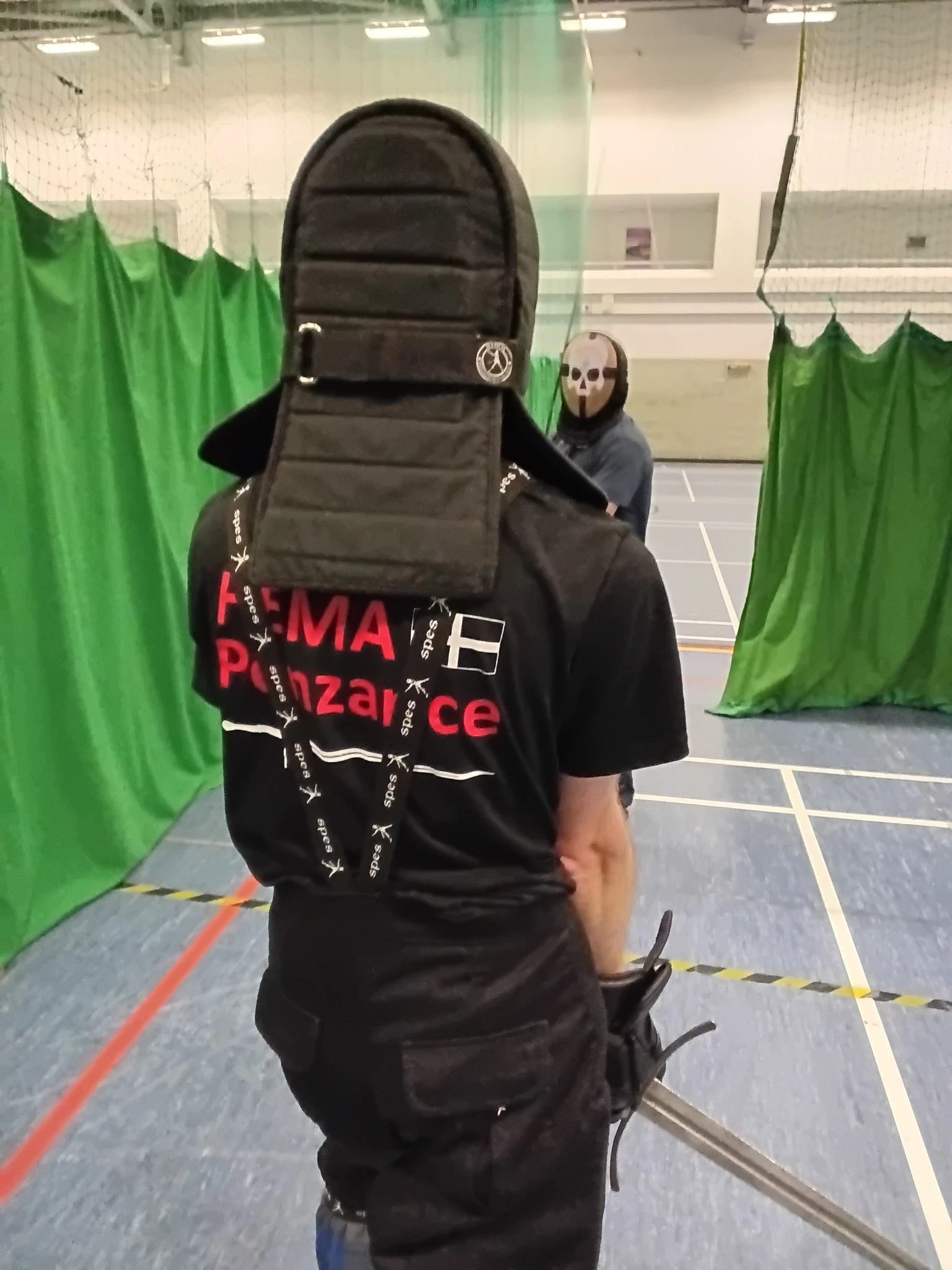
- A HEMA-built fencing mask, with a deep bib and a reinforced back. £100-£300, depending on whether you want a Level 1 or a tournament-grade Level 2.
- A throat protector (gorget). £30-£80.
- Heavy gloves designed for HEMA. £100-£250.
- A padded jacket or HEMA-specific plastron. £100-£300.
- Forearm and elbow protection.
- Knee and shin protection.
- A groin guard.
The full sparring kit runs to around £600-£1000 if you build it carefully. You do not buy any of this on your first month. You borrow, you drill, and when you are ready to step up, you buy thoughtfully. Ask your instructor. They will steer you away from the gear that looks cool but protects badly, and toward the less flashy kit that will actually keep your hands working.
HEMA Penzance has a full breakdown of what we use and why.
Step Five: Do Not Train Alone as a Beginner
Beginners often ask "can I learn HEMA at home?" The honest answer is: only if you are trying to supplement club training, not replace it.
You can absolutely do solo drills. Cutting at the air in a guard. Practising your footwork. Swinging a pell or a cutting target. Reading the manuscripts, watching good interpreters on YouTube, thinking about what you have learned. All of that is useful, and almost all serious HEMA practitioners do it. Wiktenauer has the full texts of virtually every surviving European fencing manuscript, translated and annotated, for free. Fight Like Fiore is a superb companion to Fior di Battaglia.
But solo work without a partner will teach you bad habits as well as good ones, and nothing you do alone will teach you measure (the feel of the distance between two fighters) or timing (the feel of when to act). Those skills only come from training against real people. Do your solo work between club nights. Never instead of them.
Step Six: Be Patient With Yourself
HEMA takes time. Fiore himself said that after forty years of study he was still not a perfect master. You are not going to be either, and that is the good news, because it means the art has depth to offer you for the rest of your life.
In the first month, you will feel clumsy. Your shoulders will ache in places you did not know you had shoulders. Your sword will feel heavier than it has any right to be (it is not; you are just using unfamiliar muscles). You will forget which foot is supposed to be forward. You will stand in a guard and suddenly realise you have no idea what to do next.
This is all normal. This is all good. Every experienced practitioner in the room went through exactly the same phase, and they all remember it with affection.
By month three, things start to click. The guards feel like places rather than positions to remember. The cuts start to travel the lines the manuscripts described rather than the lines you imagined they would. You begin to see your own mistakes before someone points them out to you, which is the single most important step in any martial art. By month six, you look back at your first lesson and cannot quite believe how little you knew.
That is the shape of learning this art. It is slow at first, then suddenly fast, then slow again in a deeper way. Every plateau is the beginning of a new level.
The One Piece of Advice That Matters Most
If you take nothing else from this page, take this: go to a club and stay consistent. Two hours a week, every week, for six months. Do not try to do ten hours a week and burn out. Do not skip for four weeks and come back cold. Just turn up, regularly, and trust that the art will shape you.
That is how every good HEMA practitioner started. That is how you will start too.
Come and Learn
If you are anywhere near west Cornwall, we would love to be the club you start at. HEMA Penzance trains every Tuesday evening, 7pm to 9pm, at Penzance Leisure Centre. Your first lesson is free, all equipment is provided, and no experience is necessary. Come along and see for yourself.
If you are further afield, please do find a club near you and go. The art is worth it, and the community is worth it, and you are worth it.