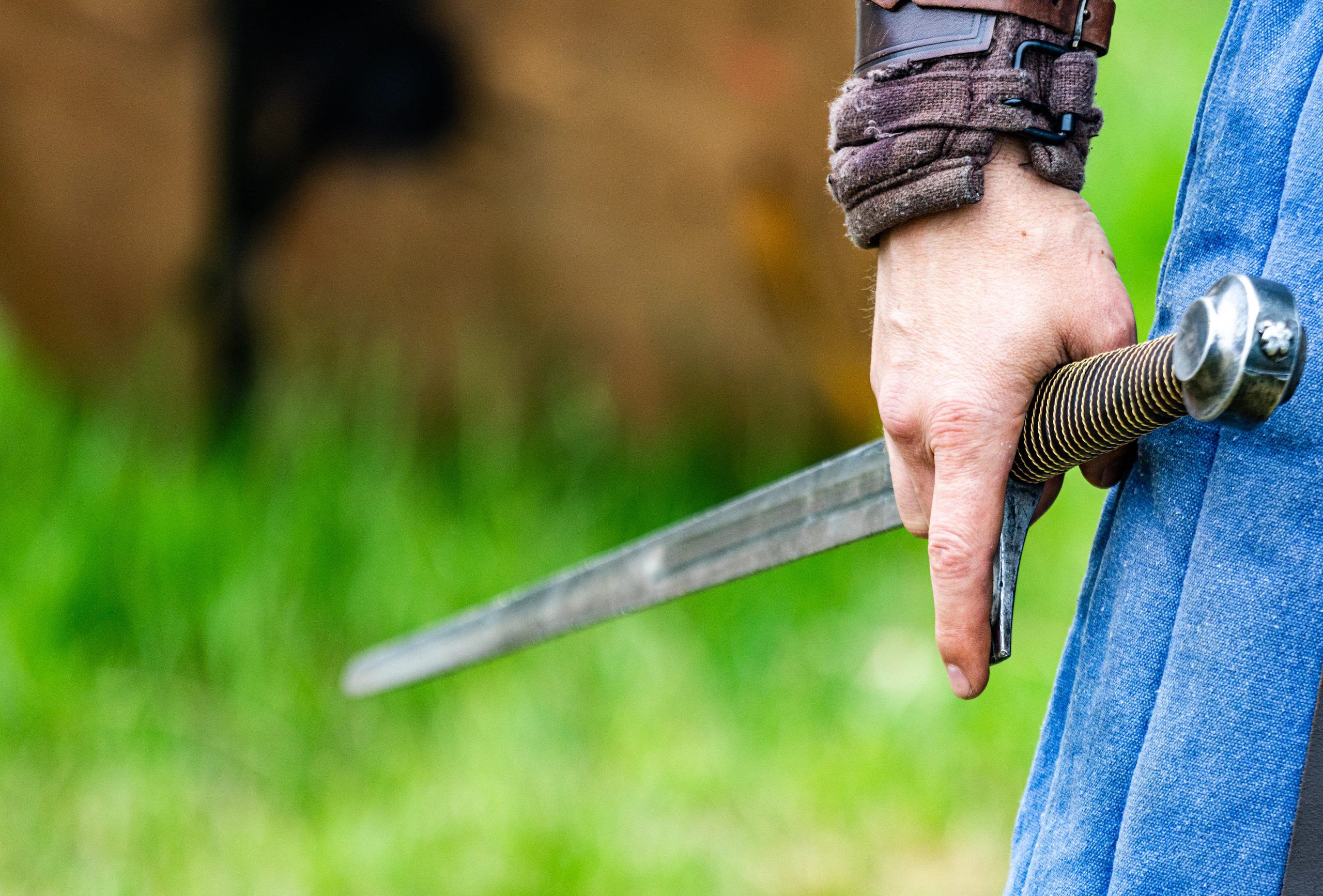
"Here begins sword and dagger plays. The advantage is great for those who can do it. The master is in this guard called Dente di Zenghiaro. Come with all the thrusts and cuts that you know. My right foot and then my dagger will turn and I will beat your sword aside. I know the narrow play and I cannot fail. Come one by one to oppose me as you wish. You will not touch me and I will break you with a turn."
This is one of Fiore dei Liberi's most confident opening lines. The scenario sounds absurd at first: a man with a dagger facing a man with a longsword. Common sense says the swordsman wins. The sword has reach, power, cutting edges, and a heavy pommel. The dagger has a tip shorter than your forearm.
But Fiore stands in his guard with a dagger and calmly tells the swordsman come one by one as you wish. You will not touch me. And then he explains how.
This is sword vs dagger, one of the more remarkable sections of Fior di Battaglia. The section where Fiore demonstrates that the mechanics of close-range mastery can overcome the geometry of unequal reach, provided the man with the shorter weapon knows what he is doing.
The Starting Position
The First Master of sword vs dagger stands in Posta Dente di Zenghiaro, the Boar's Tooth. Dagger held low at the hip, point forward, body angled with the dagger side back. Rear-weighted, ready to pass forward.
This is the same Boar's Tooth Fiore teaches with the longsword. The principle is the same: load the weapon low, invite the opponent to commit, then pass forward while the point drives upward. The difference is that the weapon is a dagger instead of a sword. The underlying mechanic is identical.
According to Fight Like Fiore's commentary: the master's dagger blade should sit at about a 20-degree angle to their forearm. Not flat (90 degrees, where it becomes vulnerable to being levered out of the hand) and not in line with the forearm (0 degrees, where it has no covering structure). The 20-degree angle locks the dagger against the forearm for structural stability while maintaining a safe distance between the forearm and any incoming sword blade.
The Master's Answer
"Come with all the thrusts and cuts that you know. My right foot and then my dagger will turn and I will beat your sword aside."
The core play is a side-step and a beat.
As the swordsman commits to an attack (any attack; the master is confident he can handle thrusts or cuts alike), the master steps offline to his side with his right foot. The hip rotation driven by the step carries his dagger across and into the path of the oncoming sword, beating the blade aside in a single motion. Because the master is now offline and the sword's energy is diverted, the swordsman is left momentarily out of position.
And now the master has closed the distance. He is inside the reach where the sword's length matters. In the narrow play (zogho stretto), the dagger is superior to the sword because it moves faster in tight spaces. I know the narrow play and I cannot fail.
Here the master can deliver a strike anywhere above the elbows. He is in a position to stab the sword arm, the chest, the neck, or the face, while the swordsman is still recovering from their committed attack.
The Second Master: The Sheathed Sword
One of the more unusual plays in the whole Fior di Battaglia appears here, and it is worth reading slowly.
The Second Master of sword vs dagger is a man walking along with his sword sheathed, carrying the hilt in his right hand and resting the scabbard against his left shoulder. He is surprised by an attacker who intends to stab him with a dagger.
Most fencing manuscripts would tell you to draw the sword first and then fight. Fiore instead teaches you how to fight with the sheathed sword.
The Scholar of the Second Master demonstrates. As the attacker raises the dagger, the scholar brings the sheathed blade down onto the crook of the attacker's elbow, striking into the bend of the arm where it collapses immediately. The sheathed sword functions like a short staff for this purpose, a hard beam with a weighted end.
Having neutralised the attack, the scholar can then either draw the sword and wound the opponent, or take the dagger from their hand as the First Dagger Master does, or apply the ligadura mezana (middle bind) from the First Master of the Dagger.
The play is a beautiful demonstration of Fiore's integrated thinking. The sheathed sword is not treated as useless until drawn; it is treated as a tool that already exists in your hand, with specific applications. If you cannot draw in time, use what you have.
The Counters and the Elbow Push
Fight Like Fiore points out something remarkable about Fiore's sword vs dagger section: many of the counters are elbow pushes. The same mechanical idea appears across the whole of Fior di Battaglia, applied in different contexts:
- Counter to 2nd Dagger Master: elbow push.
- Counter to 6th Dagger Master: elbow push.
- Counter to 7th Dagger Master: elbow push.
- Counter to 8th Dagger Master: elbow push.
- Sword vs Dagger, 2nd Scholar of 1st Master: elbow push.
- Sword in One Hand, 6th Scholar: elbow push.
- Sword in One Hand, 8th Scholar: elbow push.
- Sword in Two Hands, 14th Scholar of 2nd Master: elbow push.
- Sword in Armour, 3rd Scholar: elbow push.
- Sword in Armour, Counter to Master: elbow push.
The elbow push is one of Fiore's fundamental recurring techniques, and it appears unusually often in the counters to the sword vs dagger plays because the asymmetric situation (short weapon vs long weapon) tends to produce moments where one fighter's elbow is exposed at close range. Whoever reaches the exposed elbow first controls the exchange.
Why the Dagger Is Not Inferior
The logic of sword vs dagger inverts the intuition. At long range, the sword wins. Its reach is overwhelming; a dagger fighter cannot close without taking a hit.
But Fiore's argument is that a dagger fighter who can close successfully has a decisive advantage in the close range they have now entered. The sword's mechanics degrade at arm's-length distance. The long blade becomes awkward. The cross-guard can bind. The pommel can be caught. Meanwhile, the dagger, optimised for close work, is at its best.
So the sword vs dagger question reduces to: can the dagger fighter close without being hit? Fiore's First Master's answer is yes, provided you know the timing and the footwork. Specifically: step offline, beat the sword with the dagger-arm structure, enter the measure, and the fight is now one the dagger wins.
This is not theoretical fancy. Fiore fought judicial duels in his career, and the weapon sequences he trained men for regularly included both swords and daggers. The cross-weapon plays were practical knowledge about real combat scenarios.
The Broader Lesson
The sword vs dagger section teaches a principle that runs through the whole of armizare. The weapon in your hand does not determine the outcome. The mastery of measure, timing, and structure does.
A swordsman who fights poorly loses to a dagger-fighter who fights well. A longsword without technique is not better than a dagger with technique; in some specific configurations, the dagger is genuinely preferable.
This is why Fiore's system rewards patient study. The techniques matter more than the weapon. When you drill abrazare properly, your dagger work improves. When your dagger work is clean, your longsword work benefits. When your longsword is sharp, your pollaxe transfers almost directly. The whole art is one coherent system, and the sword vs dagger section is where that system's internal consistency is most visible, because it shows the mechanics winning in the face of apparently unfavourable geometry.
Come and Work the Section
We train Fiore's sword vs dagger plays periodically at HEMA Penzance, particularly when we want to show beginners how his integrated system transfers across weapons. Every Tuesday evening at Penzance Leisure Centre, 7pm to 9pm. Your first lesson is free, all equipment is provided, and no experience is necessary. Come along and see for yourself.
Fiore's words and the mechanical interpretation in this article are from the Getty manuscript translations and commentary at Fight Like Fiore.