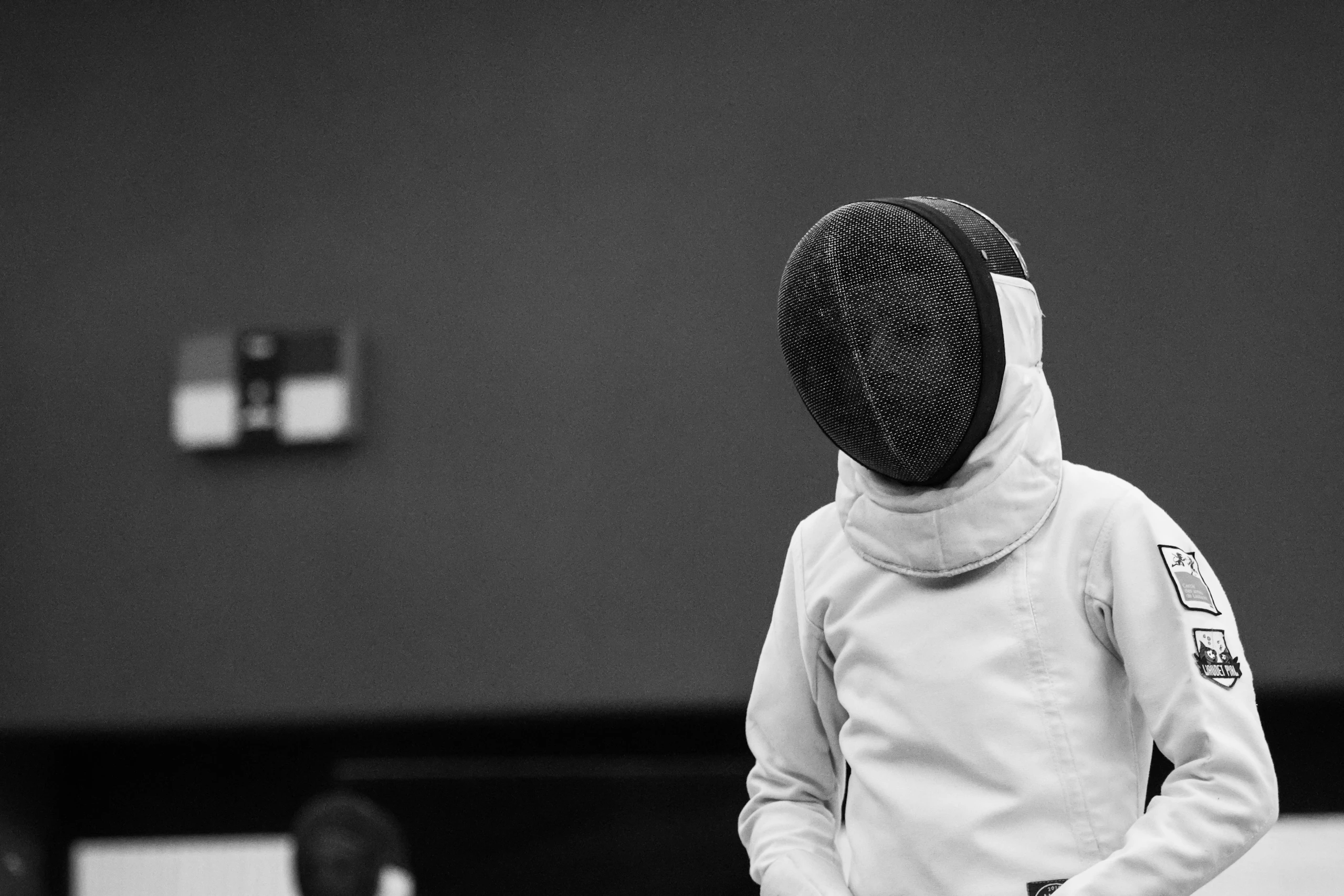
After your gloves, the mask is the single most important piece of safety equipment you will ever buy. A HEMA mask protects the most irreplaceable part of you: your face, your eyes, your jaw, and the soft tissue of your throat. A mask that fails is a mask that can cost you a great deal more than a glove that fails.
This post walks through the main questions beginners ask. Why not use a regular fencing mask? What do CEN ratings actually mean? Do I need an overlay? What should my first mask cost? The honest answers are below.
Why Not Just Use an Olympic Fencing Mask?
The numbers can fool you here. An Olympic foil mask and a HEMA mask might both be certified to the same Newton rating; a beginner reading the spec sheet would be forgiven for thinking one would do the other's job. The geometry tells the real story.
An Olympic mask is built around the assumption that the only thing reaching for your head is a thin, springy point coming straight in from the front. The bib is short. The back of the head is light. The shape narrows around the chin. None of that is what longsword work asks for.
In our art, the head gets approached from every angle. A fendente arrives from above. A rising cut threatens the chin. A bind can spin around behind your ear. The back of your head matters as much as the front. The bib needs to reach down past your collarbone, or the throat opens. The mesh has to take a longsword's edge ringing against it, again and again, across years of training. A HEMA mask is shaped for all of that. An Olympic mask is not.
So if you already own a foil mask, please leave it where it lives. The art asks for a mask that knows what art it is in.
What the Numbers Mean
The HEMA mask market speaks in Newtons. You will see ratings like 350N, 1600N, sometimes 800N or 1000N, sometimes the words CEN Level 1 or CEN Level 2. The numbers come from EN 13567, the European standard that tests fencing masks against penetration. Here is how it actually works.
The CEN rating describes the bib, that padded fabric flap which hangs down over your throat and collarbone. CEN Level 1 means the bib has been certified to resist 350 Newtons of penetrating force. CEN Level 2 means 1600 Newtons. The steel mesh is tested separately under different criteria, so the bib number is what these levels are speaking to.
That is the standard. Now here is the practical reality, which matters just as much.
We are not doing olympic sport fencing with rapiers. The HEMA longsword we train with is a steel training sword (a feder if you go that way, or a historical-profile training sword as we use at HEMA Penzance), and the tip ends in a spatulated or rolled finish, deliberately blunted and deliberately wide. Whatever a longsword thrust is going to do to you, threading cleanly through fabric the way a sharp rapier point would is not really on the table. So the threat the puncture rating speaks to is a quieter one for us than it is for the rapier fencers across the hall.
Which is why a CEN Level 1 (350N) mask, when it is built for HEMA with a deep bib and a reinforced back, is widely accepted as adequate for ordinary club sparring. Not every club agrees, and the conversation has been going for years among practitioners who care about it; but the geometry of our weapons is the reason a Level 1 mask works as well as it does in practice. Plenty of HEMA fencers train happily for years on a properly built Level 1 mask and never feel under-protected.
CEN Level 2 (1600N) is the tournament rating. If you ever want to compete, you will need it. Most top-level HEMA tournaments require 1600N masks at the door, and for the harder, faster sparring you find at competition, the extra resistance is worth having. Some HEMA fencers buy a Level 2 mask from the very beginning to keep their options open. There is no wrong answer here.
You will also see masks marketed at 800N or 1000N. These are not CEN levels; they are manufacturer ratings sitting between Level 1 and Level 2, often using particular single-layer fabrics that test individually at those numbers. Some clubs accept them, others ask for the formal CEN Level 2 certification. The honest path is: ask your instructor what your club expects, and let that answer steer you.
What you should never accept is a mask with no rating at all, or one whose paperwork you cannot find. That is not a HEMA mask, and it is not looking after your face.
The Overlay Question
Whatever rating your mask carries, many HEMA fencers eventually add an overlay, a secondary layer of padded mesh or synthetic fabric that clips over the front and soaks up additional impact. Overlays are cheap (£30-£60), easy to fit, and they take a real bite out of both the concussive shock of a hit and the long-term wear on the mesh. Some clubs ask for them in full-speed sparring; others leave the call to the individual. Either way, they are an excellent purchase, and most fencers come around to one sooner or later.
Some higher-end masks come with the overlay effectively integrated, often in the £250-£400 range. They are tidy and convenient. For a first mask, separates give you more flexibility, and you can take your time finding an overlay that suits the way you train.
Fit Matters Almost as Much as Rating
A mask that does not fit well does not protect well. Two things to check.
The back-of-head strap must hold the mask firmly against your head without pressing painfully. A loose mask can lift on impact and expose your chin. A too-tight mask gives you a headache in twenty minutes. The adjustment mechanism should let you find the middle between these two.
The bib (the padded fabric flap that protects your throat and upper chest) should reach well down onto your collarbone. A short bib leaves a gap at the throat where a thrust can penetrate. Any serious HEMA mask has a substantial bib; some practitioners add a separate gorget as well.
When you try the mask on, check that you can open your mouth, turn your head left and right without the mask shifting, and tilt your chin down without the bib pushing up into your throat. If any of those feels wrong, the fit is wrong.
What Brands to Look For
The HEMA mask market has settled around a handful of trusted makers, and any of them will serve you well.
Allstar and Uhlmann in Germany make fencing masks in both Olympic and HEMA grades; their HEMA-specific masks are well-regarded, well-fitted, and easy to find. PBT in Hungary makes HEMA masks across the rating spectrum, including both Level 1 and Level 2 options at competitive prices. Absolute Fencing in the USA covers similar ground, and is often the easier route for North American buyers. SPES in Poland and the Sparring Glove brand each offer HEMA-specific models, sometimes with integrated overlays, slightly pricier but tidy.
Whichever maker you go with, give the no-name budget masks a wide berth. The certification is the whole point, and a mask without it is not really a mask in the sense we mean. Used masks are a similar conversation: a mask that has been retired by its previous owner has been retired for reasons you cannot necessarily see, and your face is not the part of the equipment to economise on.
What to Actually Spend
A complete HEMA mask setup runs anywhere from around £130 to £350, depending on which way you go. A solid CEN Level 1 mask from a reputable maker sits in the £100-£180 range. A 1600N tournament-grade mask is more like £200-£300. An overlay adds another £30-£60. Both ends of that spread are perfectly normal places to start.
For your first mask, the right answer depends on what you want from the art. If you only ever expect to train at the club, a properly built Level 1 mask plus a good overlay will see you through years of happy practice. If you have any thought of competing, a Level 2 mask now saves you buying twice later. Ask your instructor; that is the cheapest piece of advice in HEMA, and the most reliable.
When to Replace Your Mask
A mask is replaceable safety equipment, not a lifetime purchase. There comes a moment with each one when the right thing is to retire it, and that moment is usually quieter than you might expect.
The clearest signal is a genuinely heavy hit straight to the front. Even if the mesh looks perfectly fine afterward, the impact can have shifted the weave in ways the eye cannot see, and a single heavy thrust is reason enough to set the mask aside. Visible damage is the other obvious one, and you should trust your eyes here: bent bars, loose mesh, a broken weld, a damaged strap, a torn bib, all of these speak for themselves. Time itself is the third reason. After five to seven years of heavy use, the metal has been fatigued by a great deal of practice, and a working mask becomes a sentimental object faster than we like to admit. And finally, if a mask has become anonymous in your kit bag, with no test documentation, no serial number, no traceable history, you cannot really vouch for it any more, and a mask you cannot vouch for is not a mask you should spar in.
A retired mask still has a happy life ahead of it as a drill mask, a loaner for visitors, or a teaching prop. It just stops being a sparring mask when its time comes. That is a kindness, both to your face and to the next mask after it.
The Calm Priority
Shopping for a HEMA mask is the kind of purchase that should feel reassuring, not frightening. A good mask protects you well, lasts several years, and lets you focus on what matters: the practice of a six-hundred-year-old martial art, in a safe training environment, with partners who care about each other's faces as much as their own.
Buy once. Buy well. Buy the fit, the CEN rating, and the reputation. Then forget about the mask and train.
Come and Learn
HEMA Penzance has loaner masks for your beginner months. We train every Tuesday, 7pm to 9pm, at Penzance Leisure Centre. Your first lesson is free, all equipment is provided, and no experience is necessary. Come along and see for yourself.